
SUTD: Bridging the Gap Between Human Uncertainty and Big Data Scalability in Social Sensing
Scalable Uncertainty-Aware Truth Discovery in Big Data Social Sensing Applications for Cyber-Physical Systems
The paper introduces SUTD (Scalable Uncertainty-Aware Truth Discovery), a novel framework for Cyber-Physical Systems (CPS) that jointly estimates source reliability and claim correctness in social sensing. By incorporating human uncertainty features and leveraging GPU parallelization, SUTD achieves state-of-the-art accuracy and thousand-fold speedups in big data environments.
TL;DR
Social sensing transforms humans into "sensors" for Cyber-Physical Systems (CPS), yet human data is messy, uncertain, and massive. This paper presents SUTD (Scalable Uncertainty-Aware Truth Discovery): a framework that models human "guessing" vs. "knowing" while utilizing GPU acceleration to achieve 1000x speedups. It represents a critical shift toward robust, real-time situational awareness during global crises.
Problem & Motivation: The "Certainty" Fallacy
In high-stakes scenarios like the Paris Attacks or Oregon Shootings, social media is a goldmine for real-time intel. However, previous Truth Discovery (TD) algorithms suffered from two fatal flaws:
- Binary Assumption: They assumed every tweet was an affirmative claim (). In reality, a user saying "Unconfirmed: shooting may have occurred" carries a different weight than "I see the shooter right now."
- The Sequential Bottleneck: Truth discovery is usually an iterative EM (Expectation-Maximization) process. On big data scales, these methods take forever, making them useless for emergency response.
The authors' insight? By explicitly modeling the Uncertainty Degree () and parallelizing the latent variable estimation, we can achieve both higher veracity and extreme speed.
Methodology: The Core of SUTD
SUTD operates by solving a constraint estimation problem. It defines a Sensing Matrix () and an Uncertainty Matrix ().
1. Uncertainty Formulation
Instead of a simple reliability score , SUTD defines , the reliability of source given their expressed uncertainty level . This allows the model to "trust" a source when they are confident but "discount" them when they express doubt.
2. The GPU Parallel Paradigm
The breakthrough in scalability comes from the CUDA implementation. Since the hidden variables (claim correctness) in the E-step are independent of each other given the parameters, the authors mapped each claim's calculation to a dedicated GPU thread.
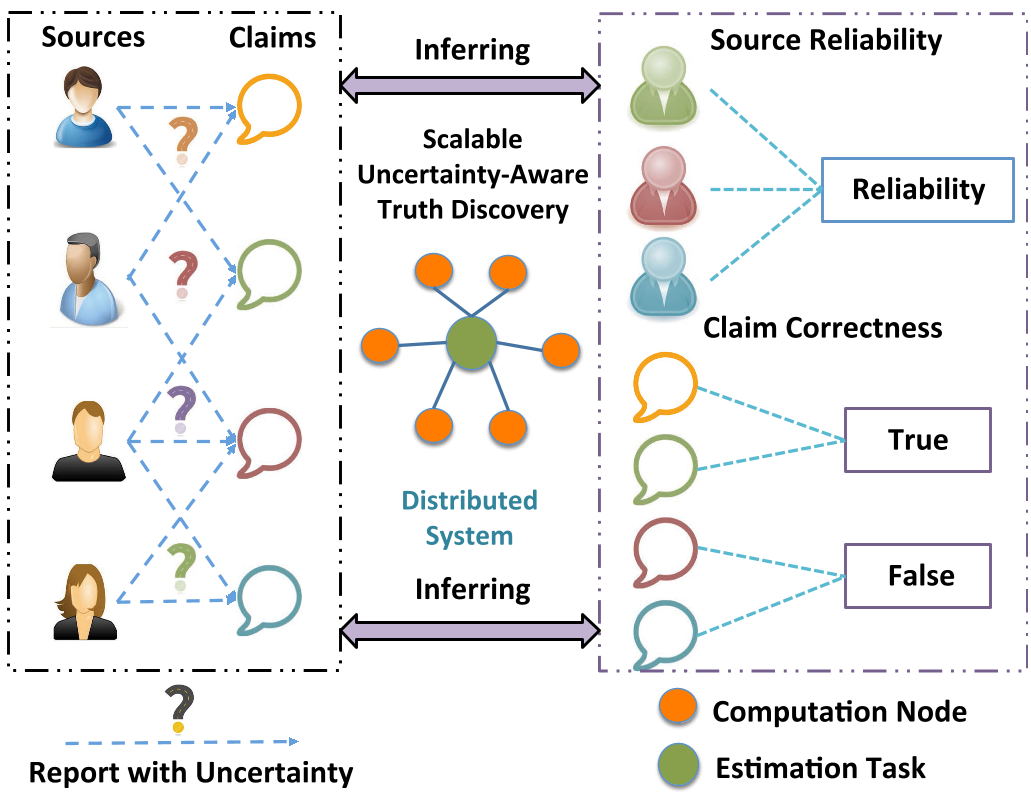 Figure 1: The SUTD Scheme, showcasing the flow from raw social sensing data to Uncertainty-Aware Truth Discovery.
Experiments & Results: Performance at Scale
The authors tested SUTD against state-of-the-art baselines (IPSN12, IPSN16, HITS) using three 2015 crisis datasets: Paris Attacks, Oregon Shooting, and Baltimore Riots.
1. Accuracy and F1-Score
By leveraging Syntactic + Semantic heuristics (checking for URLs, "RT" tags, and hedge words like "maybe"), SUTD consistently outperformed all baselines. In the Paris Attack data, SUTD-Syn achieved a 20% accuracy gain over the best baseline.
2. Massive Speedup
The execution time results are staggering. While previous SOTA models like IPSN16 took nearly 10 minutes to process the Paris Attacks dataset, SUTD finished in 0.21 seconds.
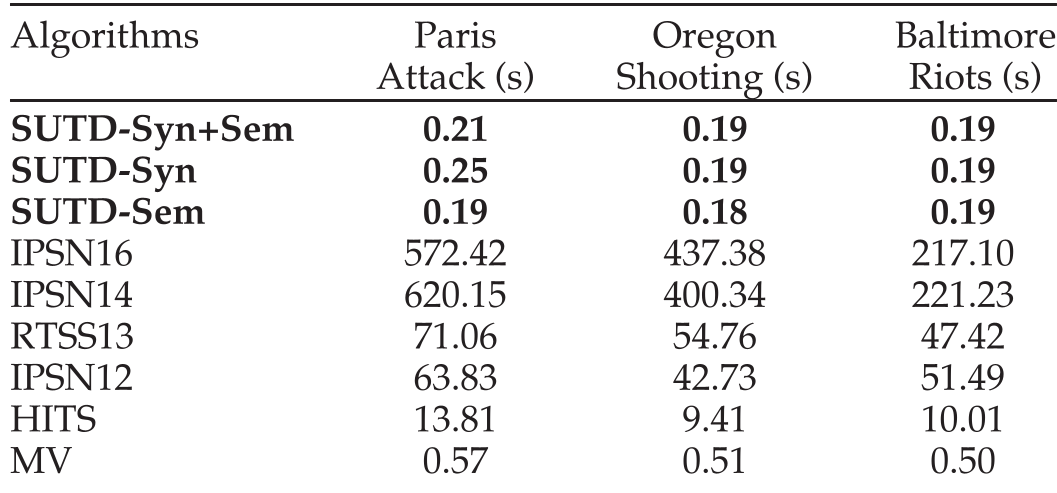 Table 1: SUTD runs 2-3 orders of magnitude faster than sequential counterparts by leveraging GPU cores.
Critical Insight & Conclusion
The SUTD framework proves that scalability does not have to come at the cost of complexity. By moving away from general-purpose CPUs and embracing the specific independence structures of the EM algorithm, the authors solved the "veracity" and "velocity" pillars of Big Data simultaneously.
Limitations: The current uncertainty measurement relies on heuristics (presence of URLs or specific words). Integration of more sophisticated LLMs or Transformers for semantic uncertainty estimation could potentially push the accuracy even higher.
Future Outlook: As CPS continues to integrate human-in-the-loop sensing, SUTD provides the architectural blueprint for real-time, reliable fact-checking at a global scale.