
Scaling Up Biologically-Inspired Vision: Breaking the Identification Barrier in the Wild
Scaling up biologically-inspired computer vision: A case study in unconstrained face recognition on facebook
The paper investigates the application of multi-layer biologically-inspired computer vision models to unconstrained, large-scale face identification using two new datasets: Facebook100 and PubFig83. By leveraging a high-throughput feature search paradigm, the authors demonstrate that their HT-L3 models achieve SOTA performance, surpassing commercial face recognition systems of the time.
TL;DR
This research bridges the gap between biological vision and machine recognition by scaling multilayer "cortex-like" models to handle unconstrained face identification. Using new datasets (Facebook100 and PubFig83), the authors prove that biologically-inspired models (HT-L3) not only scale effectively to large identity galleries but also outperform contemporary commercial SOTA systems.
Context: Moving from Verification to Identification
For years, face recognition was dominated by the "Verification" paradigm—determining if two photos are the same person. However, the real-world utility of platforms like Facebook, Flickr, and iPhoto lies in Face Identification. Identifying an individual among hundreds of potential candidates in "the wild" is exponentially harder due to variations in lighting, pose, and the "unconstrained" nature of social media photography.
The Problem & Motivation
Standard computer vision models often lack the robustness of the human visual system. The authors argue that previous datasets like LFW (Labeled Faces in the Wild) were insufficient for identification because they lacked enough samples per person. This study introduces Facebook100 (harvested from real social tags) and PubFig83 (a curated subset of celebrities with near-duplicates removed) to test if biological models can handle "familiar face recognition" at scale.
Methodology: High-Throughput Biological Insight
Instead of hand-crafting features, the authors used a family of Convolutional Neural Networks (CNNs) inspired by the Neocognitron and the primate visual cortex.
1. Model Architecture
The models consist of layers categorized as:
- V1-like: A baseline mimicking the primary visual cortex (Gabor wavelets + normalization).
- HT-L2/HT-L3: Multi-layer stacks involving Linear-Nonlinear operations (Filter, Rectify, Pool, Normalize).
2. High-Throughput Search
The core "innovation" isn't a new learning rule, but the Screening Mechanism. The authors didn't just train one model; they screened thousands of architectures with random variations to find the most "biologically plausible" and effective configuration for the task.
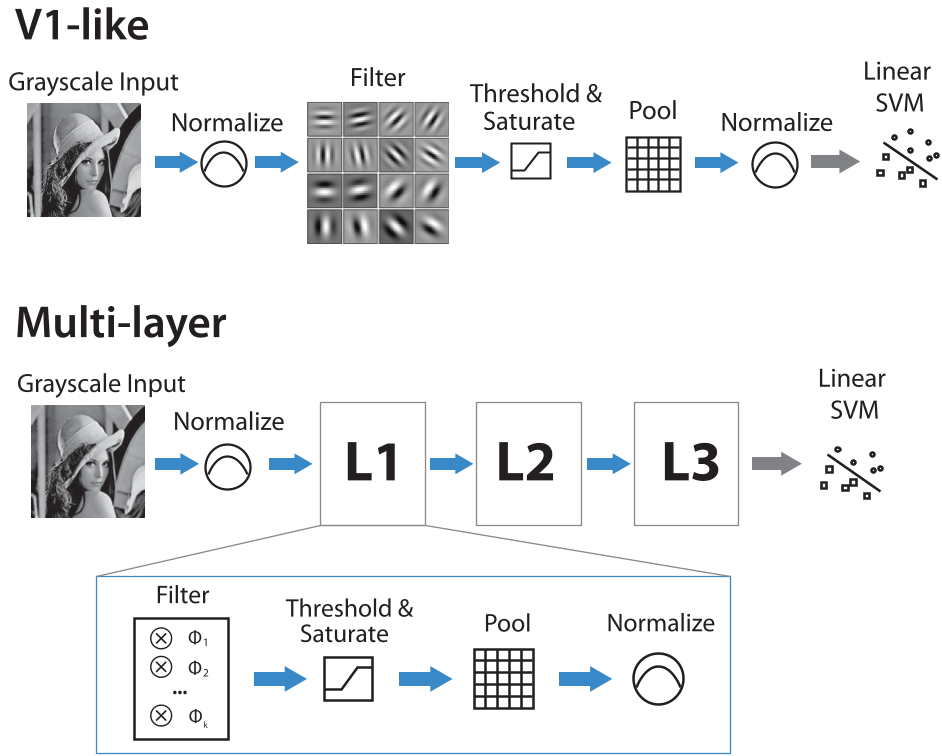 Figure: The hierarchical flow of the HT-L3 system, mimicking the feedforward filtering of the human visual stream.
Experimental Battle: Biology vs. Commercial SOTA
The researchers compared their HT-L3-1st (the top-ranked screened model) against Face.com (a leading commercial engine in 2010) and a basic V1-like model.
Key Findings:
- Depth Matters: The 3-layer biological model significantly outperformed both the 2-layer and the 1-layer V1 model.
- Scaling with Data: As the number of training images per individual grew, accuracy climbed steadily, nearing 90% for 100-way identification.
- The Reliability of PubFig83: The authors demonstrated a strong linear correlation between performance on their private Facebook dataset and the public PubFig83, validating PubFig83 as a reliable benchmark for the community.
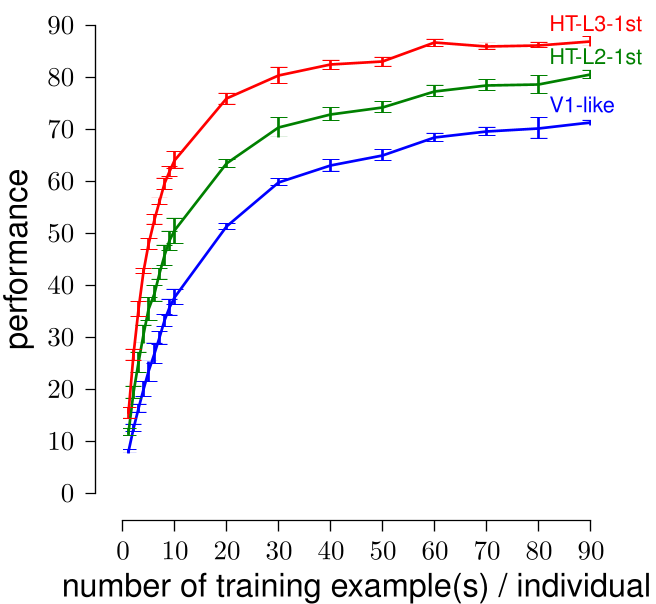 Figure: Accuracy increases as more training examples are provided, with HT-L3 maintaining a dominant lead.
Comparison Table (Accuracy)
| Model | PubFig83 (Ident.) | Facebook100 (Ident.) |
|---|---|---|
| HT-L3-1st (Aligned) | 87.11% | 89.30% |
| Face.com (Commercial) | 82.09% | 84.50% |
| V1-like (Baseline) | 75.64% | 80.06% |
Critical Insight & Future Outlook
The success of these models—even when using random filters (without backpropagation training)—is a testament to the power of hierarchical, feedforward architectures. It suggests that the "shape" of the network (the Inductive Bias) is a massive contributor to recognition success.
Limitations:
- Frontal Bias: The dataset extraction relied on frontal face detectors, meaning the models weren't fully tested on extreme profile views.
- Private Data: The Facebook100 set remains private, highlighting the ongoing tension between data-hungry AI research and individual privacy.
Conclusion
This work serves as a foundational bridge between neuroscience and large-scale engineering. It proves that scaling up biologically-inspired architectures is not only feasible but superior to many contemporary "engineering-only" approaches. For modern AI researchers, it highlights that looking back at biological "wetware" continues to offer blueprints for solving unconstrained vision problems.