
Hypernetwork Scaling Laws: A New Frontier for Knowledge Injection in LLMs
Scaling Laws for Hypernetwork-Based Knowledge Injection in Large Language Models
This paper introduces MegaWikiQA and conducts the first systematic study of scaling laws for hypernetwork-based knowledge injection in Large Language Models. The authors propose a method where a hypernetwork generates LoRA adapters conditioned on factual corpora to adapt a frozen target model at train-time, achieving superior out-of-distribution (OOD) generalization compared to standard fine-tuning.
Executive Summary
TL;DR: While the AI community has obsessed over scaling laws for pretraining, the "scaling laws of adaptation" have remained a mystery—until now. A new study by Nace AI and Purdue University researchers explores Hypernetworks as a scalable substrate for injecting millions of facts into LLMs. By training a secondary network to generate LoRA adapters for a frozen target model, they found that hypernetworks don't just scale predictably—they actually outperform traditional LoRA and full fine-tuning in generalizing to unseen, out-of-distribution (OOD) knowledge.
Positioning: This work transitions hypernetworks from a "niche trick" for model editing into a principled, SOTA-challenging framework for large-scale knowledge internalization (e.g., medical, legal, or enterprise domains).
The Core Problem: The "Forgetting" and "Rigidity" of Fine-Tuning
Existing methods for knowledge injection are fundamentally flawed:
- Full Fine-tuning: Prohibitively expensive and destroys the model's original capabilities (catastrophic forgetting).
- LoRA/PEFT: While efficient, they struggle with OOD generalization. They tend to "memorize" surface patterns of the training data rather than internalizing the underlying relational logic.
- Instability: Prior hypernetwork approaches (like MEND) operated in gradient space, which becomes unstable when injecting more than ~1,000 facts.
Methodology: The Hypernetwork-LoRA Hybrid
The authors propose a decoupled architecture. Instead of modifying the target model (), they train a Transformer-based Hypernetwork ().
How it Works:
- Fact Encoding: A large corpus of facts () is verbalized into strings.
- Adaptive Weight Generation: The hypernetwork takes these facts and predicts the and low-rank matrices for a LoRA adapter.
- Frozen Target: The target model (e.g., Qwen2.5) remains completely frozen. Only the hypernetwork's ability to "translate" facts into weights is optimized.
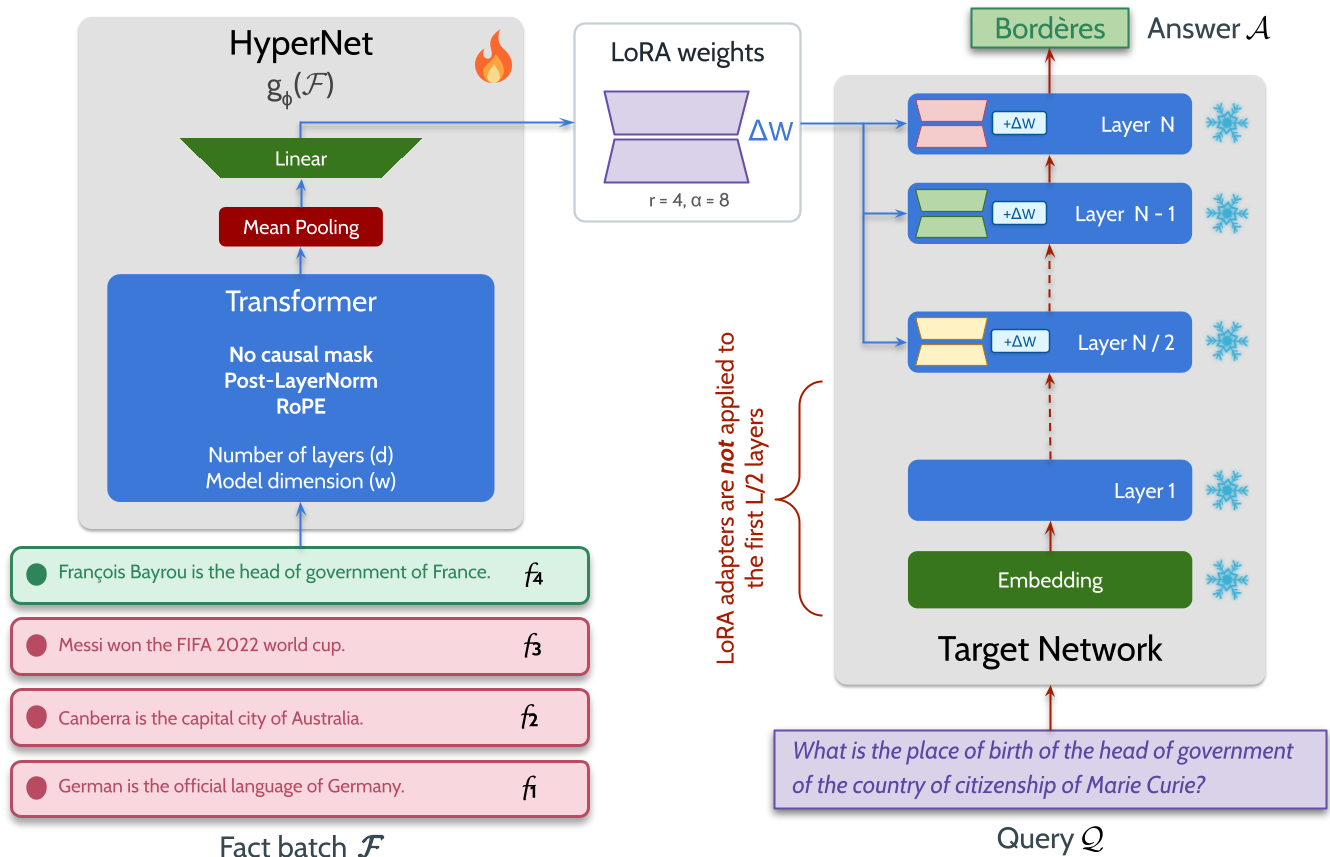 Figure 1: The Hypernetwork maps input facts directly to LoRA-style weight adaptations for the target model.
Scalability & The Power-Law Discovery
The researchers built MegaWikiQA, a massive dataset of 10M+ multi-hop questions derived from Wikidata5M, to test scaling across multiple axes:
- Width & Depth: Adding parameters to the hypernetwork leads to predictable, smooth improvements in accuracy (Power-law exponents ~ -0.09).
- Target Model Size: The most significant gains come from scaling the target model. A larger "brain" is better at utilizing the weights generated by the hypernetwork.
- Fact Count: More context facts during training lead to better "noise filtering" capabilities.
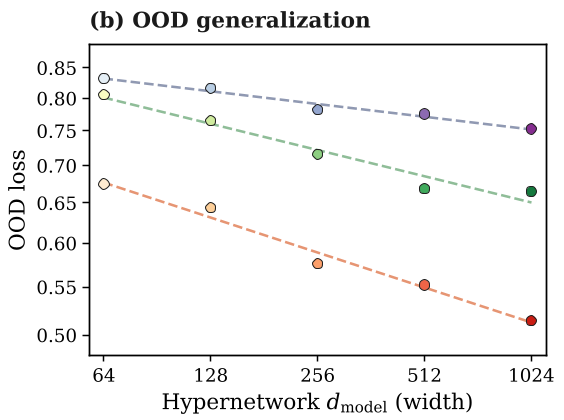 Figure 2: Consistent power-law fitting for validation and OOD metrics across increasing hypernetwork width.
The Winner: OOD Generalization
The most striking result is the comparison between Hypernetworks and standard Fine-tuning. While LoRA fits the in-distribution data slightly better, the Hypernetwork's advantage in OOD generalization grows as the model scales.
| Metric | LoRA Scaling Exponent | Hypernetwork Scaling Exponent |
|---|---|---|
| ID Validation | -0.250 | -0.226 |
| OOD Rephrased | -0.083 | -0.107 |
| OOD MCQ | -0.119 | -0.171 |
This suggests that hypernetworks learn a more "functional" mapping of knowledge that is robust to linguistic variations (rephrasing) and format shifts (Multiple Choice Questions).
Deep Insights & Critical Analysis
- Why it works: The hypernetwork acts as a "meta-learner." Instead of memorizing a fact, it learns the process of how a fact should alter a model's weights. This inductive bias is inherently more generalizable.
- The Compute/Size Trade-off: A limitation noted by the authors is that at the extreme end, the hypernetwork can become as large as the target model itself (e.g., a 2.5B hypernetwork for a 1.5B model).
- The Minimum Capacity Threshold: There appears to be a "floor" (around 0.5B parameters) below which target models struggle to effectively utilize generated adapters, indicating that reasoning capacity is a prerequisite for weight-based knowledge injection.
Future Outlook
This research provides the first empirical "map" for designing hypernetworks. Future work should focus on Parameter-Efficient Hypernetworks (e.g., sharing weights across layers) to reduce the overhead. As we move toward massive enterprise knowledge bases, hypernetworks might replace traditional RAG or Fine-tuning as the gold standard for "training on the fly."
Takeaway for Practitioners
If your task requires high reliability on Out-of-Distribution data or needs to avoid the catastrophic forgetting of fine-tuning, invest in hypernetwork architectures—especially as your base model scale increases.