
Scaling the Social Edge: How Mobility and Friendships Shape Network Capacity
Scaling Laws of Social-Broadcast Capacity for Mobile Ad Hoc Social Networks
This paper investigates the capacity scaling laws of Mobile Ad Hoc Social Networks (MAHSNs) by integrating physical mobility with social relationship models. Using a three-layered framework and a "social-broadcast" session pattern, the authors derive throughput bounds that account for non-uniform node distribution and varying mobility strengths, achieving SOTA analytical clarity for coupled social-physical networks.
Executive Summary
TL;DR: This paper provides a rigorous mathematical framework to answer a critical question: how much data can a mobile network carry when traffic is governed by human social behavior? By modeling nodes as clustered mobile entities with social "friendships," the authors prove that mobility (specifically "Strong Mobility") and specific social structures (high degree concentration) can dramatically improve the scalability of social-broadcast sessions.
Background Positioning: This work bridges the gap between classic Gupta-Kumar capacity scaling and modern social network analysis. It is a refinement of the "Three-Layered Model" but introduces realistic mobility dynamics, moving away from the "static node" assumptions of previous social-physical network studies.
Problem & Motivation: The Gap in Traditional MANET Theory
Why do traditional models fail? Most prior work treats a mobile network like a collection of random particles (i.i.d. mobility) sending data to random destinations. In reality:
- Spatial Inhomogeneity: Humans cluster in offices, malls, or homes.
- Social Dependency: We don't send data to random strangers; we broadcast to "friends" whose locations are often correlated with our own.
The authors identify a "tension" between mobility and connectivity: Does moving around help spread data (Store-Carry-Forward) or does it break the links needed for real-time transmission?
Methodology: The Three-Layered Architecture
The core of the paper is a structured decomposition of the MAHSN into three distinct layers:
- Physical Layer (Layer 1): Uses a clustered model where each node has a static "home-point" . The "Tension Coefficient" () determines how far a node can wander.
- Social Layer (Layer 2): Employs the model. Here, controls the "power-law" of friendship (how many friends one has) and controls the distance to those friends.
- Application Layer (Layer 3): Focuses on Social-Broadcast, where a source sends the same data to all its social neighbors.
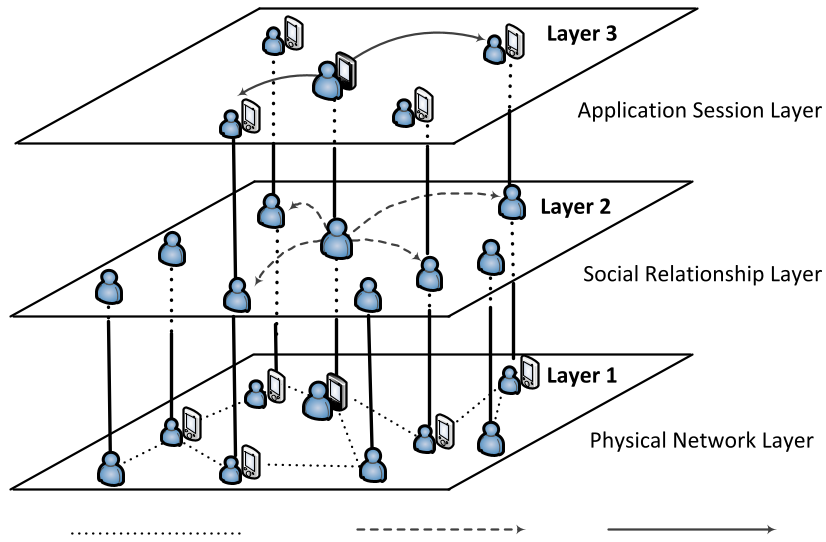
The Two Degrees of Mobility
The authors define two critical regimes:
- Strong Mobility: . Nodes move far enough to act as physical data carriers, significantly boosting capacity by leveraging the "Store-Carry-Forward" paradigm.
- Weak Mobility: . Nodes are "tethered" close to home, forcing the network to rely on multi-hop relaying, which limits throughput.
Experiments & Results: The Power of Social Parameters
The research derives tight upper and lower bounds for per-node capacity (). The most striking insight is the impact of clustering exponents .
| Clustering Exponent | High Value Impact | Capacity Result |
|---|---|---|
| Friendship Degree () | Fewer "super-popular" nodes | Increases per-node throughput |
| Friendship Formation () | Friends are geographically closer | Reduces relay burden, boosting capacity |
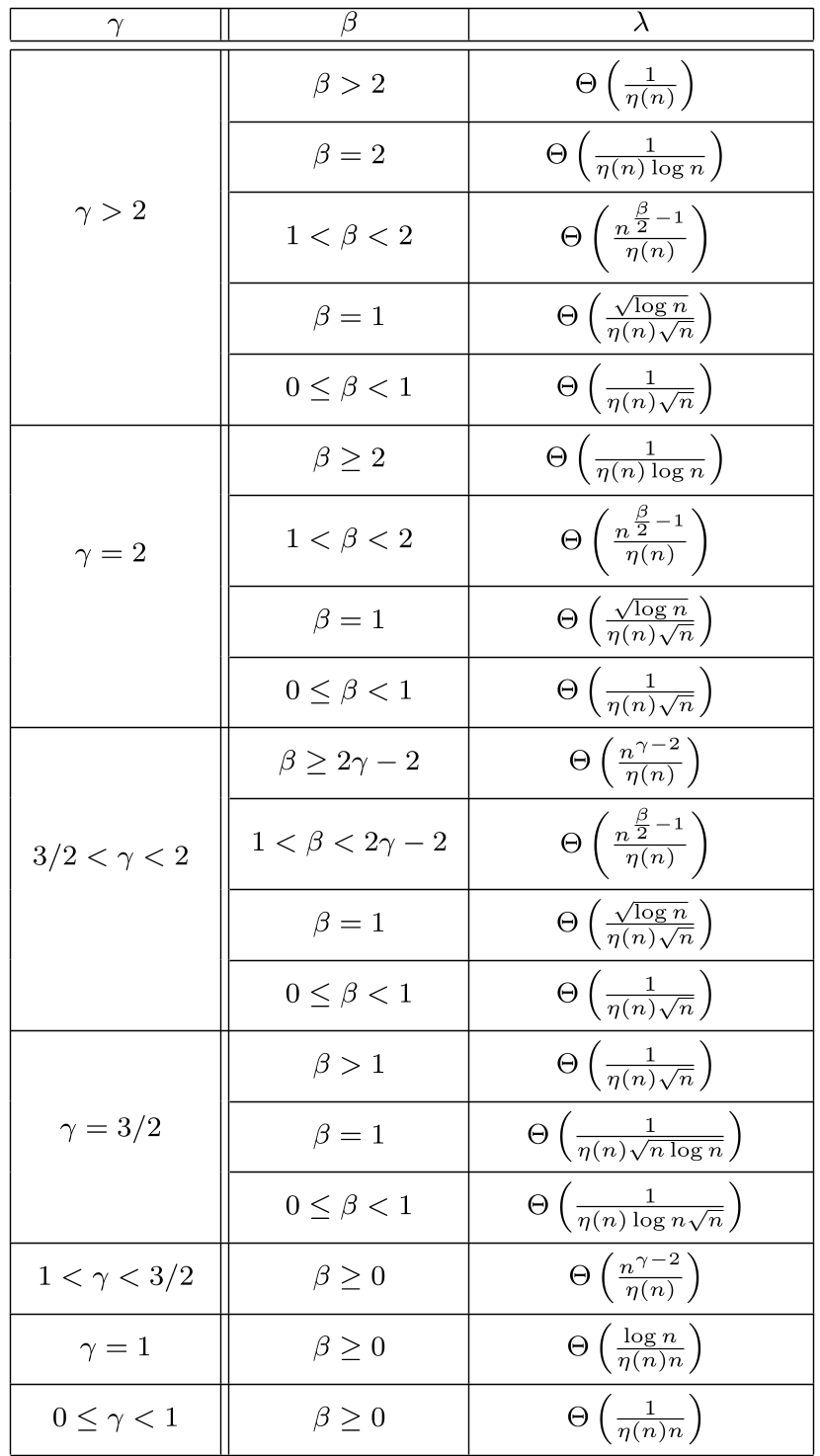
Key finding: In the Strong Mobility case, when social clustering is high (), the capacity per node can reach . If the nodes move optimally, the network achieves capacity, effectively overcoming the "bottleneck" usually found in large-scale ad-hoc networks.
Critical Analysis & Conclusion
Takeaway
This paper proves that mobility is a "capacity multiplier" in social networks. By mathematically linking the Physical Layer (mobility radius) with the Social Layer (friendship distance), the authors provide a toolkit for predicting how apps like WeChat or Twitter would perform over an ad-hoc local network (e.g., in a disaster zone or a crowded stadium).
Limitations & Future Work
- Uniform Home-Points: The current derivation assumes home-points themselves are uniformly distributed. Real cities have non-uniform home-point distributions (e.g., residential vs. industrial zones), which the authors plan to address next.
- Social-Broadcast Only: The study focuses on broadcast. Social-unicast (one-on-one) or anycast might reveal different scaling behaviors.
- Infrastructure: The model currently ignores base stations and Wi-Fi access points, which act as "shortcuts" in real-world hybrid networks.
This work remains a foundational reference for anyone looking to build decentralized social applications that are actually scalable.