
Proactive Scaling: How Social Intelligence Optimizes Geo-Distributed Clouds
10332_Scaling Social Media Applications Into Geo-Distributed Clouds.
The paper introduces a proactive, online scaling framework for social media applications in geo-distributed clouds. Utilizing an epidemic-based social influence model for demand prediction and a Δ-step look-ahead optimization mechanism, the authors achieve near-offline optimal performance in content migration and request distribution.
TL;DR
In the realm of social media, content popularity isn't just random—it's infectious. This paper presents a sophisticated framework that uses epidemic modeling to predict video demands and a -step look-ahead algorithm to minimize the cost of running social applications across global data centers. By anticipating "social cascades," the system achieves operational costs nearly as low as an omniscient offline solver.
Background: The Geo-Distributed Challenge
As social media moves toward high-definition, short-form video (UGC), the infrastructure must be as dynamic as the content. Moving gigabytes of data between Amazon EC2 regions in Northern Virginia, Tokyo, and Ireland is expensive. The problem is two-fold:
- Migration vs. Latency: You want content close to the user to reduce delay, but moving it too often spikes bandwidth costs.
- Social Volatility: A video "going viral" triggers a surge that traditional, reactive CDN caches are too slow to handle efficiently.
Methodology: The Core Engine
The authors tackle the problem by breaking it into three distinct logical layers: Prediction, One-Shot Optimization, and Long-term Adjustment.
1. Social Epidemic Prediction
Instead of simple time-series forecasting (like ARIMA), the authors use an SIR (Susceptible-Infectious-Recovered) style model. They treat potential viewers as "susceptible" and those who comment or share as "infectious."
- Insight: Social influence (friends watching) and system recommendations are the primary vectors of demand. By mapping these to geographic regions, they can predict exactly where a video will be needed in the next hour.
2. Mixed-Integer One-Shot Optimization
Every hour, the system solves a "One-shot" problem: Which cloud sites should store which videos to minimize current storage + VM + traffic costs?
- The Math: Since this is a mixed-integer problem (you either store the video
1or you don't0), they use dual decomposition. They prove the problem has a "totally unimodular" structure (Lemma 1), meaning it can be solved efficiently as a linear program without losing integer integrity.
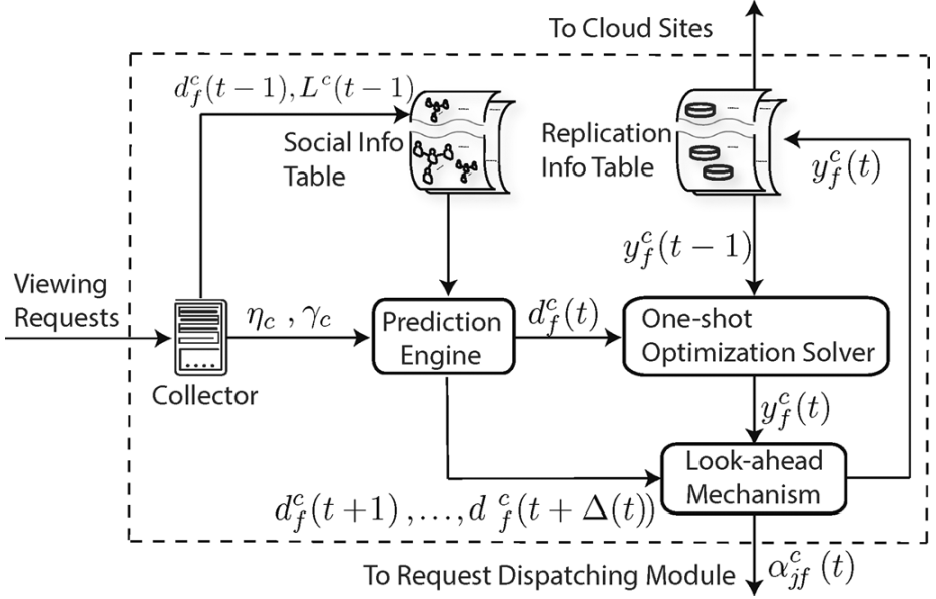 Figure 1: The implementation architecture featuring the Collector, Prediction Engine, and Optimization Solver.
3. The Look-Ahead Adjustment
This is the "secret sauce." A local one-shot decision might suggest deleting a video to save 7 in migration.
- Strategy: The -step look-ahead mechanism simulates the future for a few hours. If keeping the video now (despite current low demand) leads to lower costs over the next hours, the one-shot decision is overridden.
Experimental Results: Beating the SOTA
The authors deployed their tracker on a High-Memory EC2 instance and emulated 8 global regions.
- Cost Efficiency: Compared to a "Smart CDN" (which replicates content based on proximity), this look-ahead approach is vastly cheaper because it refuses to migrate content if the cost-to-benefit ratio over time isn't favorable.
- Latency Guarantee: While focusing on cost, the algorithm respects a 150ms RTT constraint, ensuring that "cheap" doesn't mean "slow."
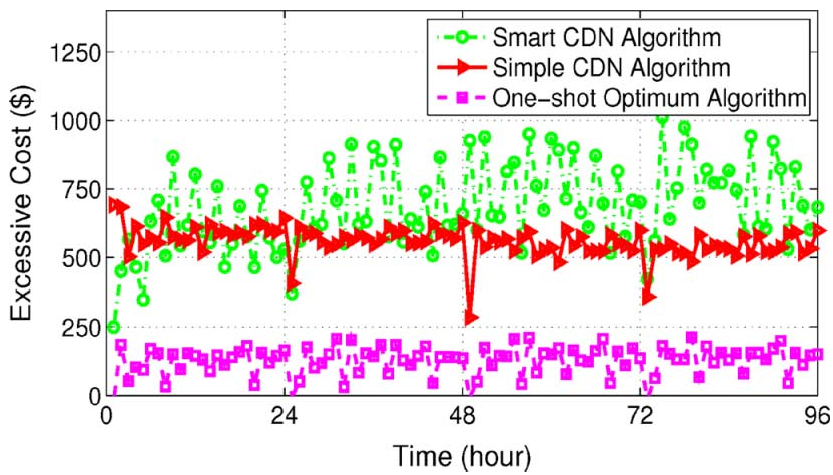 Figure 2: Excessive cost comparison showcasing the look-ahead algorithm's superiority over standard heuristics.
Critical Analysis & Conclusion
The core value of this work is the marriage of epidemiological theory with distributed systems optimization.
Takeaways:
- Proactivity is King: In cloud-native apps, the delay between a demand surge and a resource spin-up is the enemy. Social graphs provide the "early warning system."
- Small Windows, Big Gains: You don't need to predict the future for days; a look-ahead window of just 3-4 hours (as seen in Figure 4 & 5) captures the bulk of the available cost savings.
Limitations: The model assumes unit video sizes and fixed VM capacities. In a real-world setting like Netflix or YouTube, variable bit-rate segments and heterogeneous VM types (GPU vs. CPU) would add an extra layer of complexity to the optimization matrix.
Future Outlook: This logic is ripe for the Edge Computing era. As we move from 8 "regions" to 8,000 "edge nodes" (5G base stations), the importance of social-aware proactive migration will grow exponentially.