
Proactive Scaling: Navigating the Geo-Distributed Cloud for Social Media
Scaling Social Media Applications Into Geo-Distributed Clouds
This paper introduces a proactive online algorithm for scaling social media streaming applications across geo-distributed cloud environments. It utilizes a novel epidemic model to predict video demands based on social influences and interest correlations, optimizing content replication and request distribution to minimize operational costs while guaranteeing Quality of Service (QoS).
TL;DR
The explosion of social media streaming (think TikTok or YouTube) requires a massive, geo-distributed infrastructure to keep latency low. This paper presents an online algorithm that predicts where and when a video will become popular by analyzing social "epidemics." By using a smart look-ahead mechanism, it balances the cost of moving data with the cost of serving users, achieving SOTA cost-efficiency without sacrificing speed.
The "Flash Crowd" Problem in Geo-Distributed Clouds
Geo-distributed clouds offer "infinite" elastic resources, but they come with a complex pricing matrix: storage fees, VM rental, and varying bandwidth costs across regions. For social media, the challenge is two-fold:
- Demand Volatility: A video can go viral in a specific geographic region within minutes.
- Migration Oversight: Moving a video to a local data center at the wrong time (e.g., just before it loses popularity) can lead to higher migration costs than the bandwidth savings are worth.
Existing solutions either over-replicate (high cost) or react too late (high latency). This paper argues that we need to be proactive, not reactive.
Methodology: Social Epidemics & Temporal Look-Ahead
1. Predicting Viral Trends via Epidemic Modeling
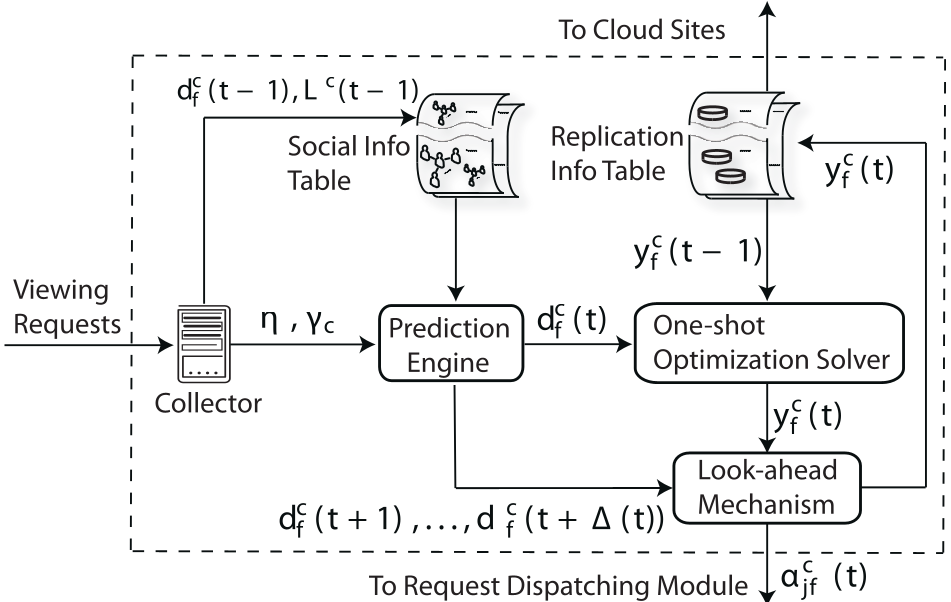
The authors utilize a Modified SIR (Susceptible-Infectious-Recovered) model. Instead of biological viruses, they model "viewing requests."
- Infection Source: Friends commenting on microblogs or system recommendations.
- Decay factor: Popularity naturally decreases as the video ages.
This allows the system to estimate regional demand before it actually happens.
2. Dual Decomposition for One-Shot Optimization
Solving the optimal replication across dozens of data centers is a Mixed Integer Program (MIP), which is usually NP-hard. The authors use Dual Decomposition, splitting the problem into:
- Subproblem A: Cost-optimal content replication (where to store).
- Subproblem B: Optimal request distribution (where to send users).
They mathematically prove that the relaxed version of this problem is totally unimodular, meaning even the simplified linear version provides the correct integer (0 or 1) results.
3. The Δ(t)-Step Look-Ahead Mechanism
The most "Academic-Professional" insight here is the look-ahead mechanism. If a one-shot optimization says "delete this video to save storage," the look-ahead mechanism checks: "Wait, will this video be popular again in 2 hours? If so, the migration cost of re-uploading it later will exceed the storage cost of keeping it now."
Experimental Validation
The authors didn't just simulate; they built a prototype on a 50-node cluster emulating 10 geographic regions (from San Francisco to Tokyo).
Key Result: Cost vs. Window Size
The experiments show that looking ahead just 2 to 3 steps (hours) is sufficient to capture almost all potential cost savings.
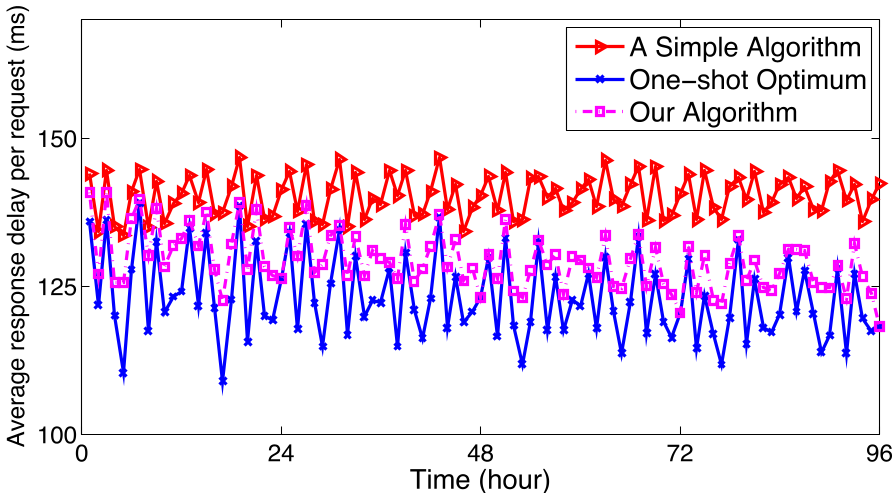
As seen in the figure above, the proposed algorithm (solid line) maintains lower operational costs compared to simple one-shot optimization or static replication, all while staying within the 150ms latency envelope.
Critical Insight & Future Outlook
This work highlights that social signals are leading indicators of infrastructure load. In the future, as AI-driven recommendations (like TikTok's FYP) become more dominant, these prediction models will likely move from simple epidemic equations to complex Graph Neural Networks (GNNs).
Limitations: The model assumes uniform video sizes and doesn't account for tiered storage (Hot/Cold storage), which is common in modern AWS/Azure setups. However, the core logic of temporal look-ahead remains a foundational principle for any cost-aware cloud architect.
Conclusion
By bridge the gap between social behavior and distributed systems theory, this paper provides a robust framework for the next generation of global-scale media platforms. It proves that the "intelligence" of the cloud shouldn't just be in how it stores data, but in how it anticipates human behavior.