
SCAWG: Bridging the Data Gap in Spatial Crowdsourcing Research
SCAWG: A toolbox for generating synthetic workload for spatial crowdsourcing
SCAWG (Spatial Crowdsourcing Workload Generator) is an open-source toolbox designed to generate synthetic yet realistic spatiotemporal datasets for Spatial Crowdsourcing (SC) research. It addresses the lack of public real-world datasets from platforms like Uber or TaskRabbit by modeling complex worker-task interactions using a mixture of spatial and temporal distributions.
TL;DR
SCAWG is an open-source framework designed to solve the "data drought" in Spatial Crowdsourcing (SC). By synthesizing workers and tasks based on real-world geosocial dynamics (like those found in Yelp and Foursquare), it provides a standard, flexible, and reproducible environment for testing task-scheduling and assignment algorithms.
The "Data Drought" Problem
Spatial Crowdsourcing (SC) requires workers to be physically present at specific locations—think Uber drivers or TaskRabbit handymen. While the field is booming, researchers face a major hurdle: the lack of public datasets. Companies like Uber treat their data as a "black box" for competitive reasons. Consequently, researchers often resort to:
- Proprietary data: Impossible for others to verify.
- Call records: Don't accurately reflect the worker-task intent.
- Simple synthetic data: Lacks the complex "locality" of human behavior.
SCAWG introduces a way to generate data that actually looks like human movement and task performance.
Methodology: From Basic Math to Human Behavior
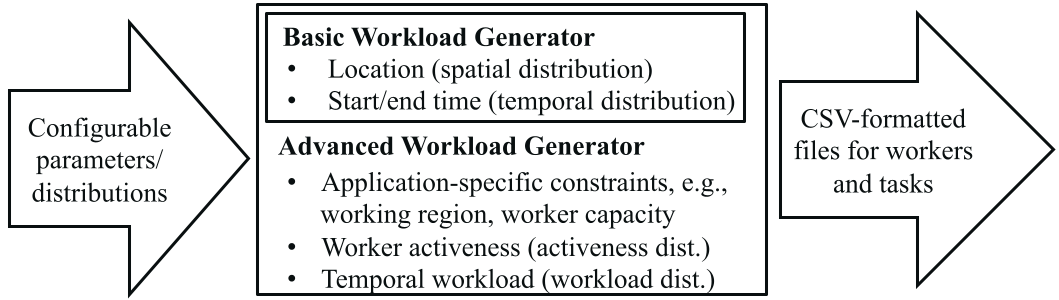
SCAWG operates through a hierarchical approach, moving from simple spatiotemporal sampling to complex behavior modeling.
1. Basic Workload Generation
At its core, every worker and task is defined by a location () and a time window (). SCAWG samples these from:
- Spatial Distributions: Uniform, Zipfian, or Mixture models (e.g., a mix of Gaussian clusters and background noise).
- Temporal Distributions: Poisson processes for entry times and various duration distributions.
2. The Advanced Logic
To mimic real-world complexity, the authors introduced several "Advanced" features:
- Worker Activeness: Not all workers are equal. Using a "Roulette Wheel" algorithm, the tool assigns higher appearance probabilities to "active" workers.
- Physical Constraints: Realistic inclusion of traveling radii, worker capacities, and specialized skill sets.
- Spatiotemporal Patterns: It captures the "peak hour" phenomenon—realizing that worker availability surges during commutes (4 PM to 7 PM).
Realism through Geosocial Insights
The true power of SCAWG lies in its grounding in real data. The authors analyzed Gowalla, Yelp, and Foursquare to define Mean Contribution Distance (MCD).
Research shows that 90% of workers travel less than 40 miles daily. SCAWG uses this "locality property" to ensure tasks aren't just randomly assigned across a map, but clustered in a way that mirrors how humans actually move in cities.
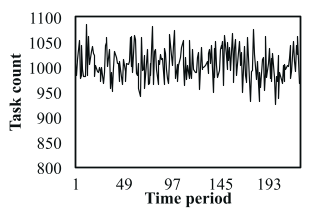 Figure: SCAWG can simulate various arrival patterns, including INCREASING, DECREASING, and COSINE models to test system robustness.
Critical Analysis & Future Outlook
SCAWG is a significant step toward Reproducible Research. By providing a configurable CSV output, it allows different research groups to compare their algorithms on the exact same synthetic terrain.
Limitations: While SCAWG models spatial and temporal distributions well, it does not currently simulate "reactionary behavior"—where a worker's future movement is influenced by the specific task they just completed (e.g., a delivery driver ending up in a new neighborhood).
Conclusion: For any researcher working on task assignment, privacy protection, or incentive mechanisms in crowdsourcing, SCAWG is an essential utility for rigorous experimental validation.
For more details and the source code, visit the authors' repository: https://github.com/infolab-usc/SCAWG