
Scene2Wav: Orchestrating Emotion from Pixels to Raw Waveforms
Scene2Wav: a deep convolutional sequence-to-conditional SampleRNN for emotional scene musicalization
Scene2Wav is a deep convolutional sequence-to-conditional SampleRNN architecture designed for automated music generation from emotionally annotated videos. It achieves high fidelity in transferring emotional visual cues into raw audio signals, outperforming traditional sequence-to-sequence baselines in both human preference and emotional accuracy.
TL;DR
Scene2Wav is a novel end-to-end framework that "hears" the emotion in a video and composes corresponding music. By combining a Convolutional Sequence Encoder with a custom Conditional SampleRNN, it transforms visual features into raw, high-fidelity audio signals that align with the emotional arc of a scene.
Context & Motivation: The Gap Between Sight and Sound
While AI has made strides in image captioning and video synthesis, the "musicalization" of scenes—generating audio that reflects the specific emotional valence of a video—remains a frontier. Traditional methods often take shortcuts by using MIDI or simplified notation, which lack the richness of real instruments. The authors of Scene2Wav argue that to truly move a viewer, the AI must operate on raw audio and understand the affective cues hidden in visual sequences.
Methodology: The Scene2Wav Architecture
The system follows a sophisticated three-stage pipeline to bridge the domain gap between vision and sound.
1. Visual Feature Extraction (The Eyes)
Unlike many models that use standard RGB, Scene2Wav utilizes the HSV (Hue, Saturation, Value) color space. This is a strategic choice: HSV more closely mimics human perceptual relationships to color and light, which are deeply tied to emotion (e.g., darker, less saturated scenes often correlate with negative valence).
2. Sequence Encoding (The Memory)
A 2-layer Gated Recurrent Unit (GRU) RNN processes the CNN-extracted features. This ensures that the model doesn't just see a static image, but understands the movement and temporal changes within a 3-second video splice.
3. Conditional SampleRNN Decoder (The Voice)
This is the paper's "Secret Sauce." The standard SampleRNN is unconditional—it generates random music. The authors modified it to be conditional, injecting the emotional visual vector v into every tier of the hierarchy.
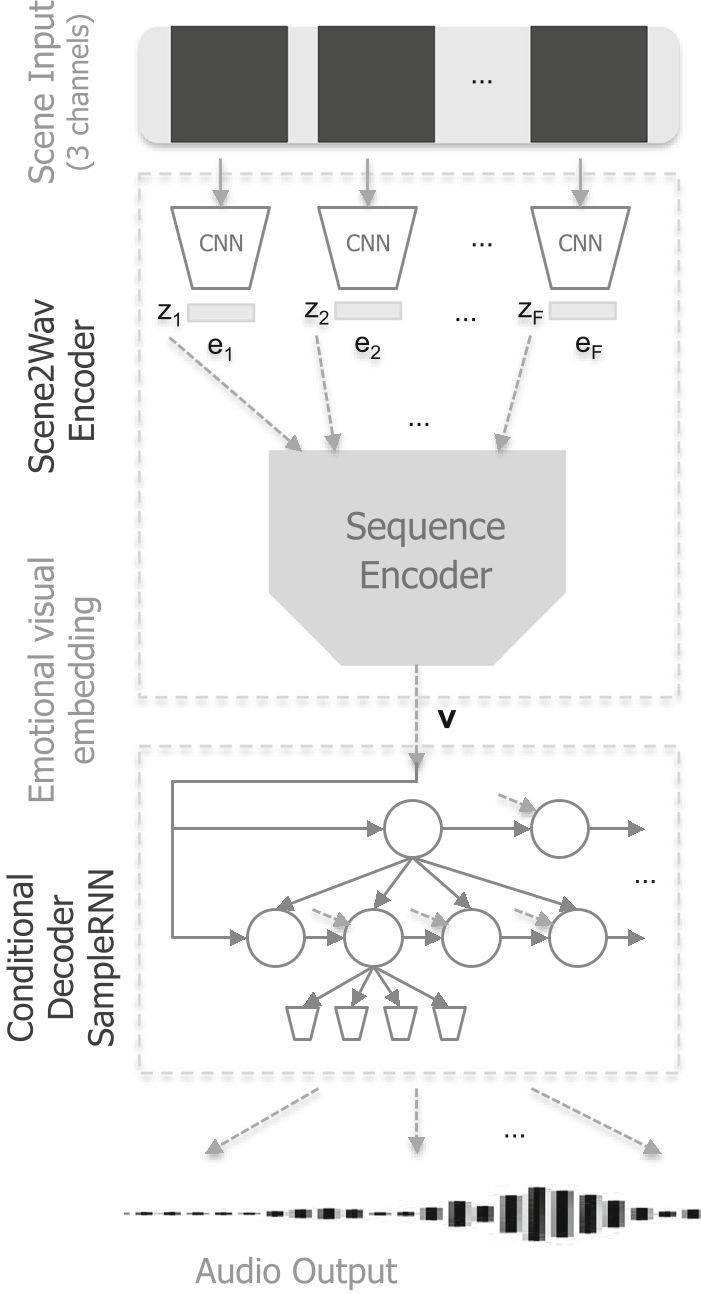
Figure: The Scene2Wav end-to-end architecture, showing the flow from HSV frames to raw audio samples.
Hierarchical Generation
The decoder generates audio at three different resolutions (Tiers):
- Tier 3 (Top): Slow temporal resolution, capturing global musical structures.
- Tier 2 (Middle): Captures more refined audio characteristics.
- Tier 1 (Bottom): Predicts individual audio samples (16,000 per second) using a Multi-Layer Perceptron.
Validation: Does it Feel Right?
Testing a generative model for emotion requires both subjective and objective measures.
Human Preference
Using Amazon Mechanical Turk, the researchers found a clear preference for Scene2Wav over traditional Convolutional Seq2Seq models. The waveforms generated by Scene2Wav (plotted below) show striking similarities in dynamic range and "shape" to the original movie soundtracks.
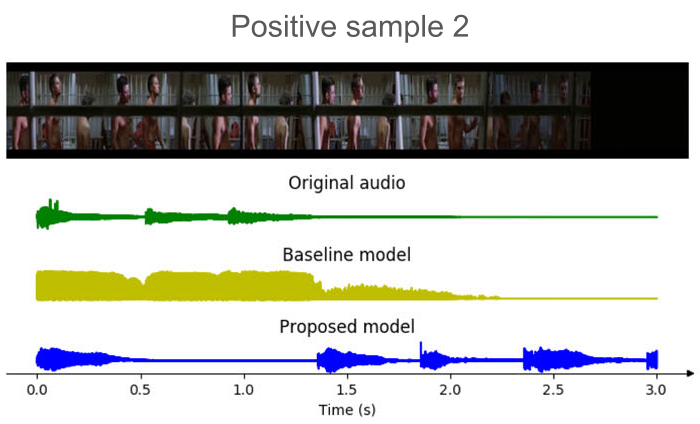
Figure: Comparison of original audio, baseline, and Scene2Wav waveforms for a negative emotional scene.
The Emotional Circle of Fifths
In a unique move, the authors mapped musical chords to emotions using the Emotional Circle of Fifths. They analyzed the "detected chords" in the generated music to see if a positive scene actually produced "happy" chords (like C Major) or "conquering" chords (like F#). Scene2Wav significantly outperformed the baseline in "Positive" consistency.
Critical Insight: Why This Matters
The real breakthrough here isn't just "making noise"; it's the conditioning mechanism. By forcing the SampleRNN to look at the visual embedding at every stage of sample generation, the authors solve the "drift" problem common in autoregressive models, where the audio becomes disconnected from the source material over time.
Conclusion & Future Prospects
Scene2Wav serves as a critical stepping stone for AI movie directors. While it currently handles 3-10 second splices, the framework is scalable. Future iterations could move beyond binary (Positive/Negative) emotion to a complex "Arousal-Valence" space, allowing AI to score entire feature films with nuanced, raw audio soundtracks that respond dynamically to the director's visual style.
Limitations: The model is still computationally expensive and occasionally produces "noisy" artifacts—a common trait in 2020-era raw audio generators—but its logic of cross-modal emotional alignment remains a gold standard for affective computing.