
Scheduled Seeding: Rethinking Viral Marketing Through Latent Influence and Precise Timing
Scheduled seeding for latent viral marketing
The paper introduces "Scheduled Seeding," a novel influence maximization framework designed for latent viral marketing. Unlike traditional models, it treats social influence as a hidden factor that enhances the probability of purchase upon contact, achieving a 25%-50% improvement in product adoption rates over PageRank-based benchmarks.
TL;DR
Most viral marketing research assumes that products spread like a plague—automatically and aggressively. This paper challenges that "active infection" myth. By introducing Scheduled Seeding, the authors model social influence as a latent factor that only works when a company makes a move. By optimizing what time to call a customer based on their social circle's status, they boosted adoption rates by up to 50%.
Background: Why Most "Viral" Campaigns Fail
In classical models like the Linear Threshold (LT) or Independent Cascade (IC), if your friend buys a phone, you are likely to "catch" the purchase. But real-world data reveals a bleaker reality: most cascades are shallow, rarely moving beyond 8 people.
The authors argue that social influence is latent. Your friends' purchases don't make you buy; they make you more likely to buy if a salesperson contacts you. This creates a scheduling problem: if you call too early, the latent influence isn't strong enough. If you call after a rejection, the customer enters a "Cooling Time" (state ) and won't buy no matter what.
The Methodology: Scoring the "Right Moment"
The proposed model transitions nodes through four states:
- Non-Infected (): Susceptible to sales calls.
- Infected and Infectious (): Recently purchased and influencing neighbors for time.
- Infected but non-Infectious (): Owns the product but stopped talking about it.
- Cooling Time (): Recently rejected an offer; inaccessible for time.
The Probability Function
The likelihood of a successful seed () is defined by: This incorporates Asch’s social conformity, where the probability increases linearly as more neighbors adopt, up to a threshold .
The Scheduled Seeding Algorithm
Instead of just picking high-degree nodes, the algorithm calculates a dynamic score () at every timestamp:
 This formula balances the immediate probability of success with the potential future influence of the node's neighbors.
Experiments and Results
The authors tested the method on a Citation Network (9,295 nodes). They compared "Scheduled Seeding" against a PageRank benchmark—the industry standard for identifying influencers.
Key Findings:
- Superiority over PageRank: Across all social thresholds (), the Scheduled Seeding method consistently outperformed centrality-based seeding.
- Significant Gains: The improvement in the number of infected nodes ranged from 25% to 50%.
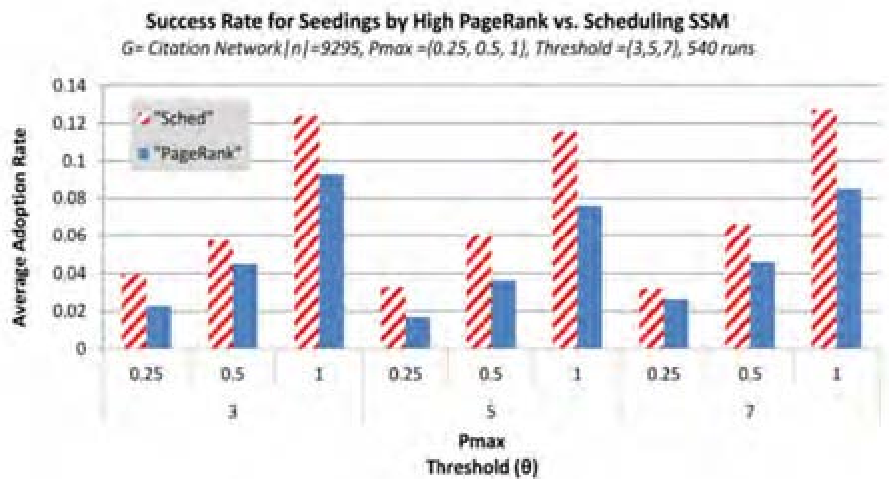 Fig 1: Success rate of Scheduled Seeding (Sched) vs. PageRank.
Critical Insight: The Value of "When"
The core contribution of this work is the acknowledgement of temporal constraints. In a world of limited marketing budgets and "customer annoyance" (Cooling Time), you cannot simply blast everyone at once.
Comparison with SOTA
While traditional SOTA methods focus on the topology of the graph (who is the "hub"?), this method focuses on the state of the graph (who is currently ready to be influenced?).
Limitations & Future Work
- Initial Seeding: The authors note the algorithm is "wasteful" in the first few steps because social influence hasn't built up yet.
- Static Topology: The model assumes the social network is static, whereas real-world relations can shift during a long campaign.
Conclusion
"Scheduled Seeding" provides a more realistic bridge between academic graph theory and practical sales operations. By treating influence as a latent probability and respecting temporal "cooling periods," it offers a blueprint for more efficient, less intrusive viral marketing.