
AS Scheme: Balancing Personalized Marketing and User Privacy via Cryptographic Decoupling
Scheme of User Privacy Protection Applied to Online Marketing
The paper proposes AS (Advertising Search), a privacy-preserving online marketing scheme for email and mobile devices. It utilizes cryptographic techniques and the Separation of Duties (SoD) principle to deliver targeted Online Behavioral Advertising (OBA) while shielding the user's identity from advertisers and ad networks.
TL;DR
The "AS" (Advertising Search) scheme is a technical framework designed to resolve the long-standing tension between Online Behavioral Advertising (OBA) and user privacy. By utilizing a Trusted Third Party (TTP), client-side profile management, and homomorphic encryption, it allows users to receive highly relevant ads in a single periodic message, reducing email/push clutter by over 80% while ensuring no single entity knows both the user's identity and their interests.
Problem & Motivation: The Privacy vs. Relevance Dilemma
Current digital marketing is built on a "surveillance" model. Ad networks track clickstreams, IP addresses, and user-agents to guess what you like. This leads to two major failures:
- Privacy Breach: Persistent tracking creates a digital shadow of the user without explicit consent.
- Inaccuracy: Inferred profiles often suffer from false positives (e.g., clicking a link by mistake) or shared session confusion.
The authors argue that the only way to get 100% accurate interests is for the user to declare them, but this typically requires giving up your identity. AS was built to break this link.
Methodology: The Core Architecture
The AS scheme relies on the Separation of Duties (SoD). It splits information among several agents so that no one has the "full picture."
1. The Agents
- The User/Application: Holds the master profile and private keys.
- Ad-Network: Knows what the user likes (Preferences) but not who they are (uses a masked IDuser).
- TTP (Trusted Third Party): Knows who the user is (Email) but not what they like.
- CDN: Simply hosts the ad content.
2. Secure Protocol Flow
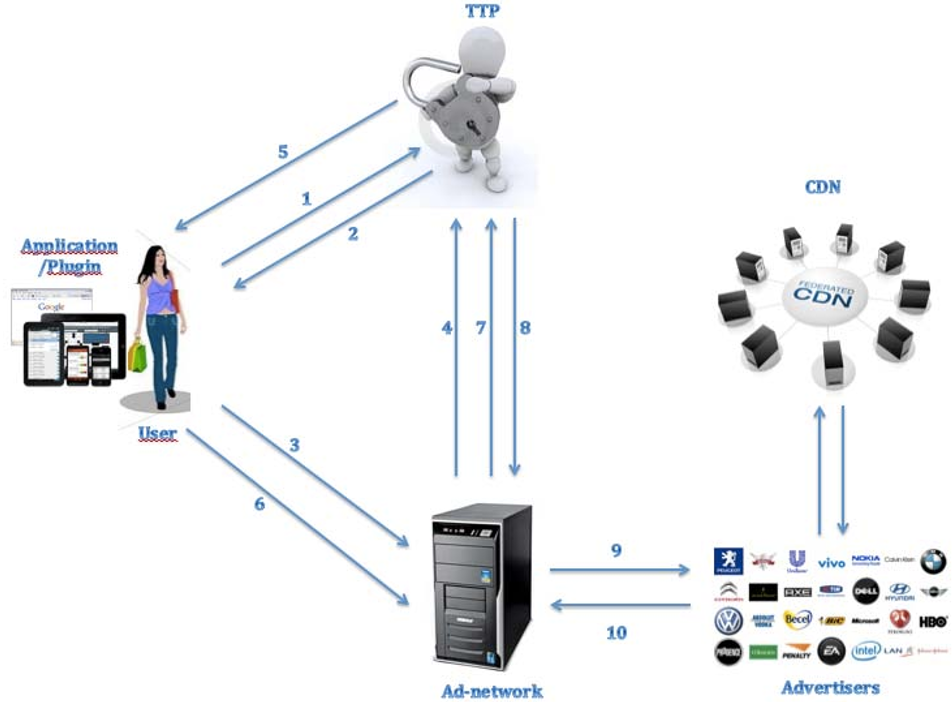
- Registration: The user app generates a public/private key pair. The email is sent only to the TTP, which returns an
IDuser. - Ad Delivery: The Ad-network selects ads based on the
IDuser's profile and sends an encrypted list. The user app locally selects ads () to display. This randomization prevents the network from knowing exactly which ad caught the user's eye. - Private Billing: To charge advertisers, AS uses Additively Homomorphic Encryption. The ad-network adds encrypted view counts to a total counter. Because the math happens in the encrypted domain, the network doesn't know which individual counter it is incrementing.
Experiments & Results: Fighting "Message Fatigue"
One of the biggest practical benefits of AS is the consolidation of marketing. Instead of 20 different companies sending 20 different emails, AS aggregates them into a single, secure daily digest.
Performance Data
In a 60-day trial with real users subscribed to various marketing lists, the reduction in noise was dramatic:
| Metric | User 1 | User 2 |
|---|---|---|
| Original Messages | 255 | 409 |
| AS Messages | 56 | 58 |
| Volume Reduction | 78.04% | 85.82% |
This demonstrates that by using an opt-out mechanism and centralized aggregation, the user experience improves without sacrificing the "reach" for the advertiser.
Critical Analysis & Conclusion
Takeaways
The AS scheme is a significant step toward Zero-Knowledge Marketing. Its strength lies in using standard cryptographic primitives (Elliptic Curve, Homomorphic Encryption) to solve a social problem: the annoyance and fear associated with digital ads.
Limitations
- Cryptographic Overhead: While minimized, the use of ZK-proofs and homomorphic addition requires more compute power than simple cookie tracking.
- User Habit: Users must install an application/extension and "opt-in" to the system, which remains a high hurdle for mass adoption.
- TTP Trust: The system is highly dependent on the TTP not colluding with the Ad-network. If they collaborate, the user's anonymity is deanonymized.
Future Outlook
As privacy regulations like GDPR and CCPA tighten, frameworks like AS that provide Privacy by Design will transition from "academic research" to "business necessity." Future iterations could potentially replace the TTP with a decentralized blockchain-based identity layer to further remove the need for centralized trust.