
SCHONA: Deconstructing the Scholar Persona through Big Data Analytics
SCHONA: A Scholar Persona System Based on Academic Social Network
The paper introduces SCHONA, a scholar persona system designed for academic social networks. By integrating data from SCHOLAT (profile and behavior logs) and CNKI (academic achievements), it utilizes Word2Vec, K-means, and TextRank to generate accurate descriptive labels for scholars.
TL;DR
SCHONA is a specialized profiling system that transforms raw academic data into structured "Scholar Personas." By fusing social behavior from the SCHOLAT platform with publication data from CNKI, the system leverages a pipeline of Word2Vec, K-means, and TextRank to generate dynamic, high-fidelity labels for researchers.
Context: Why Standard Social Profiling Fails Scholars
General-purpose user profiling (like those for Facebook or Twitter) focuses on consumer preferences and social connectivity. However, a "Scholar Persona" requires a deeper understanding of:
- Domain Expertise: Evolving research interests that aren't captured by simple keyword matching.
- Professional Dynamics: Shifts in work units (affiliations) and academic titles.
- Behavioral Nuance: Distinguishing between what a scholar reads (behavioral) and what they produce (achievement).
The authors argue that existing academic social networks (ASNs) fail to effectively mine this multidimensional data for personalized services.
Methodology: The Label Generation Pipeline
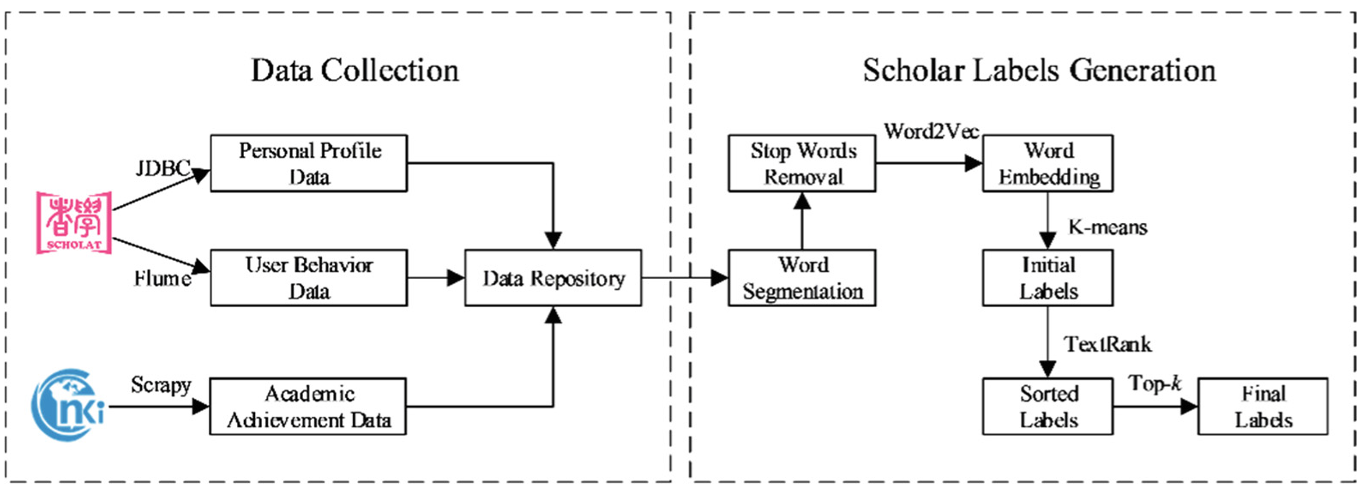
The SCHONA architecture is divided into two primary phases: Data Collection and Label Generation.
1. Multi-Source Data Collection
The system ingests three distinct types of data:
- Personal Profiles: Name, degree, and affiliation via JDBC.
- Behavioral Logs: Search history and news interactions captured via Apache Flume.
- Academic Achievements: Titles and abstracts crawled from CNKI using a Scrapy-based framework with a proxy IP pool to bypass anti-crawling measures.
2. High-Precision Label Generation
The core innovation lies in its unsupervised refined labeling process:
- Semantic Embedding: Textual data from all sources (introductions, abstracts, news) is converted into dense vectors using Word2Vec.
- Initial Clustering: K-means is applied to the word vectors for a specific scholar to identify "thematic centers."
- Graph-based Ranking: To ensure the labels are not just relevant but also significant, TextRank is employed. It treats labels as nodes in a graph, where edge weights reflect semantic similarity, and iteratively calculates the "authority" of each tag.

Experimental Insights
The system was tested on a massive dataset comprising over 103,216 scholars and 2 million academic achievement records.
Key Observations:
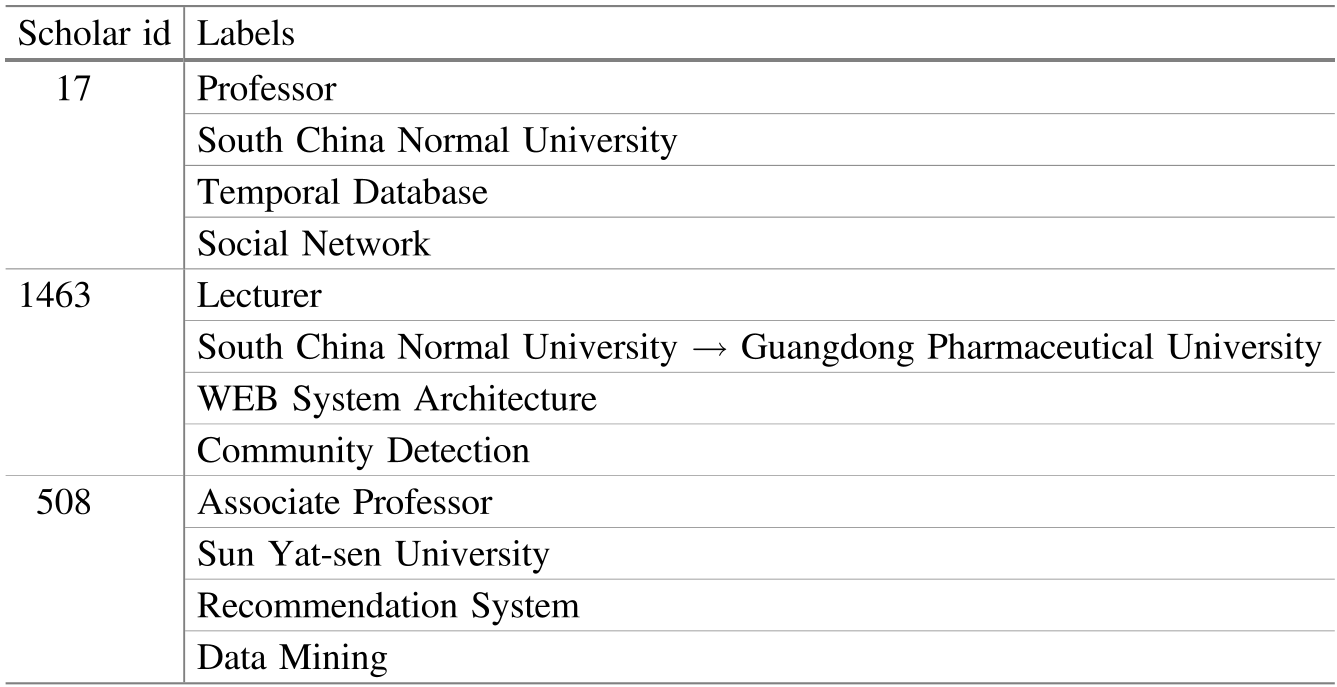
- Dynamic Tracking: SCHONA successfully captured transitions in scholar profiles. For instance, Scholar ID 1463's labels reflected a move from "South China Normal University" to "Guangdong Pharmaceutical University."
- Expertise Mapping: The system effectively distinguishes between high-level titles (Professor/Associate Professor) and granular research tags (e.g., "Temporal Database," "Community Detection").
Critical Analysis & Future Outlook
SCHONA represents a significant step toward automated academic knowledge graphing. By using unsupervised methods, it removes the need for manual tagging, which is often biased or outdated.
Limitations:
- The current system relies heavily on textual data; incorporating Academic Graph Neural Networks (to model co-authorship relationships) could further improve label accuracy.
- Anti-crawling measures on platforms like CNKI remain a bottleneck for real-time updates.
Takeaway: For developers of recommendation systems and HR-tech in academia, SCHONA offers a blueprint for building "Expert-Aware" AI that understands not just what a user likes, but what they truly know.