
SCI: Bridging the Gap Between Coding and Social Networking in the IDE
SCI: Towards a Social Collaborative Integrated Development Environment
The paper introduces SCI (Social Collaborative Integrated Development Environment), a unified platform that integrates social networking concepts into a 3D virtual collaborative IDE. It leverages the CVE virtual environment to provide real-time synchronous tools and asynchronous awareness mechanisms to enhance coordination in distributed software development.
TL;DR
SCI (Social Collaborative IDE) is a pioneering research project that transforms the traditionally solitary act of coding into a socially connected experience. By embedding social networking features—like activity feeds, user profiles, and even 3D virtual rooms—directly into the development environment, SCI aims to solve the coordination nightmare of distributed software teams by providing unprecedented visibility into what colleagues are doing before they even push their code.
Background: The Social Side of Software
Large-scale software development is fundamentally a social endeavor. Yet, for decades, our tools have treated developers as isolated nodes. The "communication tax"—the time spent switching between Slack, GitHub, Jira, and the IDE—is a major bottleneck for distributed teams. The authors of SCI posit that the IDE and the social network are not two separate tools, but complementary parts of the same ecosystem.
Motivation: Why Awareness Matters
The primary pain point in distributed development is the loss of "situational awareness." In a physical office, you can see if a colleague is busy or hear them discussing a specific module. In a distributed setting, this intuition vanishes. Existing tools like CVS or early-stage IBM Jazz focused primarily on committed code. SCI's core insight is that the most valuable information is often uncommitted: who is currently looking at a file, who is debugging a specific function, and what technical interests does a teammate have that could help solve a current bug?
Methodology: The Architecture of SCI
The SCI architecture is built upon the Idaho Collaborative IDE (ICI) and integrated into a 3D Virtual Environment (CVE).
1. The Information Layer (Awareness)
SCI provides three critical types of awareness:
- Social Awareness: Presence of collaborators and community members (who is online, their local time, and availability history).
- Action Awareness: Real-time tracking of what collaborators are doing (e.g., currently debugging, editing).
- Artifact Awareness: Visibility into who is touching which files. SCI notably tracks uncommitted changes, using color-coded markers in the editor to show lines being modified by others in real-time.
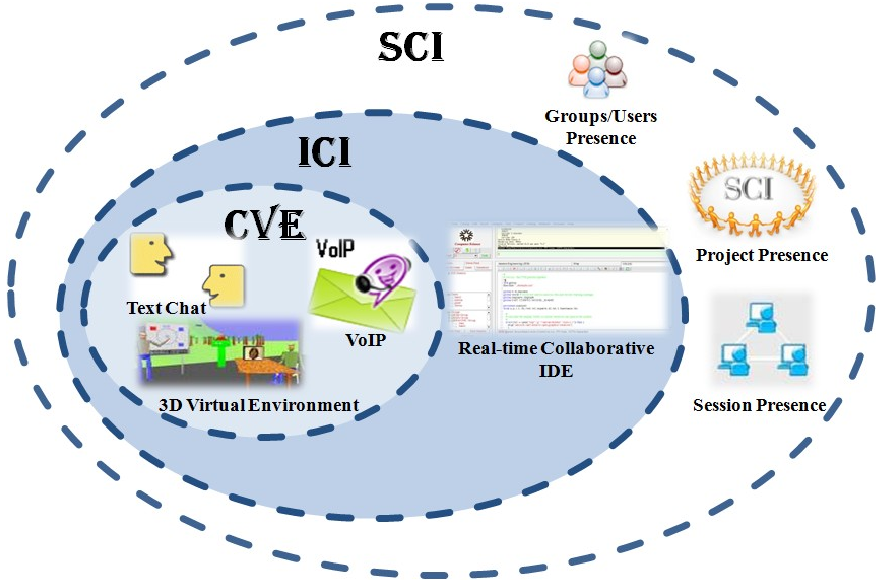 Figure 1: The high-level architecture showing the bridge between the 3D Virtual Environment and the Collaborative IDE tools.
2. The Social Layer
Instead of a dry list of usernames, SCI uses:
- User Profiles: Displaying friends, technical expertise, and availability calendars.
- News Feeds: Automated summaries of project activities (e.g., "Alice started a debugging session in Project X").
- Virtual Rooms & Meta-Information: Special Interest Groups (SIGs) are represented as virtual rooms with NPCs (Non-Player Characters) that serve as expert-system knowledge bases.
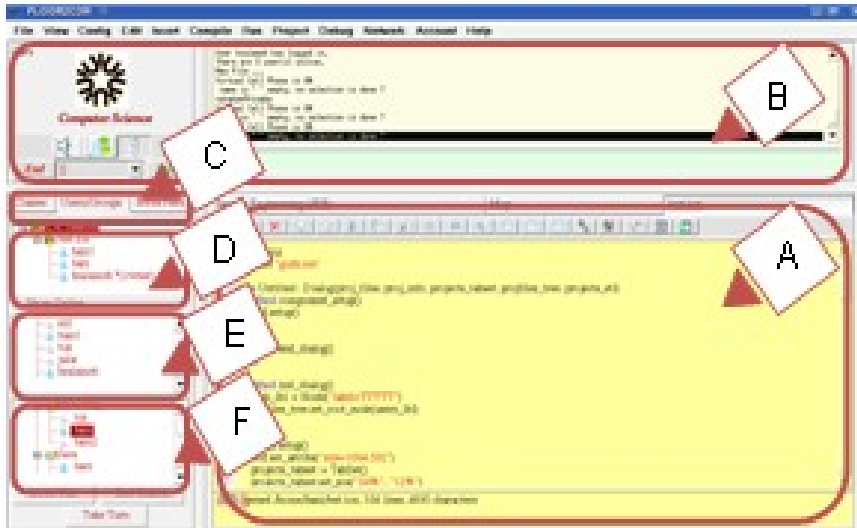 Figure 2: The SCI environment UI, showcasing the integration of session trees, user trees, and the shared development space.
Experiments & Comparison: How Does it Stack Up?
While SCI is an early-stage research prototype, the authors contrast it with industry-leading efforts like IBM Jazz and Microsoft CollabVS.
- Pre-emptive Conflict Resolution: Unlike traditional version control which only reports conflicts at the "commit" stage, SCI’s "Artifact Awareness" allows developers to see conflicts while they are happening.
- Uncommitted Change Visibility: SCI goes beyond its peers by highlighting uncommitted code changes in the text editor margin, potentially preventing hours of wasted work.
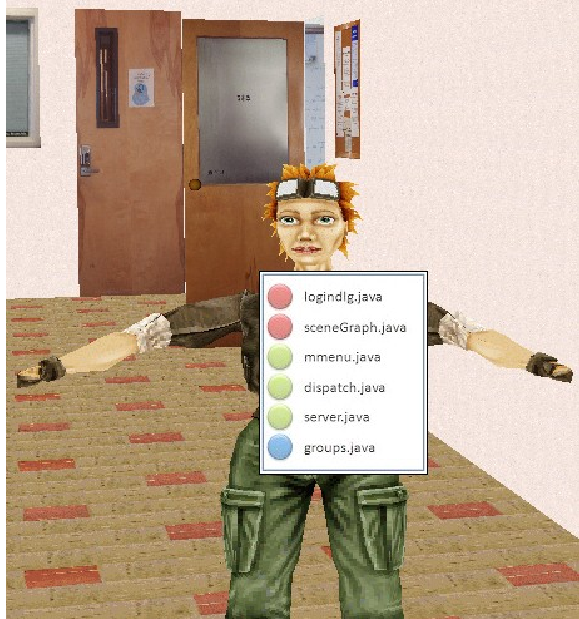 Figure 3: Visual representation of file awareness—red indicates files currently being modified, green for recently accessed, and blue for new additions.
Critical Insight & Future Outlook
The genius of SCI isn't just in making "Facebook for Developers," but in recognizing that code is a social artifact. By embedding the social context directly into the workspace, SCI reduces the "friction of interaction."
Limitations
- Visual Complexity: A 3D environment might be overkill for standard development tasks and could be distracting for some users.
- Privacy Concerns: Real-time tracking of uncommitted changes and "hovering over avatars" to see file history might feel intrusive to some developers.
Conclusion
SCI represents a bold step towards a "Social IDE." As remote work becomes the standard, the core principles of SCI—automated activity feeds, cross-tool integration, and high-fidelity presence—are likely to become standard features in our daily dev tools.
Takeaway: The future of productivity isn't just better compilers; it's better communication through tool-level awareness.