
SciChallenge: Reimagining STEM Engagement Through the Social Media Lens
SciChallenge: A Social Media Aware Platform for Contest-Based STEM Education and Motivation of Young Students
SciChallenge is a pan-European STEM education platform and contest designed to boost interest among pre-university students (ages 10-20) through a social media-integrated framework. The platform enables students to create and share User-Generated Content (UGC), leveraging a unique dual-evaluation system that combines social media metrics (engagement) with expert jury ratings.
TL;DR
SciChallenge is a H2020 EU-funded initiative that tackles the declining interest in STEM by meeting students where they live: on social media. By combining a contest-based framework with a custom web platform, it transforms students from passive learners into active content creators (prosumers). The study proves that social media integration doesn't just spread awareness—it fundamentally shifts motivation, especially for young female students.
Background: The STEM Supply Chain Crisis
Europe faces a paradoxical challenge: while R&D jobs are projected to grow by 12%, the supply of STEM graduates is actually declining (from 32% in 2006 to 29% in 2011). The authors identify a "pedagogical gap"—traditional schooling fails to leverage the lifestyle of Gen Z and Alpha, who are defined by digital interaction. SciChallenge was conceived to bridge this gap by treating science not just as a classroom subject, but as viral social content.
The "Social-Aware" Methodology
The platform's architecture is built on three pillars: Social Media, User-Generated Content (UGC), and Competition.
1. The Prosumer Workflow
Unlike old-school science fairs, SciChallenge requires students to:
- Research a topic using "Topic Sheets" (catalysts for reasoning).
- Create a Video, Poster, or Presentation.
- Upload to YouTube or SlideShare.
- Submit the link to the SciChallenge Hub for community and expert evaluation.
2. The Ranking Algorithm
The project introduces a weighted scoring system to balance "popularity" with "quality": Where is views, is likes, and (weighted at 3) ensures that a "like"—an active endorsement—carries more significance than a passive view.
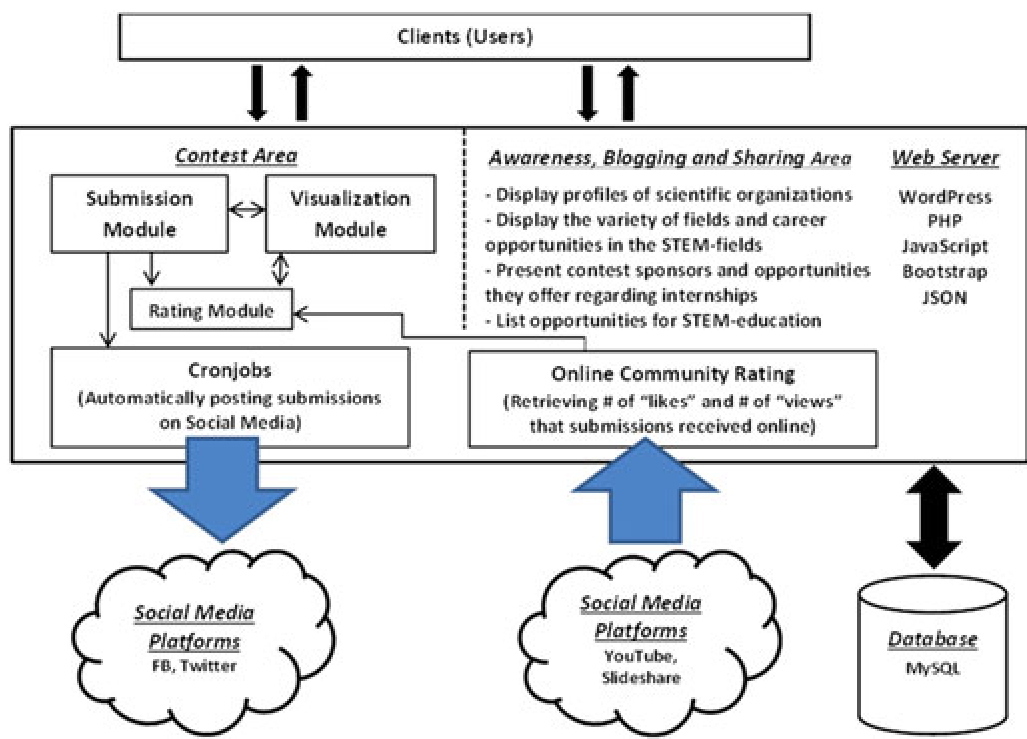 Figure 1: The architecture highlights the integration between the Contest Area and Social Media channels via APIs and Cronjobs.
Experimental Insights: Who Benefits Most?
The authors conducted an extensive evaluation using the User Experience Questionnaire (UEQ) and ANOVA analysis on 745 participants.
Key Findings:
- Gender Parity: The platform successfully attracted 419 females and 321 males, a significant feat in a field historically dominated by males.
- The Age Factor (RQ1): Interest in STEM was high across all groups, with participants finding the platform "Interesting" and "Attractive."
- The Gender/Age Interaction (RQ2 & RQ3): In the 10-14 age group (AG1), gender was a statistically significant factor () in determining motivation. Female participants in this early stage showed higher excitement levels, suggesting that early intervention is the most effective way to shatter gender stereotypes before they solidify in later adolescence.
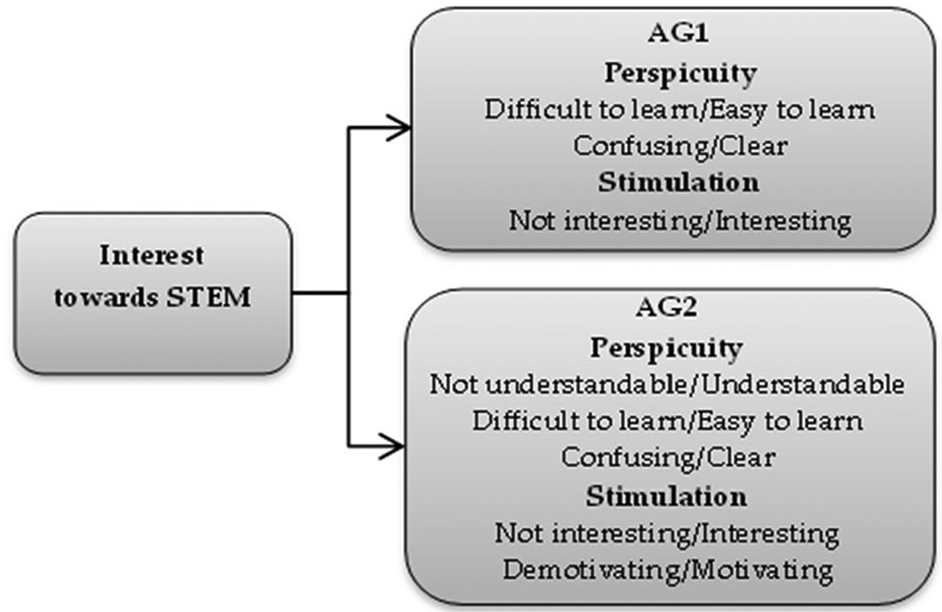 Figure 2: The classification of STEM interest factors based on UEQ metrics: Perspicuity and Stimulation.
Deep Insight: Beyond "Likes"
The true value of SciChallenge lies in its Social Awareness Sharing mechanism. By using Cronjobs to automatically post updates to Facebook and Twitter, the platform creates a self-sustaining loop of peer-to-peer inspiration. When a student sees a friend's project on their feed, the "social proof" lowers the barrier to entry for their own participation.
Critical Analysis & Conclusion
Takeaways:
- UGC is a Powerful Teacher: The process of explaining a scientific concept in a YouTube video forces deeper cognitive processing than traditional memorization.
- Social Metrics as Motivation: While some might argue "likes" are superficial, this data shows they function as a vital form of social validation that sustains long-term interest.
Limitations & Future Work:
The study noted that older students (15-20) already had established views on STEM, making the platform's impact less "transformative" compared to the younger group. Future iterations could integrate Artificial Intelligence (e.g., IBM Watson as mentioned in the related work) to provide real-time feedback during the content creation process.
Final Thought: SciChallenge proves that science doesn't need to be "rebranded"—it needs to be "re-platformed." By turning the STEM contest into a social experience, we can secure the next generation of European innovators.
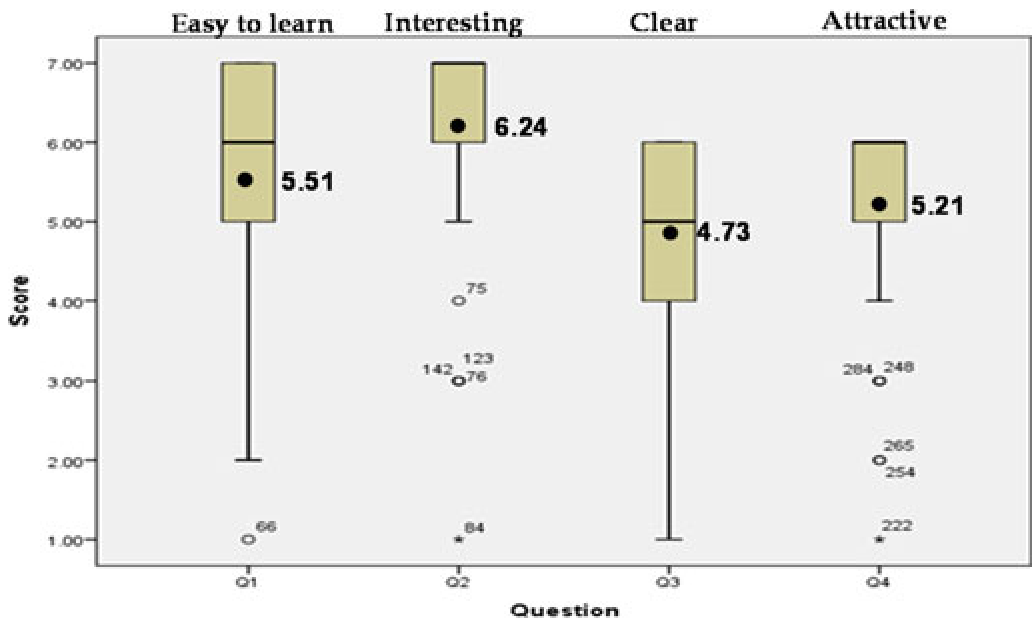 Figure 3: Boxplots demonstrating high user satisfaction and "Interesting" scores for the platform.