
Toward a Mechanics of Intelligence: The Emergence of Deep Learning Physics
There Will Be a Scientific Theory of Deep Learning
This paper presents a manifesto for "Learning Mechanics," an emerging scientific theory of deep learning that characterizes training dynamics, representations, and performance through first-principles calculations. It synthesizes diverse research strands—including solvable models, infinite limits, and empirical laws—to argue that neural networks are transitioning from black-box engineering to an explainable physical science.
TL;DR
Is deep learning destined to remain an "alchemy" of trial and error? This definitive paper argues that a Scientific Theory of Deep Learning is already emerging. By reframing the training process as a "Mechanics of Learning," the authors demonstrate how we can predict a model's behavior, optimize its hyperparameters without tuning, and understand its internal circuitry through the same first-principles approach we use in physics.
The Scientific Tension: Beyond Statistical Bounds
For decades, classical learning theory has tried to bound neural networks using statistical tools designed for simple, parsimonious models. But deep learning defies these bounds: it is overparameterized, highly non-convex, and yet generalizes beautifully.
The authors argue we are currently in a "steam engine" moment. Just as the invention of the steam engine necessitated the creation of thermodynamics, the success of LLMs is forcing the birth of Learning Mechanics. This isn't just about proving theorems; it's about finding the "equations of motion" for how a model learns.
The Five Pillars of Learning Mechanics
The paper synthesizes five critical strands of research that form the bedrock of this new science:
1. Solvable Idealized Settings
By stripping away complexity, researchers have found "hydrogen atoms" for deep learning. Deep Linear Networks, for instance, exhibit the same "greedy" learning stages as LLMs but allow for exact mathematical solutions.
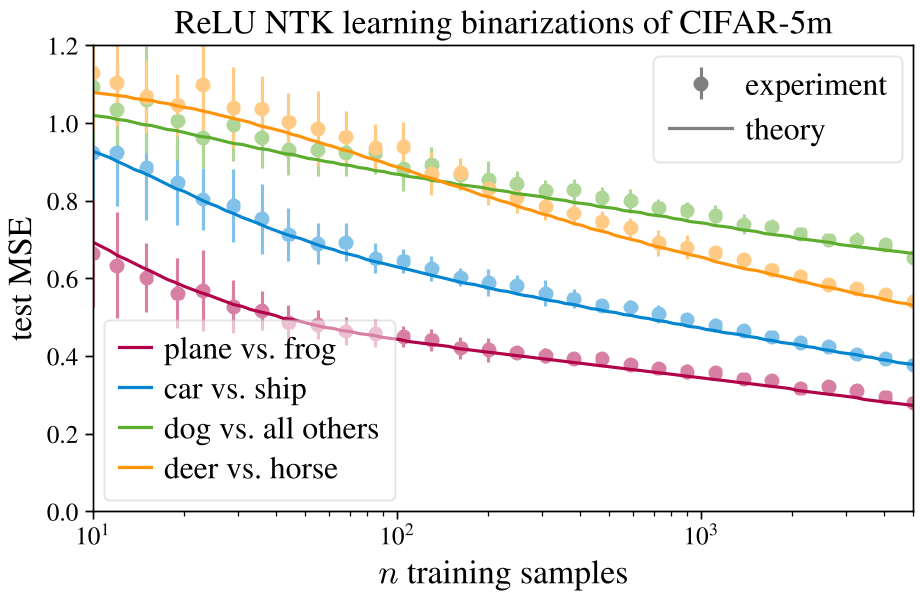
2. The Power of Infinite Limits
Why study a network with 100 billion parameters? Because at , the complexity often simplifies. The authors detail the Lazy vs. Rich dichotomy:
- Lazy (NTK) Regime: The weights barely move, and the network behaves like a simple linear kernel.
- Rich (Feature Learning) Regime: The internal representations "evolve" to match the data structure. Most modern SOTA models live in this rich regime.
3. Macroscopic Laws (Scaling Laws)
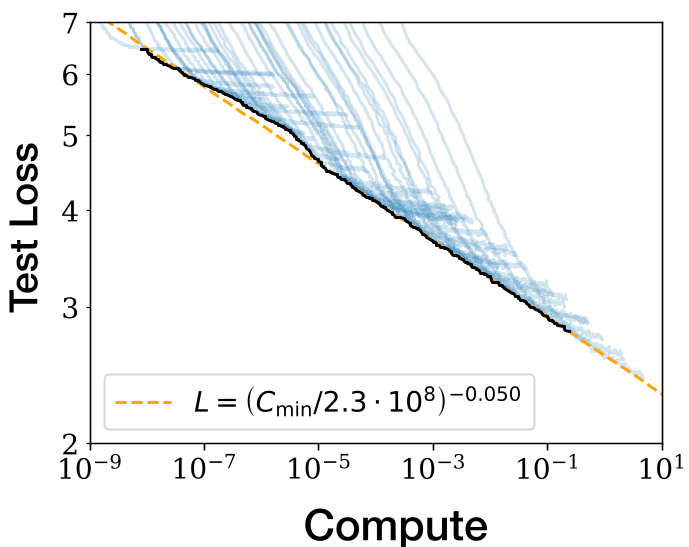
Perhaps the most famous success of this field is the Neural Scaling Law. The test loss of a model is a predictable power-law function of compute, data, and parameters. We can now predict the performance of a model using a proxy.
4. Hyperparameter Disentanglement
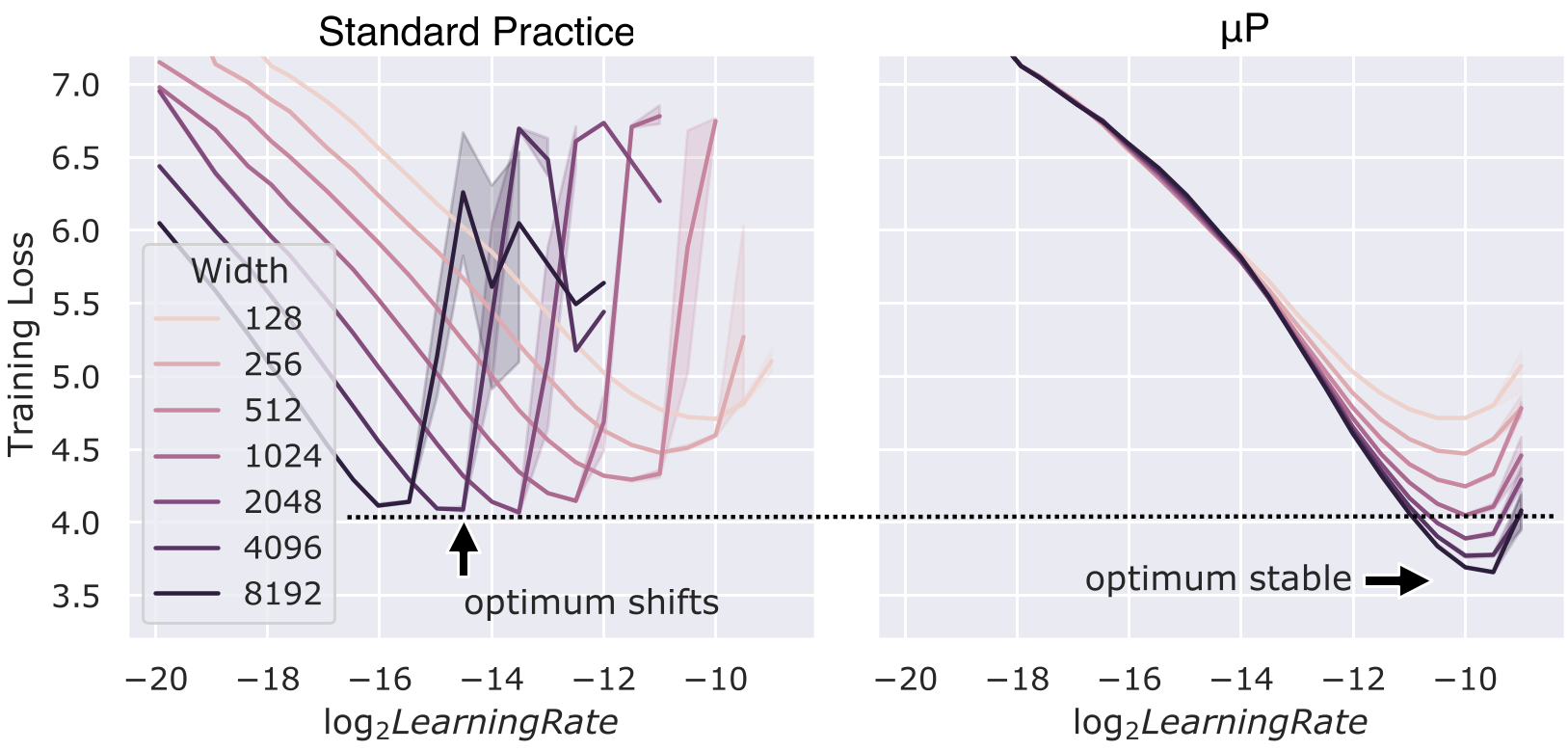
Through Maximal Update Parameterization (µP), we have learned how to scale learning rates. Previously, if you increased a model's width, the optimal learning rate would shift unpredictably. With µP, the optimal learning rate remains constant across scales.
5. Universal Phenomena
The "Platonic Representation Hypothesis" suggests that as models get larger and better, they converge toward the same internal "map" of the world, regardless of architecture (CNN vs. Transformer).
The Symbiosis: Physics vs. Biology
The paper makes a beautiful analogy: Mechanistic Interpretability (reverse-engineering specific circuits) is like Biology, while Learning Mechanics (predicting aggregate dynamics) is like Physics. You need the physics of molecules to understand the biology of a cell. Similarly, we need Learning Mechanics to provide the "Noether's Theorems" and "Conservation Laws" that explain why specific circuits form in the first place.
Critical Insight: The Discretization Hypothesis
A core takeaway for the veteran theorist is the Discretization Hypothesis: the idea that our finite, discrete-step neural networks are just approximations of smooth, infinite-width continuous dynamical systems. This shift in perspective allows us to view "training noise" and "finite width" not as bugs, but as measurable discretization errors that can be accounted for.
Conclusion: A Call to Arms
The authors conclude with ten open questions (e.g., "Can we predict scaling exponents a priori?") and an invitation to young researchers. The message is clear: Deep learning is no longer just an engineering hack—it is a frontier of natural science.
Takeaway for Practitioners: Stop treating hyperparameters as magic numbers. Start looking at alignment, spectral bias, and symmetry conservation. The theory is finally becoming useful.