
Toward Learning Mechanics: Decoding the Emerging Physics of Deep Learning
There Will Be a Scientific Theory of Deep Learning
This paper posits that a formal "Learning Mechanics" is emerging to provide a first-principles scientific theory of deep learning. It synthesizes diverse research into a unified framework focused on the dynamics of training, aggregate statistics, and falsifiable quantitative predictions.
TL;DR
Deep learning theory is undergoing a paradigm shift from a branch of mathematics obsessed with worst-case bounds to a true physical science. In this seminal paper, Simon and Kunin argue that we are witnessing the birth of "Learning Mechanics"—a framework that treats the training of neural networks as a dynamical system governed by first principles. By synthesizing scaling laws, infinite-width limits, and representational universality, the authors provide a roadmap for moving from "AI Alchemy" to "AI Engineering."
The Scientific Tension: Complexity vs. Lawfulness
Despite the immense complexity of modern LLMs, they exhibit surprisingly lawful behavior. We see test loss predictable over orders of magnitude (Scaling Laws) and internal features that look remarkably similar across different architectures (Platonic Representations).
The authors argue that the "inscrutability" of deep learning is a phase of scientific development, much like thermodynamics before the steam engine was fully understood. The central challenge isn't that deep learning is a "black box"—unlike a cell, we know every equation of motion—it's that the high-dimensional interactions are too complex for microscopic tracking. Learning Mechanics solves this by looking at coarse aggregate statistics.
The Five Pillars of Learning Mechanics
The paper maps out Five Strands of evidence that a unified theory is already being built:
1. Solvable Idealized Settings
By stripping networks of non-linearities, researchers use Deep Linear Networks to understand how models learn features sequentially. This "greedy low-rank bias" mirrors how complex models learn simple features before hard ones.
2. The Power of Limits (The Discretization Hypothesis)
Just as the ideal gas law describes trillions of molecules via simple variables, the Infinite Width Limit simplifies neural dynamics into "Mean-Field" behaviors.
- Lazy Regime: The network behaves like a linear kernel (no feature learning).
- Rich Regime: The network actively adapts its features to the data (closer to real-world performance).
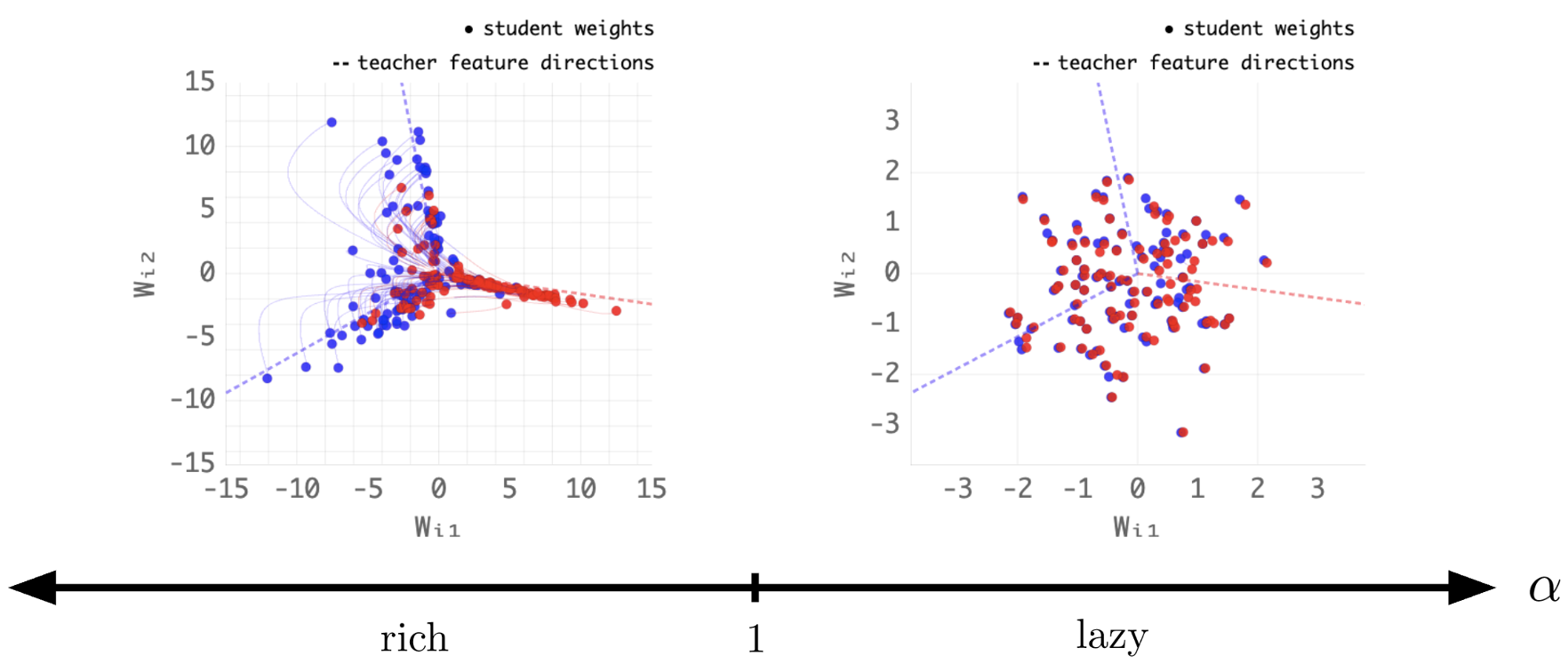 Figure 1: Smaller network output multipliers lead to "Rich" feature-learning dynamics, while larger ones induce "Lazy" behavior.
3. Macroscopic Laws
The most famous example is Neural Scaling Laws. We can predict the performance of a model with billions of parameters by training one with millions. The paper also highlights the Edge of Stability, where the "sharpness" of the loss landscape automatically stabilizes at a value determined by the learning rate ().
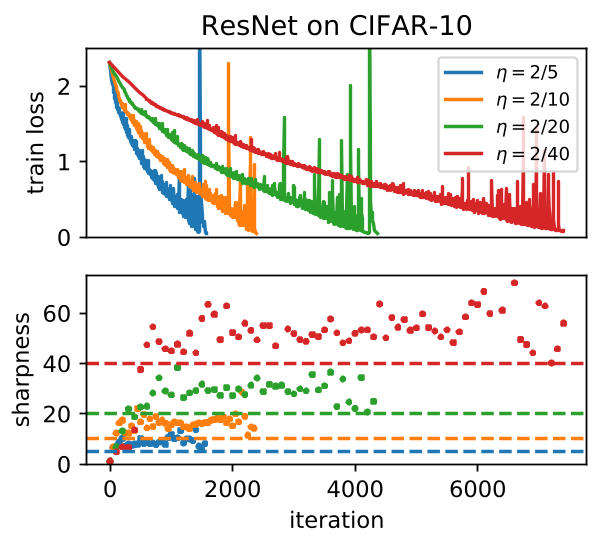 Figure 2: Across different architectures, the sharpness rises until it hits the theoretical threshold of 2/η, demonstrating a universal dynamic in optimization.
4. Disentangling Hyperparameters
Work on P (Maximal Update Parameterization) shows that we can decouple the optimal learning rate from the model's width. This allows practitioners to tune hyperparameters on a cheap, small model and "zero-shot transfer" them to a massive production model.
5. Universal Phenomena
Whether you use a CNN or a Transformer, models often converge toward similar input-output mappings and internal "Platonic" representations. This suggests that the structure of the data itself is the primary driver of the resulting model, not just the architecture.
A Symbiosis with Interpretability
The authors propose a beautiful analogy: If Mechanistic Interpretability is the biology of deep learning (identifying specific circuits and neurons), then Learning Mechanics is its physics (explaining the forces and energies that create those circuits).
The Path Ahead: 10 Open Questions
The paper concludes with a call to arms for the next generation of researchers. Key challenges include:
- Predicting Scaling Exponents: Can we calculate the "power law" before we ever start training?
- Defining Features: Moving from "I know it when I see it" to a rigorous mathematical definition of a "feature."
- The Theory of Data: Developing a formal language to describe the complexity of natural datasets like text or images.
Critical Insight
The most profound takeaway is the Discretization Hypothesis: the idea that our finite, discrete models are just approximations of a continuous, "infinite" mathematical ideal. If true, the engineering of AI is simply the task of minimizing "discretization error" within compute budgets.
By framing the study of deep learning as a mechanics, this work provides a unifying language for physicists, mathematicians, and engineers to finally dismantle the black box.