
There Will Be a Scientific Theory of Deep Learning: The Rise of Learning Mechanics
There Will Be a Scientific Theory of Deep Learning
This paper posits that a rigorous scientific theory of deep learning is emerging, framed as "Learning Mechanics." It synthesizes five major research pillars—solvable models, infinite limits, empirical laws, hyperparameter disentanglement, and universal phenomena—to argue that neural network behavior can be predicted from first principles similar to physical systems.
TL;DR
For years, deep learning has been the "black box" of the tech world—unprecedented in power but inscrutable in logic. A new position paper by researchers from UC Berkeley, Harvard, and MIT argues we are at a turning point: a unified "Learning Mechanics" is emerging. By treating neural networks like physical systems governed by "forces" (gradients) and "limiting behaviors" (infinite width/depth), we are finally moving from alchemy to a predictive science of intelligence.
Background: Beyond the Statistical Perspective
Historically, machine learning theory focused on expressivity (what can it represent?) and generalization (will it work on new data?). However, as models scaled to billions of parameters, these classical bounds became vacuous. The authors argue that we need a shift in perspective—from the biology-like "reverse engineering" of Mechanistic Interpretability to a physics-like "first-principles" study of Learning Mechanics.
The Five Pillars of Learning Mechanics
The authors identify five strands of evidence that a robust theory is already being built:
1. Solvable Idealized Settings
Much like physics uses the "harmonic oscillator" to understand complex vibrations, deep learning uses Deep Linear Networks and Kernel Methods. These models simplify the math while retaining core behaviors like the "greedy low-rank bias," where models learn simple patterns before complex noise.
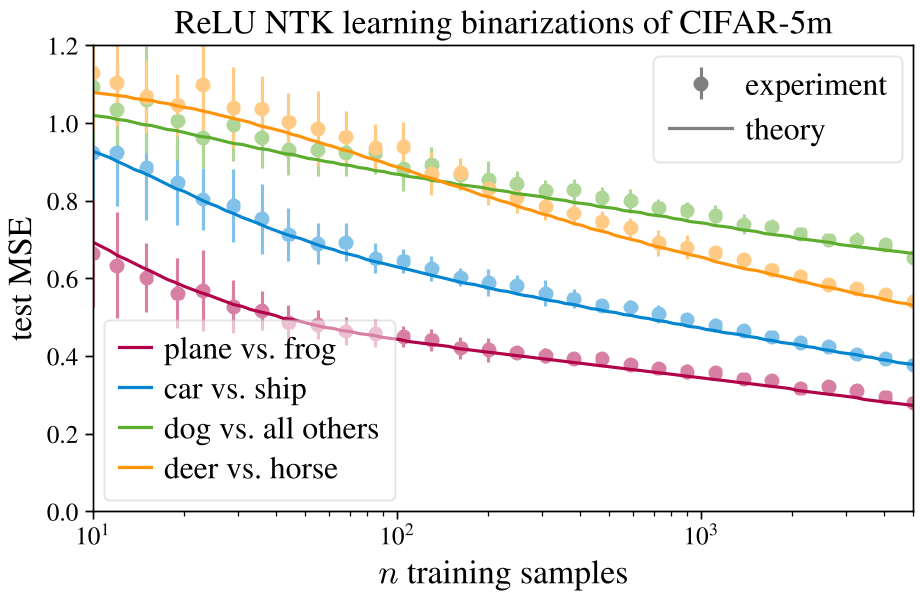 Figure 1: Comparison of learning dynamics in linearized vs. rich regimes.
2. The Power of Infinite Limits (The Discretization Hypothesis)
Large models simplify when treated as "effectively infinite." The paper highlights the Lazy vs. Rich dichotomy:
- Lazy Regime (NTK): The network behaves like a fixed linear model; features don't change.
- Rich Regime (Feature Learning): The internal representations evolve to fit the data. The authors propose the Discretization Hypothesis: Finite networks are just "noisy approximations" of these clean, infinite-sized mathematical objects.
3. Macro Laws: Neural Scaling Laws
Perhaps the most striking evidence is the Power Law. Test loss is a predictable function of compute, data, and parameters. Even if we don't fully understand the "microscopic" reasons yet, the "macroscopic" law is as reliable as thermodynamics.
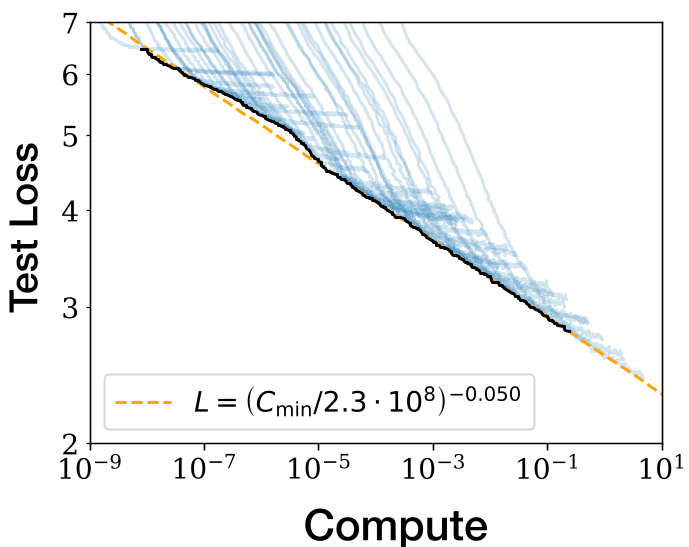 Figure 2: Test loss follows predictable power laws across orders of magnitude in scale.
4. Hyperparameter Disentanglement (µTransfer)
The "black magic" of tuning learning rates is being solved by Maximal Update Parameterization (µP). Theory now allows us to tune a tiny model and "transfer" those optimal settings to a massive model (like GPT-4) with zero additional tuning—a massive win for engineering efficiency.
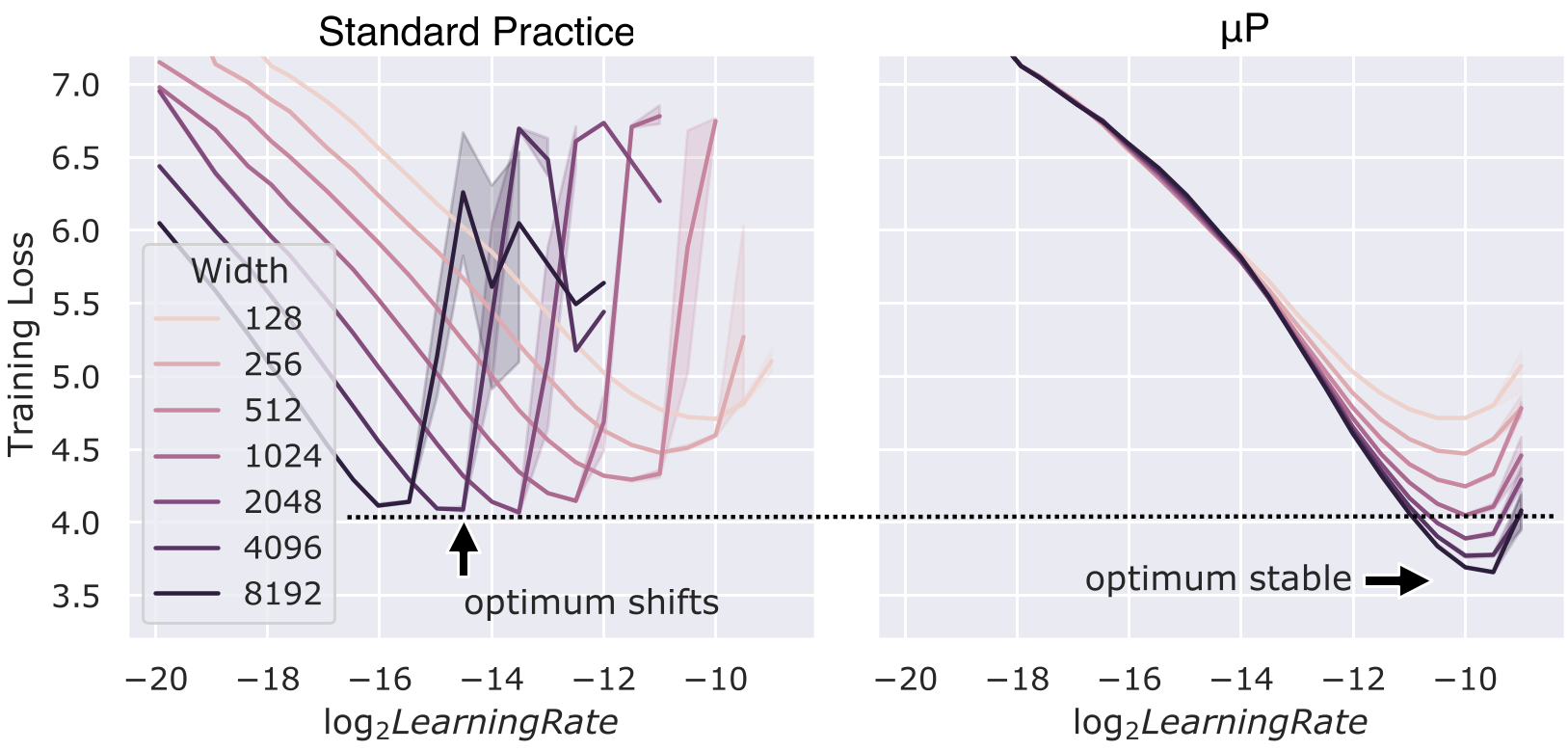 Figure 3: Under µP, the optimal learning rate remains stable across vastly different model widths.
5. Universal Phenomena
Whether it's a Vision Transformer or a CNN, models tend to converge to similar "Platonic" internal representations. This Universality suggests that the theory isn't just about specific code scripts—it's about the fundamental structure of information itself.
Critical Insight: Mechanics vs. Biology
The paper makes a beautiful analogy: If Mechanistic Interpretability is the biology of deep learning (dissecting circuits and neurons), then Learning Mechanics is its physics (describing the fundamental laws of motion that created those circuits).
Future Outlook: Zero Hyperparameters?
The authors propose ten open challenges, including:
- Predicting scaling exponents a priori: Why is the power law constant what it is?
- Eliminating all hyperparameters: Moving toward models that "self-organize" perfectly.
- Genuinely nonlinear solvable models: Breaking past the limitations of linear analogies.
Conclusion
The message is clear: the era of "guessing and checking" is ending. We are entering a phase where AI development will look less like a kitchen experiment and more like rocket science—highly calculated, predictable, and grounded in the "Mechanics of Learning."
For those interested in joining the movement, the authors have launched learningmechanics.pub to track these open questions and collaborate on the "physics" of AI.