
SCMiner: Unmasking Ghostly Concurrency Faults with System-Level PCA
SCMiner: Localizing System-Level Concurrency Faults from Large System Call Traces
SCMiner is an automated fault localization tool designed to identify system-level (inter-process) concurrency faults using system call traces. It leverages Principal Component Analysis (PCA) for unsupervised anomaly detection and maps identified abnormal sequences to specific application functions through offline function signatures, achieving high precision in real-world Linux scenarios.
TL;DR
Locating concurrency bugs in a production environment is like finding a needle in a haystack—while the haystack is actively burning. SCMiner is a breakthrough tool that localizes these "ghostly" inter-process bugs by analyzing standard Linux system call traces. By using Principal Component Analysis (PCA) to spot anomalies and Frequent Pattern Mining to map them to functions, it eliminates the need for bug reproduction or heavy production instrumentation.
The Problem: Why Thread-Level Tools Fail in the Real World
Most developers are familiar with thread-level race conditions—two threads fighting over the same memory address. However, system-level concurrency faults (inter-process) are far more insidious. These occur when separate processes or signal handlers incorrectly share persistent resources like files or devices.
Existing solutions like Falcon or CCI suffer from three fatal flaws:
- Reproduction Dependency: They often require multiple failed runs, which are notoriously hard to capture.
- Overhead: Fine-grained memory monitoring kills performance in production.
- Scope: They focus on volatile memory (intra-process) rather than system-wide resource corruption.
Methodology: The SCMiner Insight
The core philosophy of SCMiner is that failure is rare and "different." If a system behaves normally 99% of the time, the buggy execution path will stand out as a statistical outlier.
Phase 1: PCA-Based Anomaly Detection
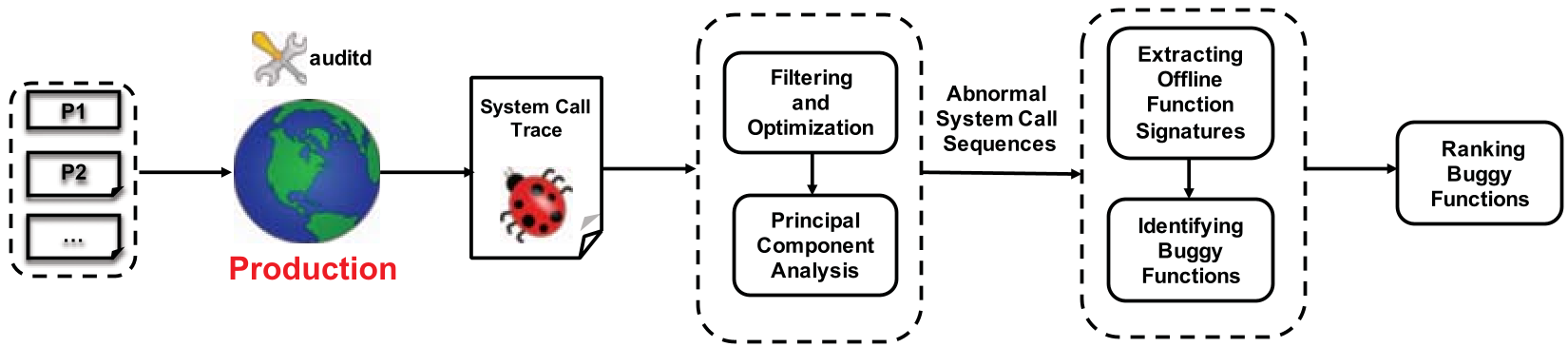
SCMiner transforms raw auditd logs into a feature matrix.
- Segmentation: The trace is split into segments based on
execvcalls (representing logical execution units). - Vectorization: Each segment becomes a vector where features are short system call sequences (e.g.,
open -> write -> close). - Finding the Outlier: By applying PCA, SCMiner identifies a "normal subspace." Any segment with a high distance from this subspace is flagged as an anomaly.
Phase 2: Function Signature Mapping
Once an abnormal system call sequence is found (e.g., Process A writes while Process B hasn't finished its read), how do we find the code responsible? Since production code lacks debug symbols or source access, SCMiner uses Offline Function Signatures. It runs the application in a controlled environment to build a map of which functions typically produce which system call patterns.
Experiments & Real-World Impact
The researchers tested SCMiner on 19 heavyweight applications, including the Linux kernel's Coreutils, Bash, and Apache.
Case Study: The Bash History Bug (Debian-283702)
In this bug, multiple shells writing to the same history file would overwrite each other. SCMiner effectively identified the sequence <open, write, write> from competing PIDs and mapped the fault directly to the history_do_write() function in the Bash source.
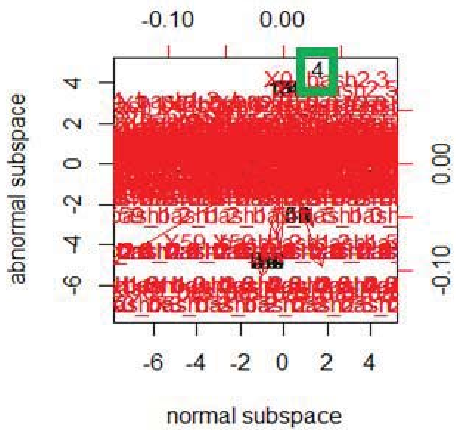 Figure: The PCA biplot shows the 'outlier' segment (Segment 4) clearly separated from the cluster of normal executions.
Key Results:
- Precision: Averaged 93%, meaning almost every flagged sequence was relevant to the bug.
- Efficiency: Post-processing takes only seconds for most apps, and production overhead is negligible (0.31x on average).
- Scalability: The tool successfully handled traces with millions of system calls, narrowing the search space down to roughly 0.02% of the original data.
Critical Analysis & Conclusion
SCMiner provides a highly practical alternative to deterministic replay. Its strength lies in its passive nature—it listens to what the OS is already reporting.
Limitations:
- It relies on the presence of "normal" data to establish a baseline. If your "normal" run is already noisy or inconsistent, PCA might struggle.
- The quality of the "Function Signatures" depends on how well your offline test suite covers the application's logic.
Future Outlook: In the era of microservices and container orchestration, inter-process communication is the new bottleneck. SCMiner’s approach to using system call patterns as a "forensic fingerprint" is a major step toward automated, production-safe debugging.
Final Takeaway: SCMiner proves that unsupervised statistical models aren't just for data science—they are powerful weapons in a systems programmer's arsenal.