
Automated Descriptive Grading: Beyond Keyword Matching in Technical Education
A Score Recommendation System Towards Automating Assessment In Professional Courses
This paper presents an automated scoring recommendation system for descriptive answers in professional courses using a multi-algorithmic NLP approach combined with Logistic Regression. By leveraging five distinct similarity metrics—Wu-Palmer, LCS, LSA, Cosine Similarity, and PMI-IR—the system maps student responses to model answer-keys to provide score suggestions without requiring subject-specific corpora.
TL;DR
Evaluating comprehensive, descriptive answers—those ranging from 500 to 1000 words—remains a bottleneck in online education. This paper proposes a score recommendation system that moves beyond simple string matching by ensemble-learning five distinct NLP similarity metrics. Tested on over 35,000 engineering exam records, the system provides a robust framework for automating assessment in "professional" courses where language is direct and objective.
Context & Positioning
In the landscape of Automated Short Answer Scoring (ASAS), most solutions are optimized for one-sentence responses. This work positions itself as a bridge between simple ASAS and complex essay grading. It focuses on Professional Courses (Applied Sciences/Engineering), capitalizing on the lack of metaphorical or subjective language to apply rigorous linguistic similarity measures.
The Core Motivation: Why Existing Metrics Fail Alone
The authors argue that no single metric can capture the multifaceted nature of a student's answer:
- Lexical Metrics (LCS) catch verbatim copying but miss synonyms.
- Knowledge-Based Metrics (Wu & Palmer) understand word relationships but ignore sentence structure.
- Statistical Metrics (LSA/Cosine) capture the "vibe" but might miss specific technical keywords.
Their insight was to treat these metrics not as competitors, but as features in a machine learning classifier.
Methodology: The Ensemble Architecture
The system follows a pipeline: Pre-processing (Lemmatization, Stop-word removal) → Feature Extraction (5 Baselines) → Classification (Logistic Regression).
The Five Pillars of Similarity:
- Wu and Palmer: Uses WordNet-style hierarchies to score noun similarity.
- LCS (Longest Common Substring): Measures consecutive word overlaps.
- LSA (Latent Semantic Analysis): Uses SVD to find hidden thematic structures.
- Cosine Similarity: Measures the angle between one-hot encoded vectors.
- PMI-IR: Uses statistical co-occurrence to determine word relatedness.
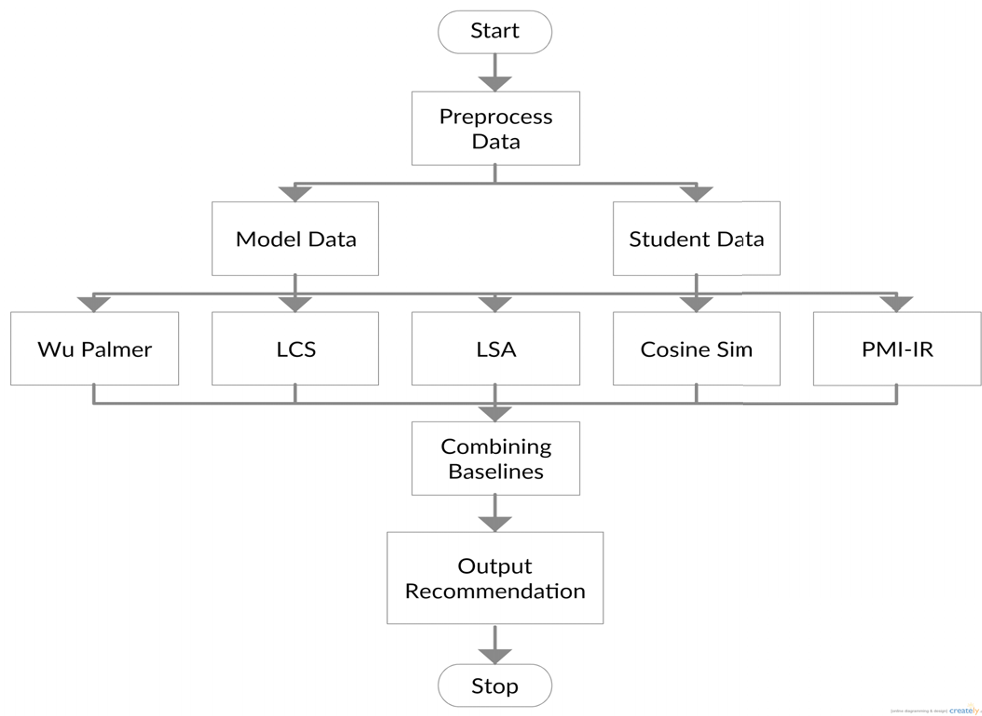 Fig 1: The high-level workflow from student input to the final recommended score.
Experimental Insights
The research utilized a massive dataset of 35,240 records from engineering courses.
Key Performance Data:
| Metric | Accuracy (Exact Match) |
|---|---|
| LCS (Baseline) | 44.08% |
| Wu and Palmer (Baseline) | 34.65% |
| Logistic Regression (Ensemble) | 54.29% (Avg) |
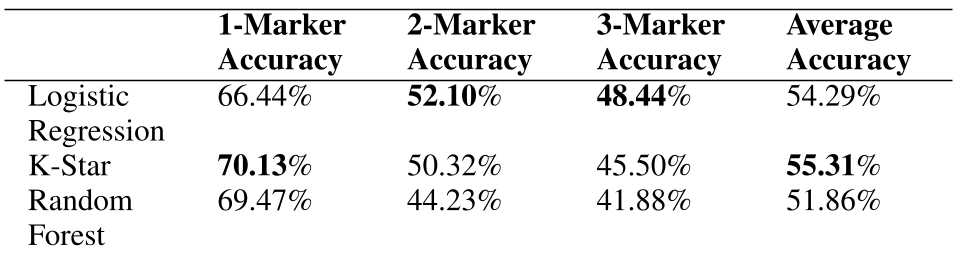 Fig 2: Comparison of different machine learning heads. While K-Star performed slightly better in accuracy, Logistic Regression remained a more interpretable choice for score recommendation.
One critical finding was the 1-Marker Accuracy (66.44%). The system is significantly more effective at grading short, factual points than complex 3-mark descriptive syntheses, where academic nuance is higher.
Critical Analysis & Future Directions
While the system is a strong step toward automation, the authors identify a "Semantic Trap": the Negation Problem. A student writing "The system is stable" and "The system is not stable" would receive a high similarity score because the word overlap is nearly identical.
Limitations:
- Dataset Bias: The system was trained on a dataset where teachers primarily gave full marks or zeros, leading to a "U-shaped" bias in recommendations.
- Subjectivity: The "ground truth" (human graders) is inherently subjective, injecting noise into the training labels.
Future Outlook: The inclusion of Sentiment Polarity to detect "not" or "never" and the use of subject-specific corpora (Inverse Document Frequency) could significantly sharpen the system's precision.
Conclusion
This work demonstrates that for professional, objective-led courses, we don't need "Magic AI" to start automating grading. Regulated, multi-factor NLP similarity combined with standard regressors provides a transparent and "good enough" recommendation engine to assist human educators.