
Job2Questions: Revolutionizing Recruitment through AI-Driven Screening
Learning to Ask Screening estions for Job Postings
The paper introduces Job2Questions, a two-stage deep learning framework for the novel task of Screening Question Generation (SQG). Deployed at LinkedIn, it automatically transforms job posting text into structured (template, parameter) screening questions, significantly outperforming rule-based and standard QG baselines in a large-scale hiring marketplace.
TL;DR
LinkedIn researchers have addressed recruitment bottlenecks by introducing Job2Questions, a system that automatically generates structured screening questions (e.g., "How many years of Java experience?") from job descriptions. By combining deep transfer learning with efficient ranking algorithms, they achieved a massive 190% increase in recruiter-applicant interactions, proving that AI can effectively filter for "must-have" qualifications that are often missing from candidate profiles.
The "Profile Gap" Problem
Traditional job matching assumes that applicant profiles and job descriptions are perfect representations of reality. However, LinkedIn's research reveals a harsh truth:
- Profiles are stagnant: 33% of members don't list education, and 70% omit spoken languages.
- Job posts are noisy: Recruiters often include "legacy" requirements (like Internet Explorer skills) that they don't actually intend to screen for.
The Motivation for Job2Questions was to create a bridge—a way to extract the true intent of a recruiter and turn it into an actionable question the candidate must answer during the application process.
Methodology: The Two-Stage Architecture
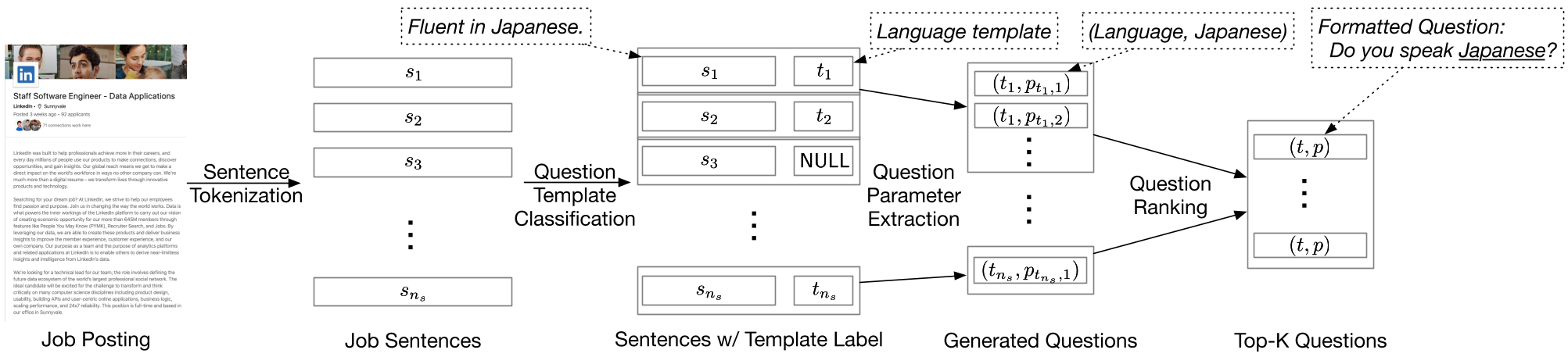
The system avoids the issues of free-form text by using Structured Questions (Template + Parameter). This ensures clarity for both human and downstream AI models.
1. Candidate Generation (Intent & Entity)
The model tokenizes job postings into sentences and processes them via:
- Question Template Classification (TC): Using a Deep Averaging Network (DAN). While BERT provides slightly higher accuracy, DAN was chosen for production due to its 9ms latency (vs. BERT's 100ms), which is critical for real-time recruiter interfaces.
- Template Parameter Extraction (PE): An entity linking system identifies skills, degrees, and languages to fill the templates.
2. Candidate Ranking
Not every requirement is a good screening question. The system uses XGBoost with pairwise ranking to sort candidates based on:
- Job Features: Industry, company, and location.
- Question Features: Template type and confidence scores.
- Interaction Features: Pointwise Mutual Information (PMI) between the job and the question context.
Experimental Validation
Offline Accuracy
The J2Q-TC-DAN model achieved an overall accuracy of 87.98%, striking the best balance between precision and inference speed. The pairwise ranking model outperformed standard Logistic Regression and rule-based systems, showing significant gains in NDCG (Normalized Discounted Cumulative Gain).

Real-World Business Impact
The deployment led to transformative results in the LinkedIn marketplace:
- Efficiency: Ranking applicants by their answers to these questions improved the "good fit" rate by 7.45%.
- Engagement: Recruiters were much more likely to communicate with candidates who met the auto-generated screening criteria.
- Satisfaction: The 11-point jump in Net Promoter Score (NPS) suggests recruiters felt a tangible reduction in their manual workload.
Deep Insights: What Recruiters Actually Want
The study provided fascinating data on industry-specific "bottleneck" qualifications:
- Technology: 91% of questions focus on Tools/Skills.
- Agriculture: High focus on Languages (4.4x more likely than other industries).
- Transportation: Focus heavily on Credentials (licenses) and Work Authorization.
Conclusion
Job2Questions demonstrates that in large-scale IR (Information Retrieval) systems, structured simplicity often beats unstructured complexity. By constraining the AI to generate questions from vetted templates, LinkedIn maintained quality and explainability while scaling to 20 million job postings. Future work points toward Sequence-to-Sequence models for more creative question generation, though the challenge remains balancing creativity with the strict requirements of a professional hiring environment.