
SCRPM: Securing the Digital Road with Privacy and Speed
SCRPM: securing crowdsourcing-based road pavement monitoring system with location privacy
This paper introduces SCRPM, a secure and lightweight protocol for crowdsourcing-based road pavement monitoring (CRPMS). It combines pseudonym-based identity management with algebraic signatures to ensure location privacy and high computational efficiency, achieving significantly faster processing than traditional bilinear map-based protocols.
TL;DR
Road Pavement Monitoring Systems (CRPMS) rely on "Probe Cars" to detect potholes and "Entering Cars" to adjust driving plans. However, current systems either sacrifice privacy (exposing real locations) or speed (using slow cryptography). SCRPM solves this by replacing real IDs with pseudonyms and swapping heavy "Bilinear Pairings" for ultra-fast Algebraic Signatures, resulting in a 10x speedup and robust location privacy.
The Conflict: Security vs. Real-Time Performance
In the world of Intelligent Transportation Systems (ITS), data is currency. But uploading your location and vehicle ID to a server creates a "Stalker’s Paradise." If a malicious actor intercepts this data, they can trace a driver's daily routine or pinpoint their exact location.
Current academic solutions to this problem usually fall into one of two traps:
- Identity Exposure: They focus on encrypting the pavement data but leave the sender's ID in plain sight.
- Computational Bloat: To secure the ID, they use complex Bilinear Maps. For a car moving at 100 km/h, waiting for a server to process a heavy pairing operation means the car might have already hit the pothole before the warning was verified.
Methodology: Lightweight Protection via Algebraic Signatures
The core innovation of SCRPM lies in its "Signcryption" mechanism. Instead of the standard Elliptic Curve pairings, the authors leverage Algebraic Signatures.
1. Pseudonym-based Identity
Instead of using a driver's license number, the system uses . This one-way transformation ensures that while the server knows who is contributing, an eavesdropper only sees a random-looking string.
2. The Shared Key Intuition
The protocol uses a clever key derivation where both the Probe Car (PC) and the Entering Car (EC) can compute a shared secret without ever sending the secret itself over the air. This is achieved through keying materials distributed by the Monitoring Server during registration.
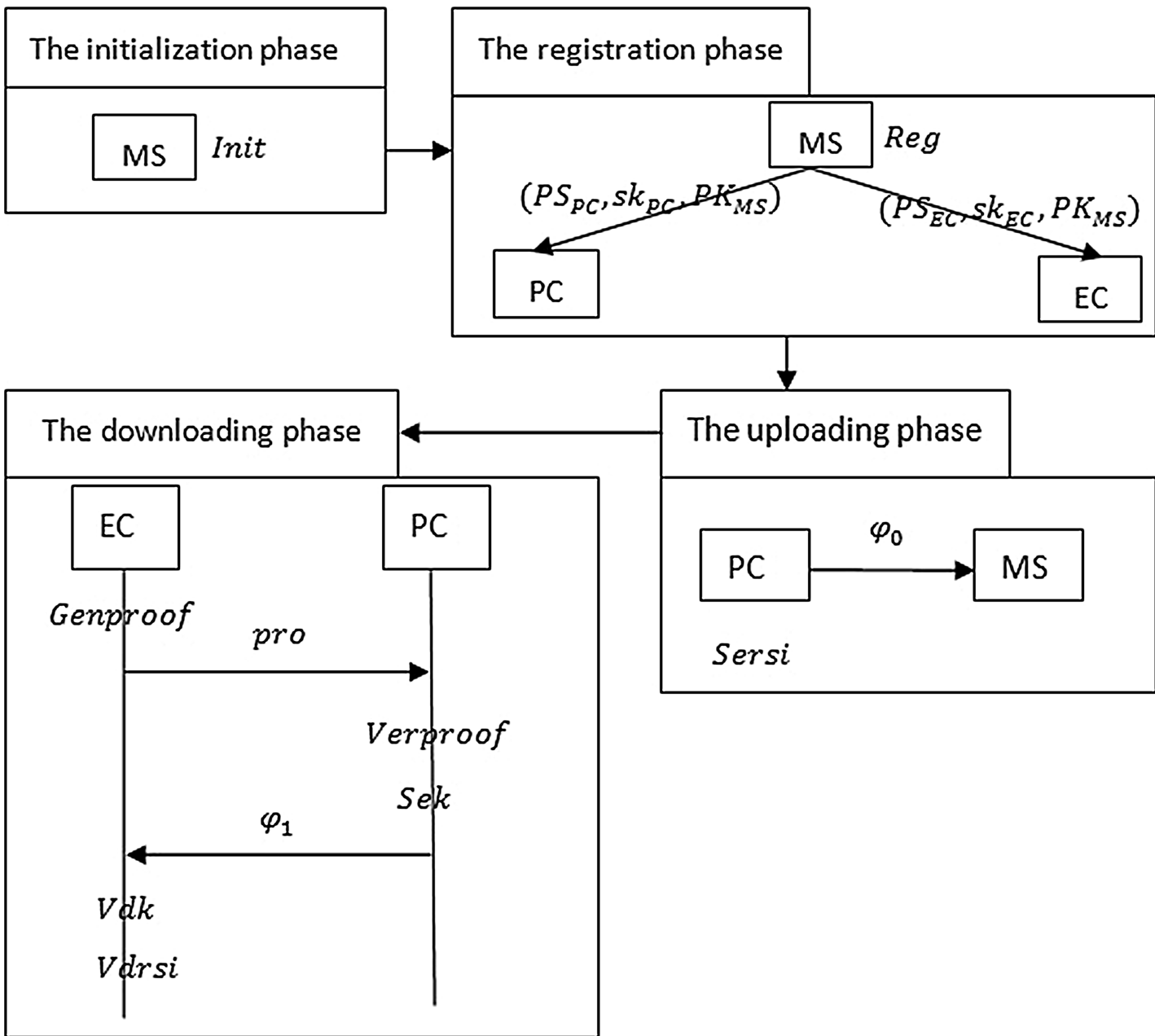
3. Efficiency Over Bilinear Maps
Traditionally, the "Cost of Security" is measured in (Time for pairing). SCRPM avoids this entirely. By using modular exponentiation and simple algebraic signing, the computation becomes negligible .
Experimental Results: Breaking the Efficiency Barrier
The authors compared SCRPM against prominent frameworks like SPOC (Secure and Privacy-preserving Opportunistic Computing).
- Computation Time: While previous methods took upwards of 118ms on the client side, SCRPM completes the same verification in 1.2ms.
- Communication Load: Protocol messages are trimmed down to 800 bits, significantly lower than the attribute-based encryption methods used in prior work.

Critical Analysis & Future Outlook
SCRPM is a masterclass in "Pragmatic Cryptography." It recognizes that in vehicular networks, a "perfectly secure" system that is too slow to run is actually "insecure" because it won't be used.
Limitations:
- Key Management: As noted by the authors, if the Monitoring Server's master key is compromised, or if keys need updating after a long period, the system requires a more robust key-revocation logic.
- Trust in Data: SCRPM secures the identity and the transmission, but it doesn't verify if the Probe Car is lying about the road condition. A future "Reputation Protocol" is needed to filter out "trash" data.
The Takeaway: For researchers in IoT and V2X (Vehicle-to-Everything), SCRPM provides a blueprint for how to build privacy-preserving systems that actually meet the millisecond-latency requirements of the real world.