
SCTA Tracer: Quantifying the Ghost in the Machine of Distributed Cooperation
SCTA Tracer: A Distributed Environment for Standardized Awareness Support Assessments
This paper introduces the Standardized Coordination Task Assessment (SCTA) and its implementation, the SCTA Tracer, a distributed tool designed to evaluate the effectiveness of awareness support in cooperative environments. It utilizes a novel "freeze probe" technique and a "4I" (Illusive, Ineffective, Inefficient, Ideal) quadrant visualization to categorize awareness systems based on user response times and error rates.
TL;DR
Evaluating "Awareness"—the intuitive understanding of what others are doing in a shared workspace—has long been a subjective hurdle in CSCW. The SCTA Tracer systematizes this by using a standardized letter-counting "stress test" combined with freeze probes to capture fleeting cognitive states. It maps the results into a 4I Quadrant System, categorizing awareness support as Illusive, Ineffective, Inefficient, or Ideal.
Background: The Ephemeral Nature of Awareness
In distributed systems, awareness is a "secondary task." No one logs on just to "be aware"; they log on to edit a document or code a feature. Awareness happens in the periphery. However, because human memory follows an exponential decay (Ebbinghaus's forgetting curve), traditional post-task interviews are often inaccurate. The SCTA Tracer addresses this by measuring awareness in situ—catching the user while the "mental snapshot" of their partner's activity is still active.
Methodology: The 4I Framework
The researchers developed the Standardized Coordination Task Assessment (SCTA-4I). The primary task is deceptively simple: teams count occurrences of letters in random strings. To do this efficiently, they must coordinate: "I'll count A-M, you count N-Z."
The Freeze Probe
At random intervals, the system halts the task and blanks the screen. It then asks participants questions like:
- "Who counted the letter C?"
- "How many Ds were there?"
- "Was your partner counting Es?"
By measuring the Response Time and Error Rate, the system places the awareness support mechanism into one of four quadrants:
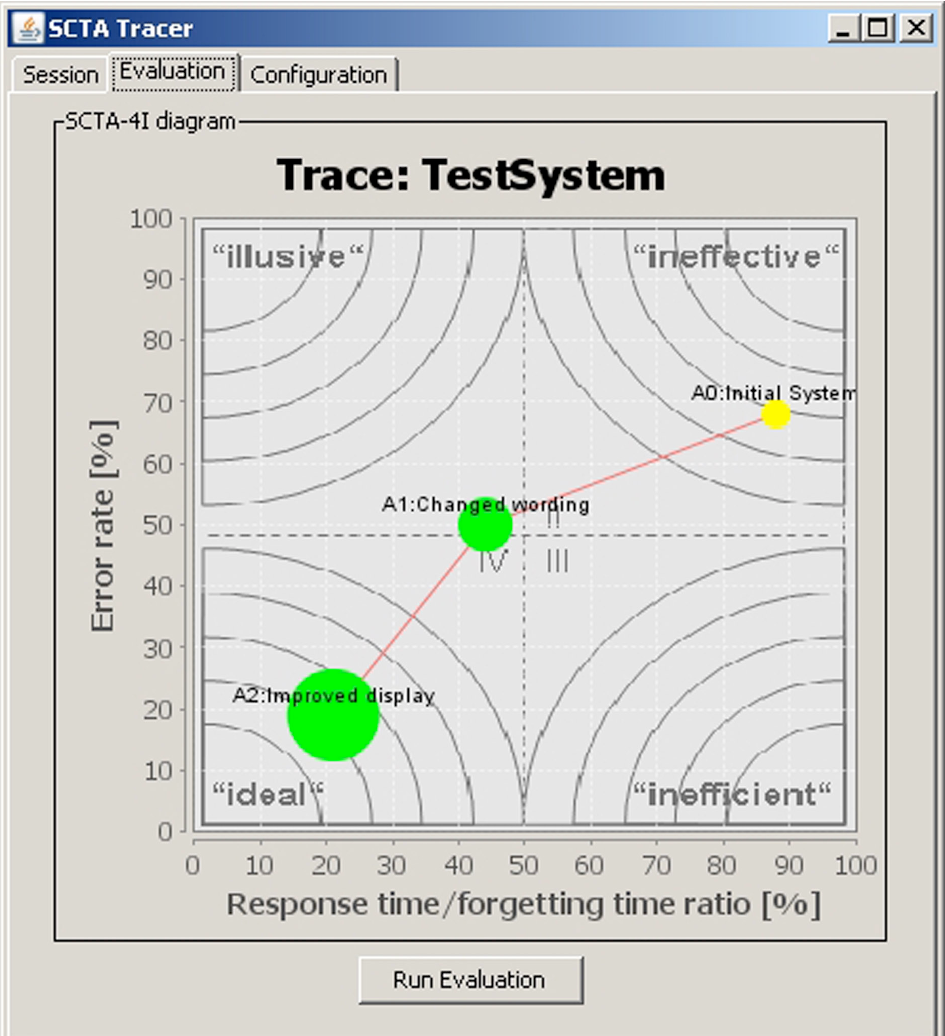
- I. Illusive: Fast but wrong. Users think they know what's happening but are mistaken.
- II. Ineffective: Slow and wrong. The worst case; the system provides no usable cues.
- III. Inefficient: Correct but slow. Users can figure out what's happening, but it requires high cognitive effort.
- IV. Ideal: Fast and correct. This is the "Gold Standard" for UI designers.
Architecture & Implementation
The SCTA Tracer is built on a Mediator Pattern using Java RMI. This allows for a clean separation between the "Administrator" (who controls the session) and the "Colleagues" (the participants).
Key technical features include:
- JFreeChart Customization: The authors extended
XYLineAndShapeRendererto create the 4I diagram, where circle size represents Team Performance and color intensity represents Coordination Errors (e.g., both partners counting the same letter). - XML Data Binding: Using JAXB for lightweight persistence, allowing researchers to save "Traces" (evolutionary paths of a system's development) without the overhead of a heavy database.
Critical Insight: Why Use a Toy Task?
One might ask: Why count letters instead of evaluating a real collaborative editor? The authors argue that for early-stage development, high "situatedness" (real-world complexity) is a distraction. By using a standardized, boring task, they isolate the coordination engine. If your awareness tool can't help people count letters together, it certainly won't help them core-program a satellite.
Results and Limitations
The SCTA Tracer succeeds in turning qualitative "feelings" about software into quantitative vectors. However, it still requires users to manually input counting results, which may slightly interfere with the "secondary" nature of the awareness task.
Future Outlook
The next step for this research is to move beyond letter counting to include location and presence awareness. The authors also plan to deploy the tool via Java Webstart to allow the global CSCW community to benchmark their own awareness prototypes against the SCTA standard.
Conclusion
The SCTA Tracer is a bridge between the "Wild West" of subjective UI testing and the rigor of psychometric analysis. For developers of collaborative software, it provides a much-needed "push-button" evaluation to see if their latest feature actually helps users—or just adds to the noise.