
SDHM: Decoding the "Internet Water Army" through Hybrid Spammer Detection
SDHM: A hybrid model for spammer detection in Weibo
This paper introduces SDHM (Spammer Detection Hybrid Model), a novel framework for identifying malicious users on Weibo. By integrating user posting behavior, online social network (OSN) attributes, and LDA-based text content analysis, the model distinguishes "Internet Water Army" spammers from legitimate users, achieving a peak F1-measure of 0.918.
TL;DR
Social media platforms are under siege by the "Internet Water Army"—manually controlled spam accounts that mimic human behavior to spread rumors and advertisements. This paper presents SDHM (Spammer Detection Hybrid Model), a sophisticated framework that integrates posting frequency, social network influence, and LDA-based topic modeling. By treating original posts and retweets as distinct signals, SDHM achieves a dominant F1-measure of 0.918, significantly outperforming baseline heuristic methods.
The Motivation: Why Static Rules Fail
Most spam detection research focuses on Twitter, yet the landscape of Chinese social media (specifically Weibo) presents unique challenges. Existing methods often fail for two reasons:
- Feature Dependency: They treat features like "follower count" and "post text" as independent variables, ignoring how they interact.
- The Retweet Loop: Spammers on Weibo rely heavily on retweets to amplify content. Traditional models treat an original tweet and a retweet with equal weight, missing the strategic "amplification" behavior characteristic of paid posters.
The authors' key insight is that Posting Behavior is asymmetric. A spammer's value is not just in what they write, but in whom they echo and how fast they do it.
Methodology: The Anatomy of SDHM
SDHM is built on three pillars: Behavior, OSN Attributes, and Content.
1. The Asymmetric Weighting Engine
The model uses a specific evaluation function to calculate a user's spamming value. It distinguishes between the user's original content () and their retweets of user ().
- Intuition: If a user frequently retweets accounts that are already flagged as high-risk (), their own spam score escalates faster.
2. Temporal & Linguistic Forensics
The authors identified that 99% of legitimate users have a post similarity score below 0.2. Spammers, however, are caught by:
- Longest Common Subsequence (LCS): Measuring the overlap between time-adjacent posts.
- Time Gap Analysis: Spammers often post "gaplessly" (under 1-minute intervals).
3. Topic Modeling (LDA)
By applying Latent Dirichlet Allocation, the researchers found that spam accounts cluster heavily around specific "Promotion" topics, whereas normal users exhibit a more distributed topic variance.
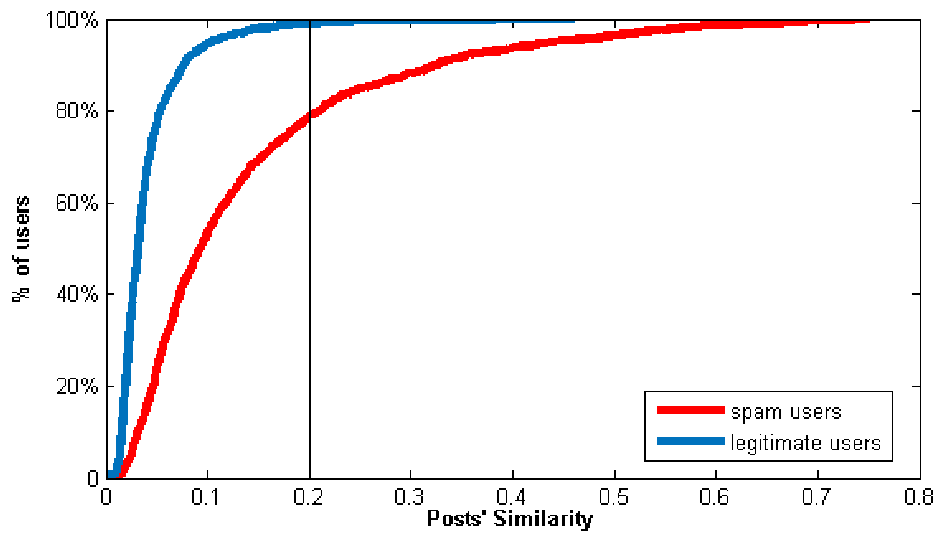 Fig 1: Topic probability distributions revealing the commercial nature of spam accounts.
Experiments: Proving the Hybrid Advantage
The authors tested SDHM against a version of the model that ignored content classification.
Key Findings:
- Content is King: Without the LDA content analysis, the F1-measure plummeted from 0.918 to 0.78. This proves that behavior alone isn't enough; you must analyze what is being said.
- Optimal Thresholding: Through parameter tuning ( for post balance and for source-user impact), the authors found that retweets are often the "dominant part" of a spammer's profile on Weibo.
 Fig 2: Performance gain achieved by incorporating text content characteristics.
Critical Analysis & Conclusion
The SDHM model marks a shift from "Bot Detection" to "Spammer Detection." While bots are easy to catch via API limits, the human-controlled "Water Army" requires the organic, multi-layer approach SDHM provides.
Limitations & Future Paths
- Evolving Tactics: As spammers begin using AI (LLMs) to vary their phrasing, simple LCS-based similarity might lose effectiveness.
- Cold Start: The model relies on existing follower/following data. Detecting a "sleeper cell" of spam accounts before they start a campaign remains an open challenge.
Final Takeaway: Effective moderation in the era of social manipulation requires looking at the organic intersection of behavior and content. SDHM provides a robust mathematical blueprint for this synthesis.