
SDN-Based Multi-Tier Architecture: The Backbone of Next-Gen Pervasive Healthcare
SDN-Based Multi-Tier Computing and Communication Architecture for Pervasive Healthcare
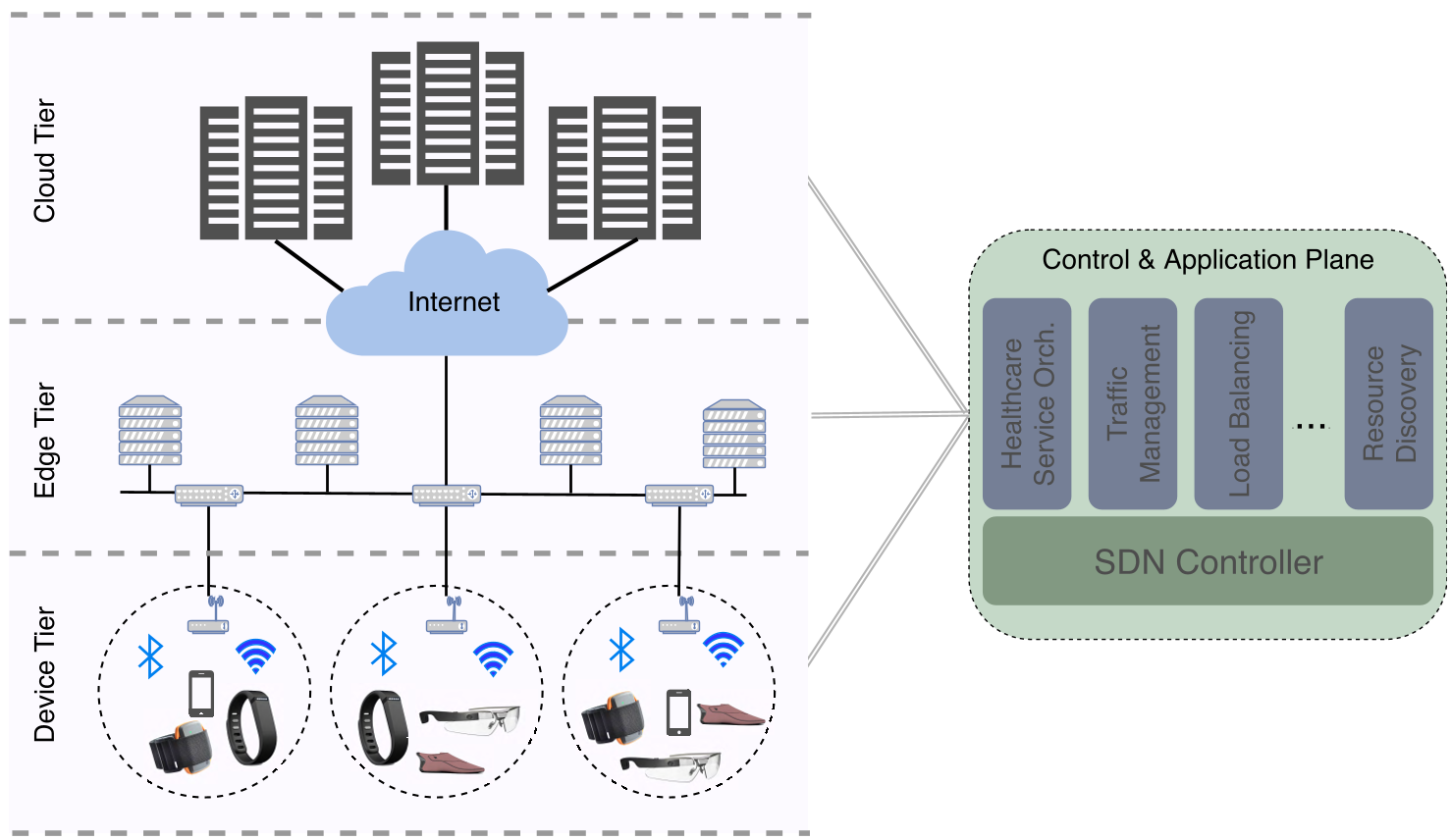
This paper proposes an SDN-based multi-tier computing and communication architecture specifically designed for pervasive healthcare, featuring end-user devices, edge servers, and cloud data centers. It introduces an SDN-driven load balancing mechanism and validates the framework using a real-world machine learning-based fall risk assessment service, achieving high inference accuracy and significantly reduced service latency.
TL;DR
Pervasive healthcare requires a delicate balance between high-intensity computation (like gait analysis and deep learning) and ultra-low latency. This paper introduces a tiered architecture—Device, Edge, and Cloud—unified by a Software-Defined Networking (SDN) controller. By orchestrating microservices across these layers, the system achieves 93.8% accuracy in fall risk detection while drastically reducing service delays compared to traditional cloud-only models.
Background & Motivation: The Latency-Accuracy Paradox
As wearable gadgets like smart rings and glasses proliferate, they generate massive streams of physiological data. However, clinicians face a "Goldilocks" problem:
- On-device processing saves latency but drains battery and lacks the power for complex machine learning.
- Cloud processing offers unlimited power but suffers from unpredictable WAN delays, making real-time interventions (like fall detection) impossible.
The authors argue that the missing link isn't just "more hardware," but a programmable network that knows where to send a specific task at a specific time.
Methodology: Programmable Control for Healthcare Microservices
The core innovation lies in the SDN Control Plane. Unlike traditional networks where routing is static, this system uses a Northbound application on a Ryu Controller to monitor the CPU load of every edge server in real-time.
1. The Multi-Tier Pipeline
The system splits a healthcare application (specifically Fall Risk Assessment) into modular components:
- User Tier: Sensors collect data at 100Hz and perform basic bundling.
- Edge Tier: Performs spatio-temporal gait parameter extraction (Cadence, Stride Length, etc.) and real-time inference.
- Cloud Tier: Handles long-term storage and retraining of the ML models using accumulated global data.
2. Intelligent Load Balancing
When a user device sends data, the SDN controller intercepts the request and calculates the selection probability for available edge servers based on their current CPU load:
Real-World Use Case: Fall Risk Assessment
To prove the architecture works beyond theoretical simulations, the researchers implemented a fall risk assessment service using data from 16 move-disorder patients.
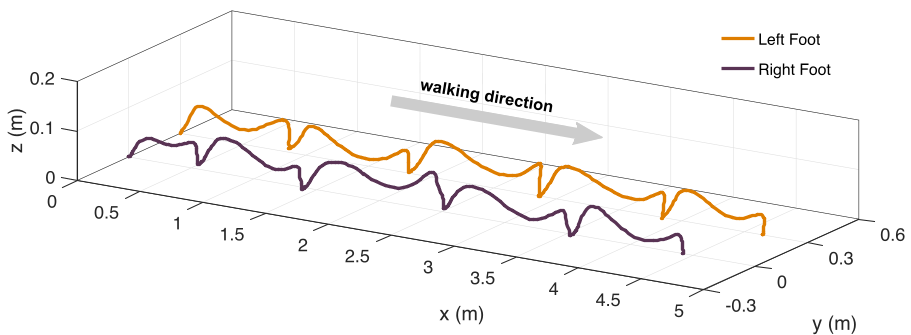
- Gait Analysis: By applying a Kalman filter to 3D accelerometer signals, the system estimates the foot's trajectory and extracts 17 spatio-temporal parameters.
- Inference: Using Support Vector Machines (SVM), the system labels patients as high or low risk based on their history of falls.
Experimental Results: Scalability at the Edge
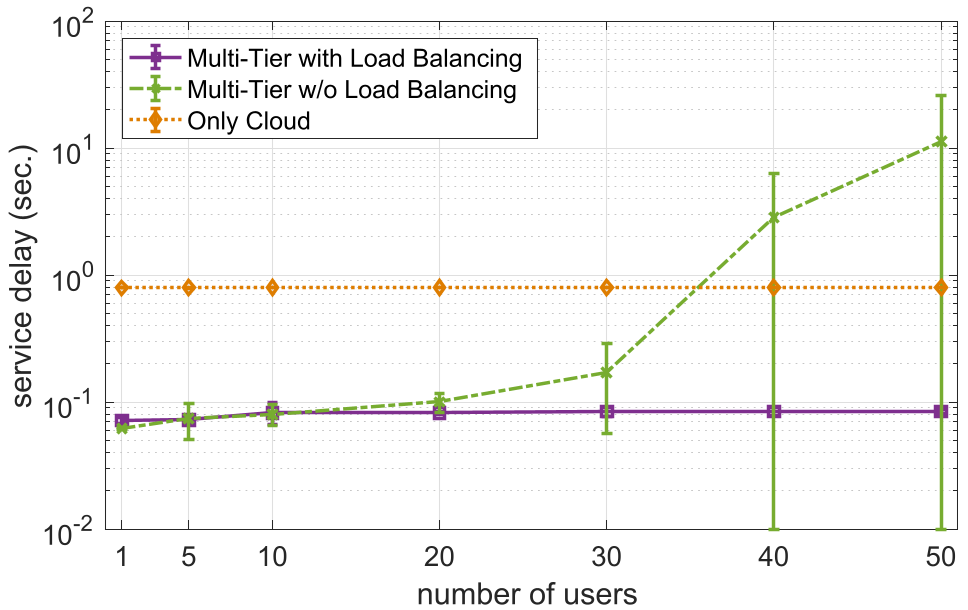
The researchers emulated the network using Mininet to test how the system scales with up to 50 concurrent users.
Performance Highlights:
- Inference Accuracy: The SVM model achieved 93.8% accuracy, proving that complex bio-medical logic can be offloaded without loss of precision.
- Latency Advantage: In high-traffic scenarios (50 users), the cloud-only approach suffered from massive network delays. The SDN-balanced edge approach maintained an average delay significantly lower—nearly a 10x speedup in response time for intermittent monitoring scenarios.
- Resource Efficiency: Without load balancing, some edge servers hit 100% CPU capacity while others remained idle. The SDN-based probability algorithm distributed tasks evenly, keeping all nodes around a healthy 20% utilization.
Deep Insight: Why SDN Matters Here
Most "edge" papers treat the network as a transparent pipe. This work treats the network as an active compute resource. By using OpenFlow to modify packet headers on the fly, the architecture can "redirect" a healthcare request to a different room's edge server if the current one is busy, without the user ever knowing.
Conclusion & Future Look
The paper successfully bridges medical diagnostics and network engineering. While the current implementation uses a single SDN controller, future work could explore Distributed SDN systems to prevent the controller from becoming a single point of failure in critical medical environments. As we move toward 5G/6G, this multi-tier, programmable approach will be the blueprint for autonomous hospitals.