
Beyond the Screen: An SDN-Enabled Big Data Platform for Real-Time Social TV Analytics
278_Toward an SDN-enabled big data platform for social
The paper proposes an SDN-enabled big data platform for social TV analytics that integrates a distributed crawler, Hadoop-based processing, and real-time social media mining. By leveraging Software-Defined Networking (SDN) to optimize intermediate data "shuffling," the system achieves significant improvements in processing rates and network efficiency.
TL;DR
Social TV—the act of discussing television programs on social media—generates a goldmine of data. However, processing this data in real-time is a bottleneck. This paper introduces a unified big data platform that uses Software-Defined Networking (SDN) to optimize Hadoop shuffles, coupled with a distributed crawler designed to intelligently bypass social network rate limits. The result is a system that understands public sentiment faster and more efficiently than traditional cloud architectures.
Background & Motivation: The Real-Time Challenge
When a major TV event happens (e.g., the Super Bowl or a viral drama), Twitter and Weibo explode with activity. For stakeholders, analyzing this "social response" in real-time is critical for targeted advertising and program scheduling.
However, two "walls" stand in the way:
- The API Wall: Social platforms like Sina Weibo strictly limit data access via rate limits and IP blocking.
- The Shuffle Wall: In big data frameworks like Hadoop, the "shuffle" phase (moving intermediate data between nodes) accounts for a massive portion of total job time. Traditional networks are "blind" to these data flows, leading to congestion and delays.
Methodology: Integrating SDN with Big Data
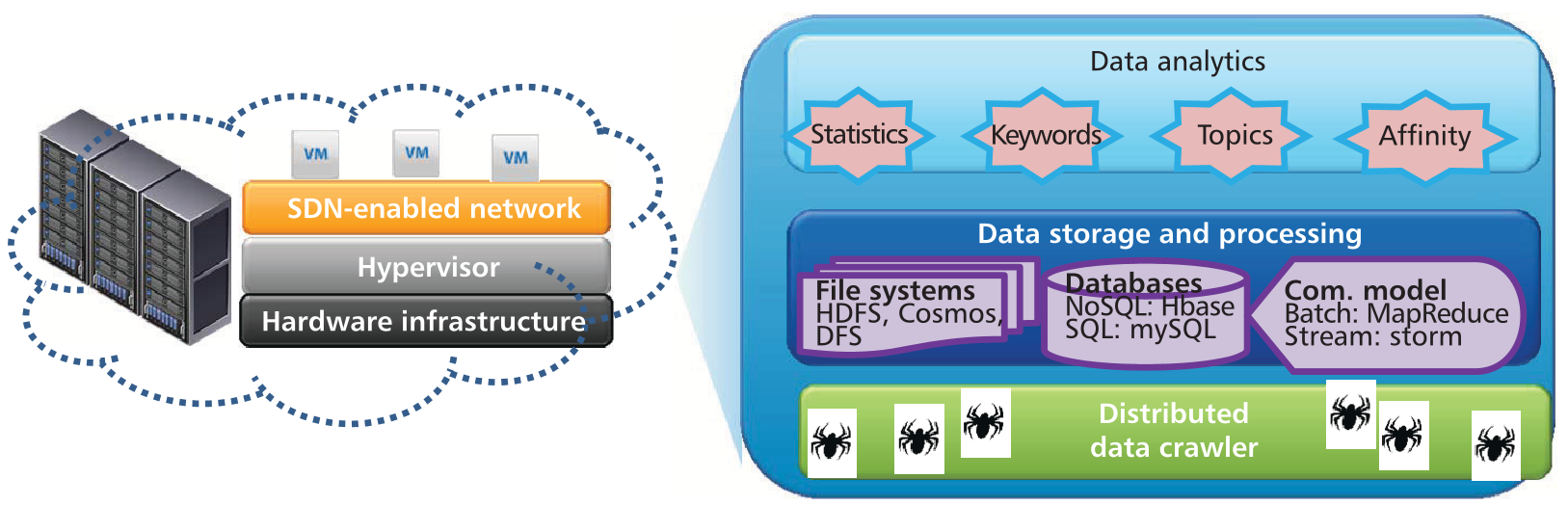
The authors propose a four-layer architecture, but the true innovation lies in how the Infrastructure and Data Processing layers communicate.
1. The Distributed Crawler
To overcome the API wall, the system uses a Program Descriptor that dynamically expands fixed keywords into dynamic ones. It employs a "rare property" pool (IPs and API keys) managed by Zookeeper to ensure that task nodes stay under the radar of OSN anti-crawling mechanisms.
2. SDN-Enabled Shuffling
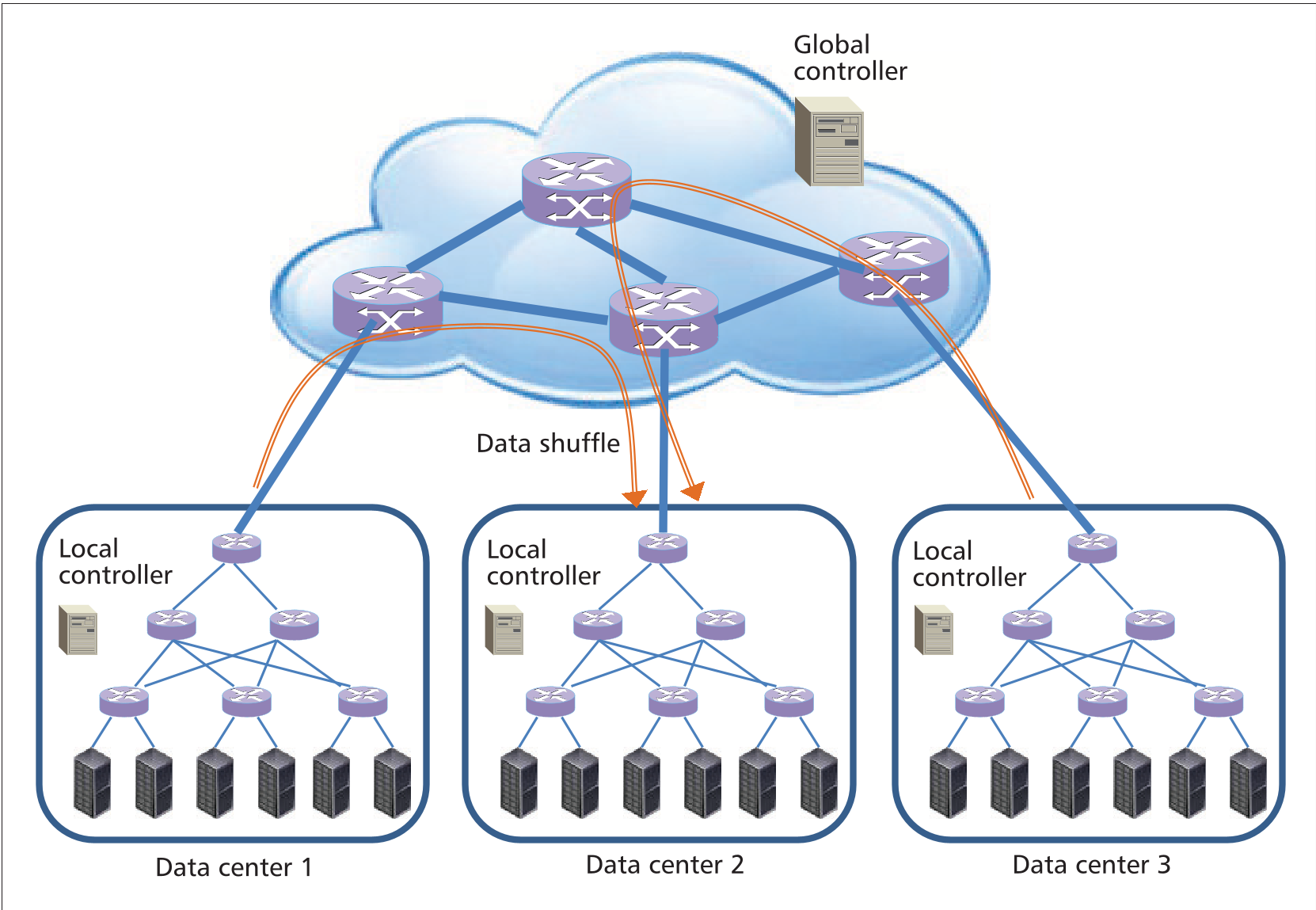
This is the core technical contribution. In a standard setup, data flows are dictated by rigid routing protocols. Here, the researchers integrated an SDN controller (Floodlight) with the Hadoop scheduler.
- Local Layer: Manages intra-data center traffic using OpenFlow-enabled switches.
- Global Layer: Provides a "God's eye view" of traffic across different IP segments/data centers, allowing the system to reroute intermediate data to the most efficient processing node (e.g., a node with high CPU but low network congestion).
Experimental Results
The system was tested using the "Hadoop Sort" benchmark over three racks with varying capacities.
Key Findings:
- Faster Execution: The SDN scheme (colored bars) consistently finished tasks faster than Traditional Methods (TM).
- Intelligent Routing: By moving intermediate data to the rack with the highest processing power (Rack 1), the SDN controller minimized the total sum of transmission and computation time, a feat impossible in standard static networks.
Social Perception Case Study: "Longmen Express"
The authors applied their platform to analyze 315,337 tweets about the Chinese show Longmen Express.
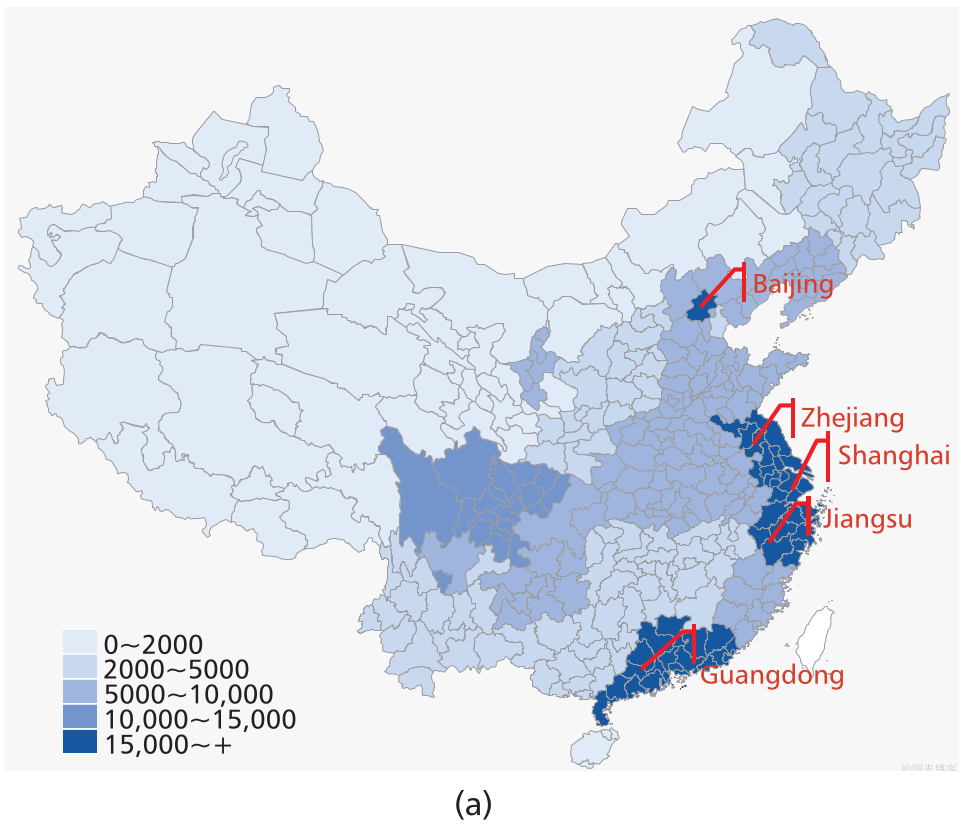
The analytics confirmed that audience engagement peaks during live broadcasts (Fig 5c), and geographic data showed that developed regions like Beijing and Shanghai contribute the highest volume of social interaction. This data allows TV producers to adjust content or advertising strategies mid-season.
Academic Insight & Future Outlook
While this paper was published in 2015, its core insight—network-aware computing—is more relevant than ever in the age of Edge Computing and Federated Learning. The shift from "moving data to computation" to "dynamically optimizing the path between them" remains a SOTA pursuit.
Limitations: The current system relies on keyword-based extraction, which may miss nuanced sentiment or sarcasm. Future iterations would benefit from integrating modern LLMs to better interpret the "noisy" nature of microblogs (abbreviations, slang, and emojis).
Conclusion
By breaking the silos between the network layer (SDN) and the application layer (Hadoop), the authors proved that cross-layer optimization is the key to conquering big data's "Final Mile"—the real-time analytics of human behavior.