
SeamFarm: Bridging the Cloud-Edge Gap for Modern Precision Agriculture
Poster: SeamFarm -- Distributed Data Analytic for Precision Agriculture based on Seamless Computing
SeamFarm is a distributed data analytic framework for precision agriculture that leverages the "Seamless Computing" paradigm. It integrates Cloud, Fog, and Edge resources using Kubernetes orchestration to enable efficient machine learning tasks on resource-constrained IoT devices.
TL;DR
The SeamFarm framework introduces a distributed analytic architecture for precision agriculture. By adopting Seamless Computing via Kubernetes, it allows heterogeneous IoT devices to collaborate on machine learning tasks (like image classification and rainfall prediction), optimizing for low latency and reduced device strain.
Background & Positioning
In the landscape of IoT-driven agriculture, we are moving beyond simple data collection. The current frontier is distributed intelligence. SeamFarm sits at the intersection of Fog Computing and Container Orchestration, aiming to solve the "resource-constrained" bottleneck of edge devices. Rather than treating the Cloud as the only brain, SeamFarm treats the entire network—from a Raspberry Pi in the field to a VM in Google Cloud—as a single, fluid computing fabric.
The Problem: The Heterogeneity Headache
Precision agriculture deployments are notoriously messy. You have:
- Heterogeneous Hardware: A mix of ARM-based Raspberry Pis and AMD64 servers.
- Data Gravity: Massive amounts of sensor data (images, humidity, temperature) that are expensive and slow to move to the cloud.
- Task Overload: A single node trying to run a TensorFlow model might crash or consume excessive power, leading to local system failure.
Current Fog Computing models often struggle with the mobility and dynamic scaling of these devices.
Methodology: The Seamless Computing Fabric
The core innovation of SeamFarm is the application of "Seamless Computing." The authors leverage Kubernetes not just for cloud scaling, but as a management layer for the field.
1. System Architecture
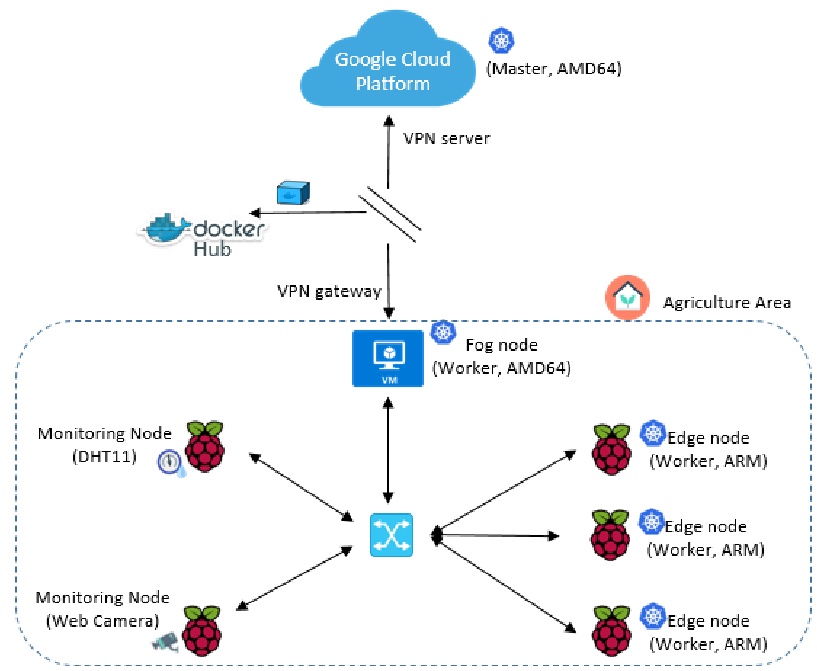
The architecture is a three-tier hierarchy connected via a VPN to simulate a single Virtual Local Area Network (VLAN):
- Cloud Layer: Google Cloud VM acts as the Kubernetes Master, handling scheduling and heavy model training.
- Fog Layer: Local servers (e.g., laptops/industrial PCs) providing low-latency classification results.
- Edge/Monitoring Layer: Raspberry Pi devices gathering DHT11 sensor data and camera images.
2. Task Affinity
Using Kubernetes nodeAffinity, SeamFarm intelligently maps components to nodes. For example, local image classification is pinned to Fog nodes to ensure low latency, while the initial training happens in the Cloud Machine Learning Engine.
Experiments and Results
The authors validated SeamFarm using two practical use cases: Image Classification and Rainfall Prediction.
Key Findings:
- CPU Optimization: As tasks were distributed across multiple edge nodes, the individual CPU usage per node plummeted, preventing thermal throttling and extending hardware life.
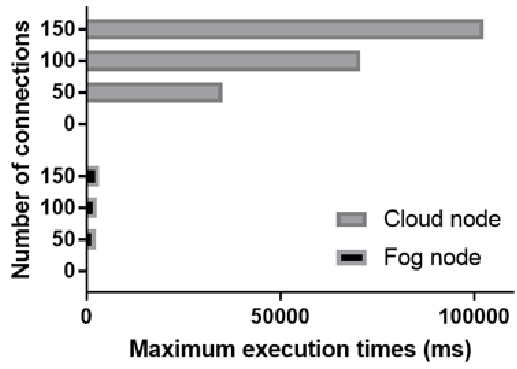
- Latency Reduction: Executing classification on Fog nodes proved faster than Cloud nodes because it bypassed the dependencies on external, often unstable, agricultural network backhauls.
Critical Insight & Conclusion
The true value of SeamFarm lies in its use of Containerization. By packaging ML tasks into Docker containers, the researchers eliminated "environment hell" across different CPU architectures.
Takeaway: For researchers and engineers in Smart Farming, this paper highlights that the future isn't just "more sensors," but "smarter orchestration."
Limitations: The study used a relatively small-scale cluster (1 Cloud, 1 Fog, 3 Edge nodes). In real-world "Smart Farms" spanning hundreds of acres, the overhead of the Kubernetes control plane on low-bandwidth satellite or LoRaWAN links remains a critical area for future exploration.