
Search Engine: The Invisible Architect of Social Network Evolution
Search engine drives the evolution of social networks
The paper introduces the "Search Network Model" to quantify how search engines act as catalysts for social network evolution. By modeling user-topic interactions as a bipartite graph, the study demonstrates that search engines intensify the power-law degree distribution and significantly reduce the average network diameter.
TL;DR
This study reveals that search engines are not just passive tools for finding information; they are active drivers of social network topology. By creating "shortcuts" between users and interests, search engines intensify power-law distributions, reduce network diameter (the "Small World" effect), and—critically—accelerate rumor propagation.
The "Chicken-and-Egg" Problem of Social Growth
Why do social networks grow the way they do? Standard models like preferential attachment explain "the rich get richer" phenomenon, but they fail to account for how users find niche topics or join distant communities without existing social bridges.
The authors identify a critical gap: The Search Engine Effect. In modern social ecosystems, users don't just follow friends; they search for keywords. This creates a bipartite graph (User-Topic) where search engines act as a shortcut mechanism, bypassing the traditional need for a chain of social connections to reach a specific node.
Methodology: The Search Network Model
The core of the paper is an evolutionary algorithm that updates a bipartite graph through three distinct phases:
- Preferential Attachment: New users choose a "prototype" user based on their current degree (popularity).
- Edge Copying: Users replicate the interests (links to topics) of their prototype.
- Search Linkage (The Innovation): Users establish new links to topics directly via search engine results, governed by a probability related to ranking algorithms and similarity.
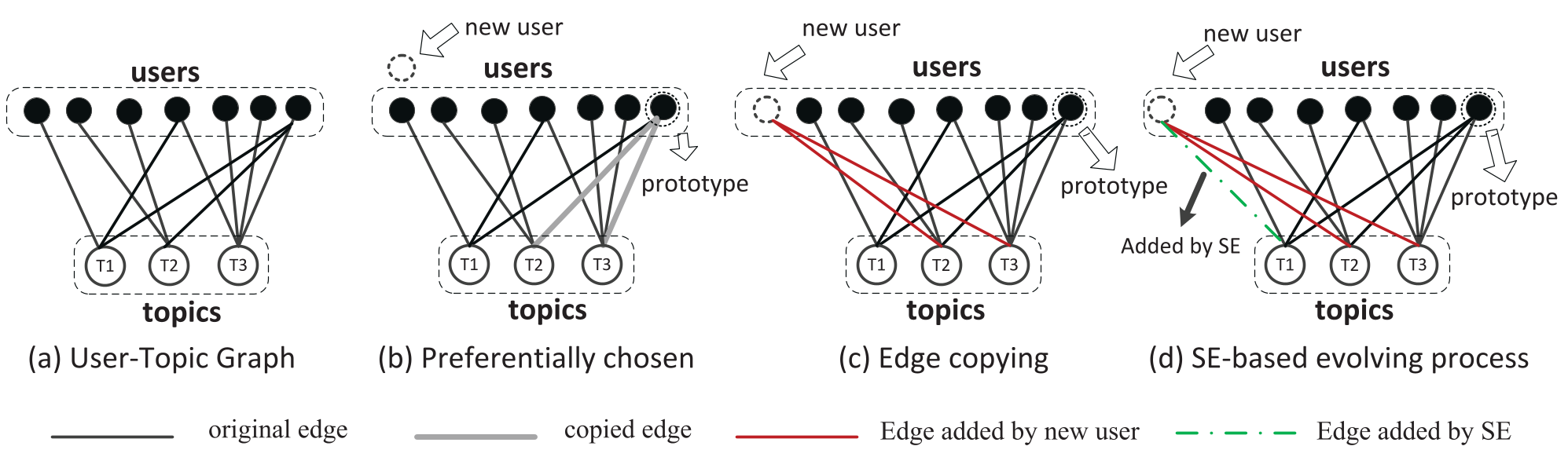
The mathematical beauty of this model lies in Theorem 1, which proves that the resulting degree distribution isn't just a standard power law, but a summation of a series of power law distributions. This explains why search-enabled networks have such "precipitous" or intensified curves.
Experimental Insights: Shrinking Worlds and Viral Rumors
Using real-world datasets like Facebook and Weibo, the authors confirmed two major structural shifts:
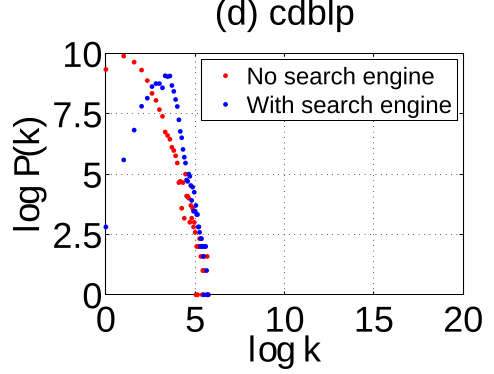
1. Intensified Power Law
The search engine pushes the degree distribution to more extreme ends. In logarithmic coordinates, the slope becomes steeper, meaning search engines help popular topics become even more dominant more quickly than through social sharing alone.
2. Network Diameter Collapse
The "Six Degrees of Separation" becomes even fewer. By creating virtual edges between separated groups, the search engine effectively "shrinks" the diameter of the network. This facilitates faster information flow—but there is a dark side.
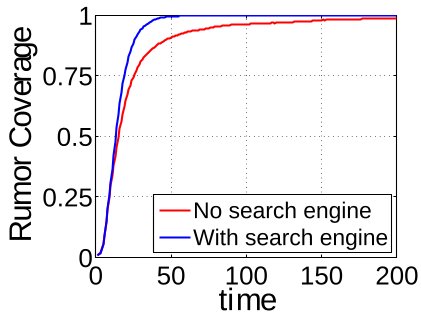
3. Accelerated Rumor Propagation
The experiment quantified rumor coverage (). Because search engines bridge isolated clusters, rumors no longer need to "travel" through a social chain; they can be discovered and spread by users across the network simultaneously.
Critical Analysis & Conclusion
The paper provides a rigorous mathematical framework for something we intuitively feel: the internet feels smaller because of Google, Bing, and internal search bars.
Key Takeaways:
- Evolutionary Driving Force: Search engines are active participants in network growth, not just mirrors of it.
- The Power of Shortcuts: By reducing the distance between nodes, search engines increase the "efficiency" of a network, but also its "volatility" (e.g., how fast misinformation spreads).
- Limitations: The model assumes a somewhat random probability for search linkage (). In reality, personalized SEO and algorithmic bias likely create "Filter Bubbles" that might counteract some of the diameter-shrinking effects by keeping users within specific topic clusters.
Future Outlook: As AI-driven search (like LLM-based search) becomes more prevalent, the "Search Linkage" step will become even more precise, likely accelerating these evolutionary trends even further.