
TOM: Enhancing Web Mining through Search Intent and Topic Ontologies
Utilizing Search Intent in Topic Ontology-Based User Profile for Web Mining
The paper introduces the Topic Ontology Model (TOM), a Web mining framework that constructs user profiles by integrating search intent (specificity vs. exhaustivity) via the Pattern-Taxonomy Model (PTM). It achieves superior information retrieval performance on the Reuters RCV1 corpus compared to standard pattern-based baselines.
TL;DR
The effectiveness of Web search is often hindered by a lack of understanding regarding why a user is searching. This paper proposes the Topic Ontology-based User Profile Model (TOM). By analyzing the structural characteristics of search patterns using the Pattern-Taxonomy Model (PTM), TOM can distinguish between a user's need for specific details versus broad overviews, significantly improving retrieval precision and recall over traditional keyword or basic pattern-based systems.
The Motivation: Beyond Simple Keyword Matching
Web mining aims to discover relevant hidden information, yet modern search engines are still primarily reactive to keyword queries. The core issue is Intent Blindness. Two users typing "Apple" might have vastly different goals: one wants specific technical specs for the M3 chip (Specificity), while another wants a general history of the company (Exhaustivity).
Current ontological profiles often map "what" a user likes but ignore the "how" and "to what extent" they want that information. The authors argue that a truly intelligent system must move from data diagrams (static interest registration) to Information Diagrams that capture semantic relationships and search depth.
Methodology: The Geometry of Search Intent
The authors leverage the Pattern-Taxonomy Model (PTM) to bridge the gap between simple term frequencies and complex semantic intent.
1. Pattern Taxonomy Construction
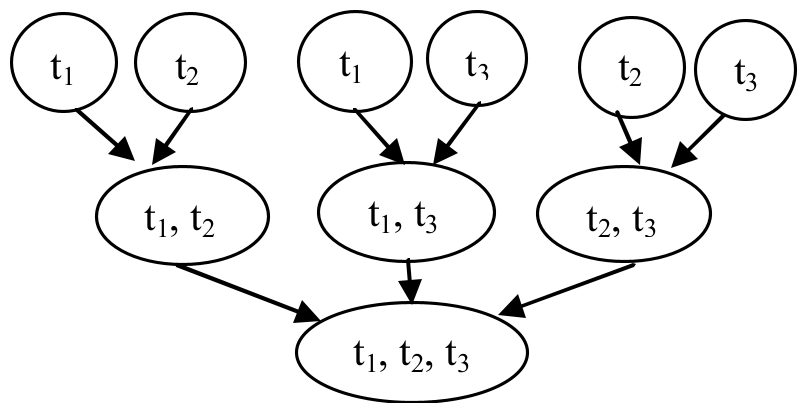
Instead of treating documents as "bags of words," the model identifies frequent sequential patterns. These patterns are organized into a tree-like hierarchy (Taxonomy) where:
- Depth (Levels): Indicates a clear, focused search direction (Specificity).
- Breadth (Branches): Indicates a wide-ranging, exploratory interest (Exhaustivity).
2. Quantifying Intent with Dempster-Shafer Theory
To transform these patterns into a functioning retrieval model, the authors apply the Dempster-Shafer (D-S) theory of evidence. They define two critical functions:
- Specificity (spe): Related to the Belief function, it aggregates support from all sub-patterns to quantify how focused a document is.
- Exhaustivity (exh): Related to the Plausibility function, it measures the overlap of concepts to quantify breadth.
The system calculates a factor based on the ratio of multi-term patterns (2-term and 3-term) to single-term patterns. If a topic exceeds a specific threshold, it is classified as a "Specific" intent, and the relevance scoring shifts accordingly.
Experimental Results
The model was tested using the Reuters RCV1 corpus, a benchmark for adaptive filtering. The authors identified 39 specific topics out of 100 to test the TOM framework.
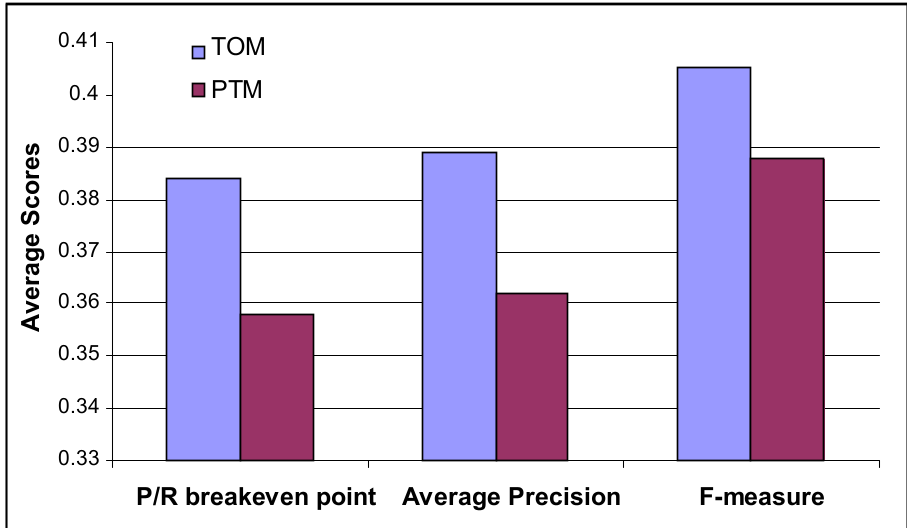
As shown in the results, TOM (Topic Ontology Model) consistently outperformed the baseline PTM across three vital metrics:
- P/R Breakeven Point: Higher threshold for balanced precision and recall.
- Average Precision: Significantly better at ranking relevant documents higher.
- F-Measure: Improved harmonic mean of precision and recall, proving the robustness of the intent-based approach.
Critical Analysis & Conclusion
The real value of this research lies in its structural approach to intent. While modern LLM-based search engines use latent embeddings to capture "meaning," this paper provides a transparent, mathematical framework for understanding the structure of a user's information need.
Limitations:
- The model relies on implicit feedback to build the PTM, which can be noisy in real-world scenarios.
- The threshold for is an experimental coefficient, which might require constant tuning as Web content evolves.
Future Outlook: This work paves the way for "Intent-Aware" AI agents. For researchers today, the insight is clear: Don't just model the topic; model the topology of the user's curiosity. Integrating these ontological structures with modern Large Language Models could lead to search experiences that understand not just our words, but our goals.