
MFRS: Mimicking Human Social Intelligence for Decentralized Resource Discovery
A Search Strategy for Social Resource in Decentralized Social Networks
The paper introduces the Multi-Function Resource Search strategy (MFRS), a decentralized peer-to-peer (P2P) social network discovery framework. It leverages human social theories—specifically knowledge accumulation, interest clustering, and social forgetting—to enable efficient discovery of multi-keyword resources.
TL;DR
Centralized social networks face privacy and single-point-of-failure risks. While P2P architectures offer a solution, searching for complex, multi-keyword resources across a decentralized web is notoriously inefficient. This paper presents MFRS (Multi-function Resource Search), a strategy that treats P2P nodes like human actors who build knowledge bases, form interest groups, and recommend "well-connected" friends to boost search accuracy by prioritizing high-value nodes.
Context: The Social Fabric of P2P
We often think of Peer-to-Peer (P2P) networks as cold protocols like BitTorrent. However, modern decentralized social networks (OSNs) are essentially human networks mapped onto silicon. The researchers behind MFRS argue that if human social networks are self-organizing and efficient at information discovery, P2P networks should mimic their three core "Human Tactics":
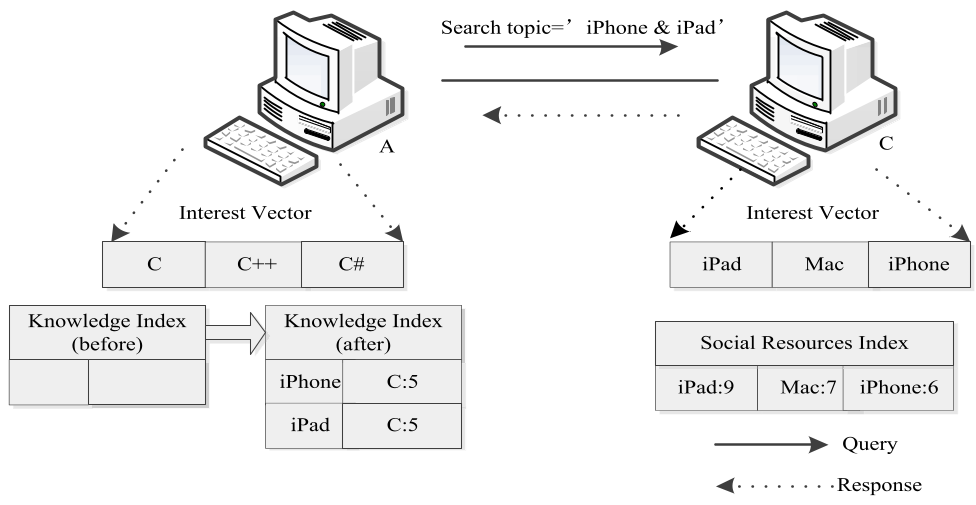
- Knowledge Memory: Building personalized indices based on interaction frequency.
- Self-Organization: Turning random interactions into organized interest clusters.
- Social Forgetting: Using LRU (Least Recently Used) logic to discard irrelevant information over time.
The "Why": Beyond Simple Keyword Matching
Why do current methods fail?
- NeuroGrid and RBFS are often too "blind" or too rigid, either flooding the network with query traffic or failing when the network churns (nodes going offline).
- ESLP (the predecessor) ignored the quantity of resources a node might have, looking only at the existence of a topic.
The authors' insight is that not all peers are equal. A node that is "well-connected" (a social butterfly) is objectively better for forwarding a query than a leaf node, even if it doesn't have the resource itself.
Methodology: The MFRS Engine
MFRS operates through two primary mechanisms: Recommended Node Selection and Adaptive Routing.
1. The Three-Stage Selection Process
When a query for "Twitter and Facebook" arrives, the node doesn't just guess. It filters candidates through three vectors:
- DMRNV (Direct Matching): Nodes confirmed to have both keywords.
- inDMRNV (Indirect Matching): Nodes that have at least one of the keywords.
- GNV ("Good" Nodes): If no matches are found, the node picks "Good" nodes—those with high Devotion ().
2. Physical Intuition of the Math
The forwarding degree () is calculated as: This formula ensures that if a peer has a high Relation Degree () — meaning it holds a giant share of the relevant resources — the system grants it a higher forwarding budget (). This "invests" query traffic where the payoff is likely highest.
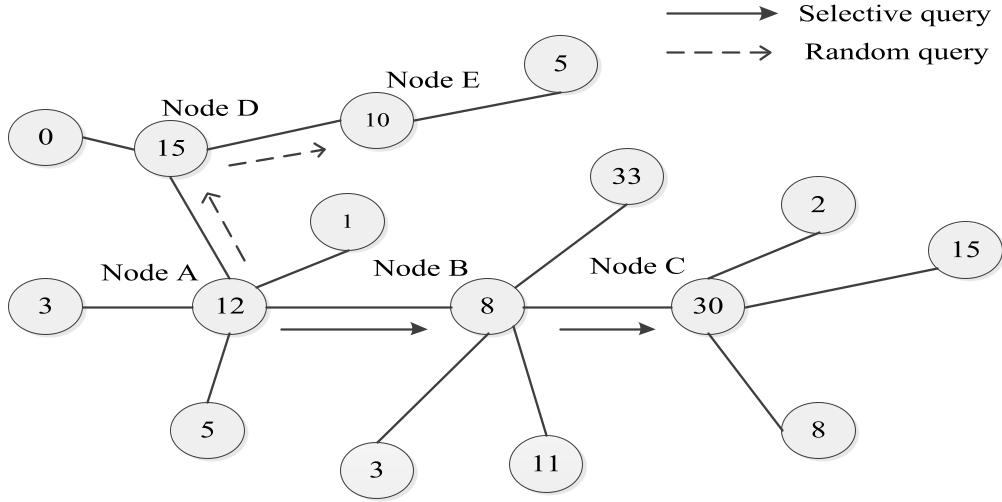 Figure 4 demonstrates how selective queries to well-connected nodes reach 38 resources vs. just 25 via random selection.
Experimental Battleground
The team simulated a dynamic network of 1,000 nodes with high "churn" (nodes constantly joining/leaving) to mimic real-world instability.
- The Metric: "Found Resources per Message" (Efficiency).
- The Result: As the network "matures" and nodes learn from each other, MFRS's efficiency pulls away from NeuroGrid and RBFS.
- Overhead: MFRS achieves this without the massive traffic spikes seen in ESLP, as it smartly prunes the search path.
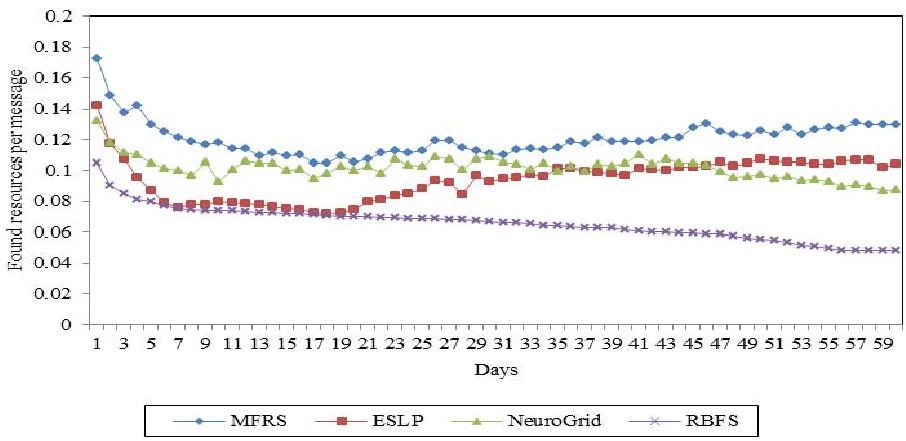 The search efficiency of MFRS (Found resources per message) remains consistently superior as the network knowledge base matures.
Critical Analysis & Takeaways
Key Contribution: The genius of MFRS lies in its "Interest Index" vs. "Knowledge Index" distinction. By separating what a node is interested in from what a node knows about others, it creates a local map that mirrors human social expertise.
Limitations: The paper assumes resource topics can be neatly categorized into Open Directory Categories. In the era of LLMs and unstructured embeddings, a fixed topic-list might be too rigid.
Future Outlook: For the next evolution of decentralized web (Web3), the MFRS logic of "Selective Forwarding" to "Good Nodes" could be the blueprint for efficient data retrieval in IPFS or decentralized AI training networks where bandwidth is the primary bottleneck.
Conclusion
By treating peer nodes not just as data silos but as social entities with varying levels of "Devotion" and "Relation," MFRS proves that the most efficient way to navigate a digital network is to follow the ancient rules of a human one.