
Searching in the Dark: Decentralized Identity Authentication through Online Learning
Searching in the dark: A framework for authenticating unknown users in online social networks
The paper introduces a decentralized authentication framework for Online Social Networks (OSNs) to authenticate users without prior shared secrets. It combines a bandit online learning protocol to discover optimal "trust chains" for certificate collection with Zero-Knowledge Proofs (ZKP) to ensure secure identity verification.
TL;DR
In the decentralized world of Online Social Networks (OSNs), how do you prove you are who you say you are to someone you've never met? This paper presents a framework that uses Bandit Online Learning to navigate trust chains and Zero-Knowledge Proofs (ZKP) to authenticate users without a central authority or pre-shared secrets. It achieves a near-optimal search efficiency with a regret bound of .
The Motivation: The "Shared Secret" Paradox
Traditional security assumes you either know someone (shared secret) or you both trust the same "Big Brother" (Centralized CA). In OSNs, these assumptions fail:
- No Prior Contact: Users frequently interact with "friends of friends" (unknown users).
- The Fragility of Trust: Trust is not infinite; it atrophies as the distance between users in a social graph increases (the "Social Power" constraint).
- Impersonation Risk: Without a reliable way to verify public keys, OSNs are ripe for identity theft via profile cloning.
The author's insight: Treat the social graph as a Secure OSN where real-life friendships are edges. The goal is to find the most "fruitful" path in this graph to collect certificates that prove an identity.
Methodology: Learning the Trust Landscape
The framework operates in two distinct phases: Search and Verification.
1. Decentralized Bandit Search
Because the availability of certificates on nodes changes over time, the initiator cannot know which path is best. The paper treats this as a Multi-Armed Bandit problem.
- H-Plate Construction: The search is limited to a "Social Power" (max hops).
- Exploration vs. Exploitation: Using a decentralized version of the "Best-Expert" algorithm, nodes decide whether to explore random paths to find new witnesses or exploit known high-yield paths.
- Regret Minimization: The protocol is mathematically proven to minimize "regret"—the difference between the certificates collected and what could have been collected by an omniscient optimal strategy.
 The Best-Expert update rule ensures that local decisions lead to global efficiency.
2. ZKP-Based Verification
Once a certificate (signed by a mutual trust point) is found, the user must prove they own it without revealing the certificate itself to prevent tracking or reuse. This is achieved through Zero-Knowledge Proofs of Knowledge (PK) using Hohenberger-Waters (HW) signatures.
Experimental Validation
The researchers simulated the framework on a modified Kleinberg small-world network (100 nodes).
- Search Efficiency: In both "Uniform" and "Pulsing" (where nodes go offline) distributions, the unit regret consistently decreased as increased, proving the "learning" aspect of the protocol works.
- Speed: Security doesn't have to be slow. Using the Pairing-Based Cryptography (PBC) library, verification stays under 1 second for standard security bits (128-256 bit), making it viable for real-time mobile social apps.
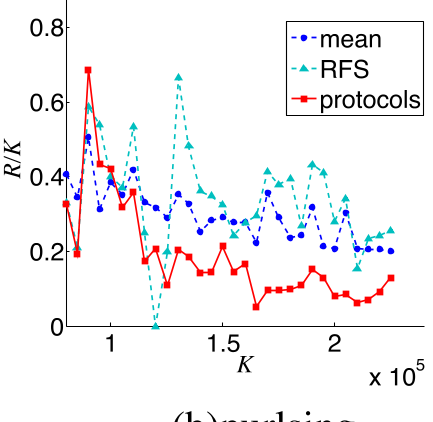 The red line represents the framework's performance, showing lower regret compared to random path strategies.
Professional Insights: Why This Matters
The brilliance of "Searching in the Dark" lies in its Inductive Bias: it assumes that while we don't know the whole network, the local structure of social trust is predictable enough for a bandit algorithm to exploit.
Limitations:
- The model currently assumes an "oblivious" adversary. In a real-world scenario, an adaptive adversary might try to manipulate the "benefit" signals to lead the initiator toward malicious nodes.
- Scaling to millions of nodes would require more hierarchy than a simple H-plate BFS.
Conclusion: This paper provides a robust mathematical foundation for decentralized trust. It moves us away from "trusting a company" (like Meta or LinkedIn) and toward "trusting the network topology," a shift that is essential for the future of Web3 and privacy-centric social platforms.