
Navigating the Human Knowledge Graph: Strategic Expertise Finding in Social Networks
Searching For Expertise in Social Networks: A Simulation of Potential Strategies
This paper presents a large-scale simulation study evaluating eight expertise-seeking strategies within social networks using the Enron email dataset. The authors introduce and compare novel strategies like Hamming Distance Search (HDS) and Weak Tie Search (WTS) against established methods, identifying critical tradeoffs between computational efficiency and social "bother" costs.
TL;DR
Finding "who knows what" in a large organization is a social minefield. This seminal study uses the Enron email corpus to simulate how different search algorithms—ranging from simple "Random Walks" to "Structural Dissimilarity"—perform in the real world. The verdict? Looking for "Weak Ties" and leveraging "Best Connected" hubs gets you answers faster, but it risks spamming the CEO.
The Motivation: Moving Beyond Metadata
In an ideal world, finding an expert is a simple database query. In reality, expertise is "latent"—trapped in sent folders, project reports, and the heads of busy colleagues. Prior work like ReferralWeb or Yenta focused on discovery, but they lacked a rigorous comparison of search strategies.
The authors argue that we shouldn't just care about "What" is found, but "How" it is found. Every step in a social search "bothers" a human. If an algorithm takes 20 steps to find an expert, that is 20 potential work interruptions. The goal is to find the shortest path with the lowest "social noise."
Methodology: The Enron Testbed
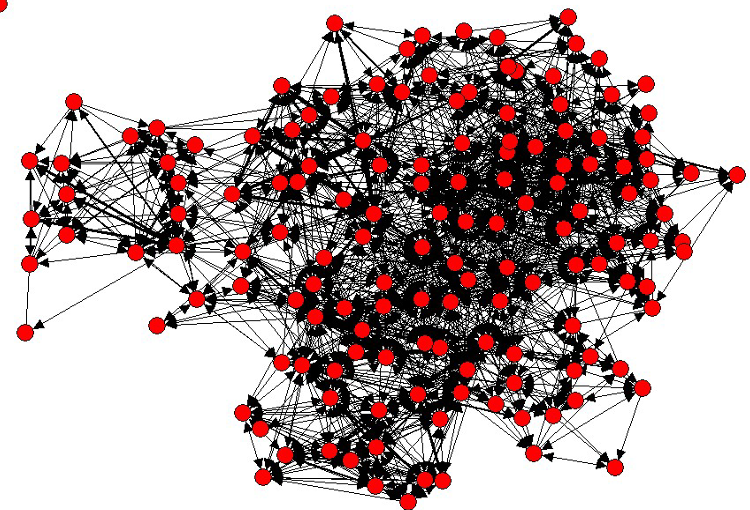
To avoid the artificiality of synthetic graphs, the authors mapped the Enron Management Network.
- Nodes/Edges: 147 employees connected by email exchange.
- Expertise Profiles: Generated via TF/IDF indexing of the messages actually sent/received by each person.
- Strategies: 8 total, notably:
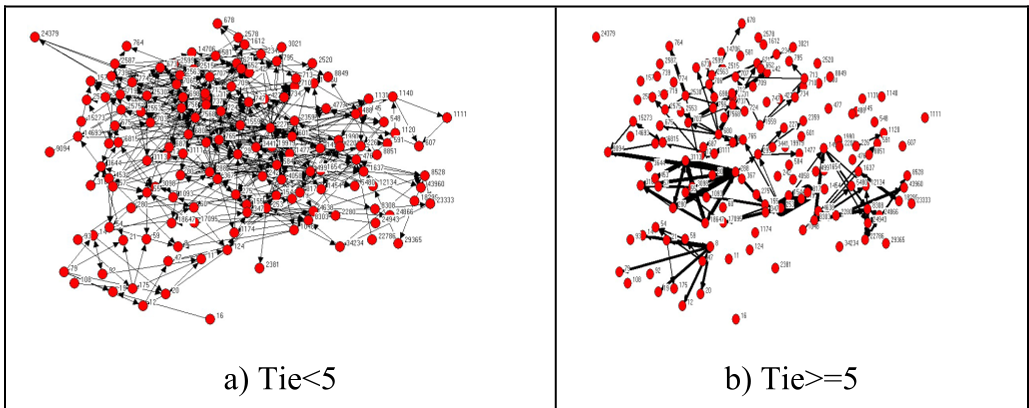
- Weak Tie Search (WTS): Passing queries to acquaintances with the lowest interaction frequency (the "bridges" to other departments).
- Hamming Distance Search (HDS): Aiming for neighbors who have the least common friends (maximizing structural reach).
- Information Scent (ISS): Greedy matching based on how much a neighbor's "profile" looks like the query.
Key Insights from the Simulation
1. The Power of Structure over Scent
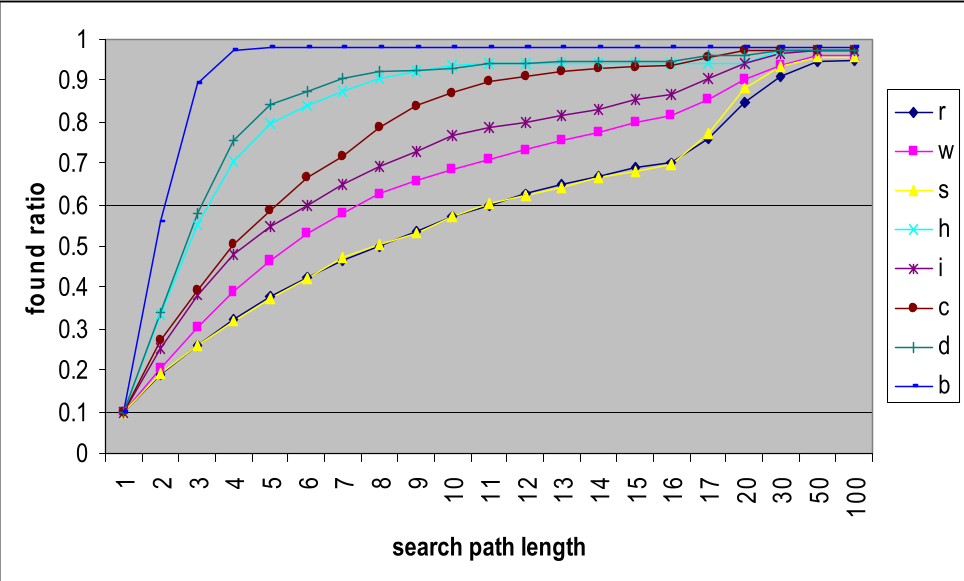
Surprisingly, Best Connected Search (BCS) and Hamming Distance Search (HDS)—which purely look at the network's "plumbing"—often beat similarity-based approaches. They reach 80% of targets within 6 steps. This suggests that in a dense organizational network, whom you know (and how many people they know) is more predictive of search success than a keyword match on the neighbor's immediate profile.
2. Weak Ties vs. Strong Ties
The study provides empirical proof for Granovetter's famous "Strength of Weak Ties" theory. Strong Tie Search (STS) frequently got stuck in "local loops"—groups of close friends talking to each other about the same things. Weak Ties acted as escape hatches, propelling the query into different parts of the company.
3. The "CEO Problem" (Labor Distribution)
The most efficient algorithms (BCS, HDS) have a dark side: bottlenecks. Because they favor high-degree nodes, the query frequency for popular managers was exponential. In the Enron data, the CEO and CIO were targeted almost constantly.
- Takeaway: A purely "efficient" algorithm might be socially unsustainable if it doesn't incorporate load-balancing or "availability" metrics.
Critical Analysis & Future Outlook
The paper's strength lies in its Sensitivity Analysis. By removing the 10 most connected "hubs" and re-running the tests, they proved that while efficiency dropped, the relative superiority of structural search remained.
Limitations:
- Assumption of Transparency: The model assumes agents can "see" their neighbors' profiles (Transactive Memory). In high-privacy environments, this is rarely true.
- Static Expertise: The study treats expertise as a static vector, ignoring that experts "learn" and "forget."
Conclusion: This research serves as a foundational bridge between graph theory and CSCW (Computer-Supported Cooperative Work). For future AI-driven organizational tools (like Copilot or Slack AI), the lesson is clear: don't just look for a keyword match. Look for the "structural bridges"—the people who talk to everyone but aren't yet inundated with requests.