
Searching for People to Follow: Why Global Authority Fails Social Discovery
Searching for people to follow in social networks
The paper introduces a specialized "Searching for People to Follow" (SPTF) framework tailored for microblogging platforms like Sina Weibo. It combines Tag Expansion and Prediction (TE&P) with category-specific ranking algorithms (Follow Rank and Forward Rank) to solve the social discovery problem, achieving significant user retention insights.
Executive Summary
TL;DR: This research tackles the critical "Search for People to Follow" (SPTF) problem, which is distinct from passive recommendations. By crawling 0.25 billion profiles on Sina Weibo, the authors developed a system that uses Tag Expansion and Prediction (TE&P) and a modified PageRank algorithm to find relevant accounts. Their core finding: there is no "one-size-fits-all" ranking; academics value retweets (Forward Rank), professionals value authority (PageRank), and companies value internal domain density.
Positioning: This work transitions the field from "Expert Finding" (identifying topic authorities) to "Social Discovery" (finding accounts worth engaging with), effectively bridging information retrieval and social network analysis.
The "Broken" Social Funnel: Why New Users Leave
The authors reveal a startling statistic: 56% of users with fewer than 100 followers eventually abandon the platform. This "loss rate" is primarily due to a lack of relevant connections.
Existing systems fail because:
- Cold-Start: New users have no history for recommendation engines to leverage.
- Sparse Metadata: ~65% of users have no tags, making them invisible to keyword searches.
- Celebrity "Sinks": In standard PageRank, celebrities who follow nobody act as "black holes," swallowing the rank of the entire network and distorting authority measurements.
Methodology: Tag Enrichment and Relationship-Aware Ranking
1. Tag Expansion and Prediction (TE&P)
To solve the sparsity problem, the authors use Structural Equivalence. If User A and User B share many of the same followers, they are likely similar.
- Expansion: Uses existing tags to predict new ones via logistic regression.
- Prediction: For tag-less users, the system looks at their "closest friends" (computed via equivalence) and propagates their tags based on a learned weighting scheme.
2. Fixing PageRank for Social Graphs
The paper identifies that in social networks, celebrities often have zero out-links. To fix this, they introduce a self-following factor ():
This ensures that authority is distributed more logically across the network. They further branched this into:
- Follow Rank: Based on the explicit "Following" graph.
- Forward Rank: Based on "Retweet/Forwarding" volume, representing active content validation.
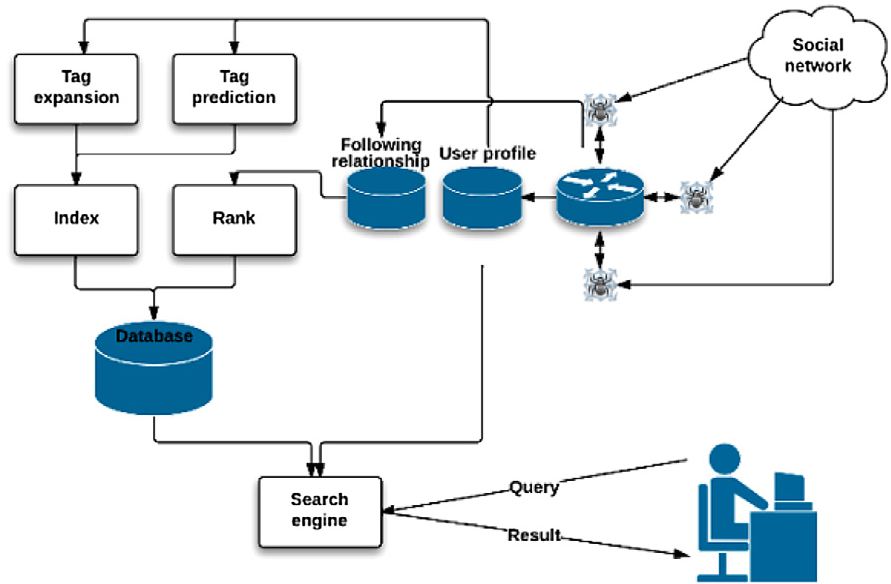 Figure 1: The Xunren system architecture, integrating the crawler, index, and TE&P modules.
Experiments: Query-Specific Optimization
The study categorized 1.7 million query logs into three intent classes. The results using nDCG (Normalized Discounted Cumulative Gain) show a clear divergence in what "value" means:
- Academics (e.g., "Machine Learning"): Users prefer accounts that are frequently retweeted. Forward Rank outperformed all others.
- Occupations (e.g., "Singer", "Film"): Users seek established authority. PageRank and TunkRank were the most effective.
- Companies (e.g., "Xiaomi", "Google"): Users look for internal density. Domain-Follower Rank (counting followers who also belong to that company) performed best.
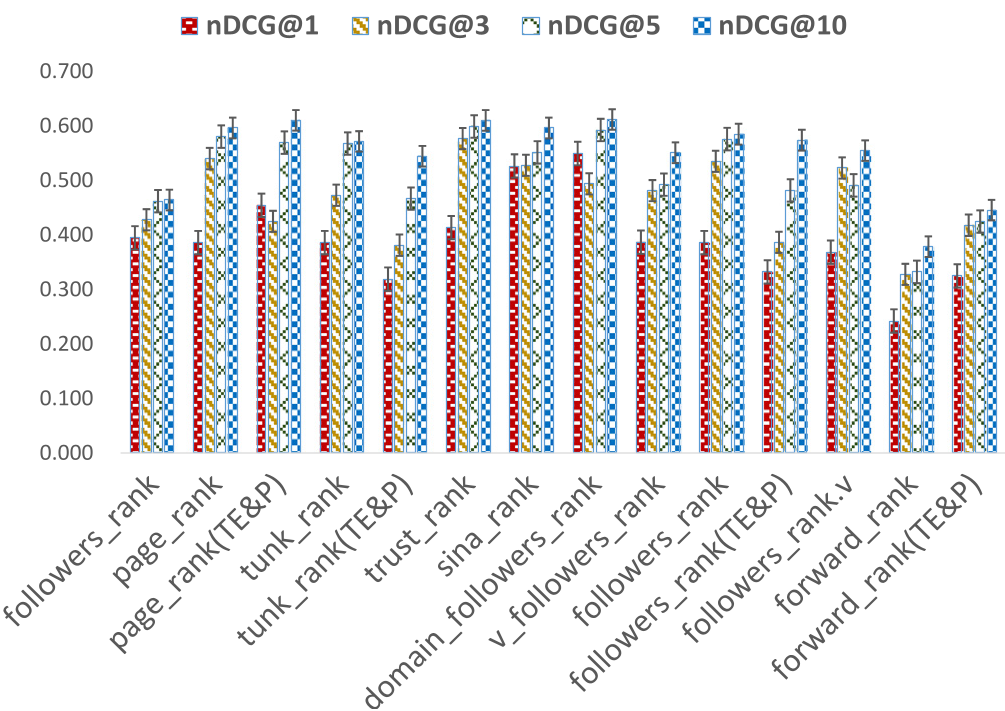 Figure 2: Performance (nDCG@10) across different query categories, highlighting that Forward Rank dominates the Academic domain.
Critical Insight: The Fault-Tolerance of Retweets
A fascinating takeaway from the "Ablation-style" study in Table 18/19 is that TE&P actually hurts Follow-based algorithms (PageRank) but boosts Forward Rank by 20%.
Why? Follow-based ranks are sensitive to "false positive" tag predictions—if a director is mistakenly tagged as a "TV Host," his high authority will mistakenly push him to the top of the "TV Host" search. However, users rarely "Forward"/Retweet content outside their niche. Thus, the forwarding relationship acts as a natural filter for noisy tag predictions.
Conclusion and Future Outlook
This paper proves that "authority" is not a singular metric in social networks. The value of an account is contingent on the intent of the searcher.
Limitations: The TE&P accuracy still needs improvement to avoid harming follow-based rankings. Future Work: The authors suggest exploring "Community Detection" to better understand how User Groups (not just categories) influence follow-intent, a precursor to modern "Interest Graph" engines used by platforms like TikTok and X (Twitter).