
REACH: Finding the "Who" in Your Fading Memory
Finding someone in my social directory whom i do not fully remember or barely know
This paper introduces REACH (Relationship Analytics for Connecting Humans), an intelligent people-finding system designed to help users locate contacts within their personal social directories using partial or vague memories. It utilizes multi-faceted characterization and personalized ranking to achieve a 76% Top-1 retrieval precision.
TL;DR
As our digital social circles expand, we often find ourselves searching for "that one person" whose name is on the tip of our tongue. REACH (Relationship Analytics for Connecting Humans) is an intelligent system that rebuilds your fragmented social directory by mining communication patterns. It allows you to find contacts using fuzzy clues—topics discussed, people involved, or even the "vibe" of the interaction—achieving a remarkable 76% Top-1 accuracy in identifying the person you barely remember.
The Motivation: The "Weak Tie" Problem
In the era of hyper-connectivity, our social directories are no longer curated lists; they are digital graveyards of one-off email threads and LinkedIn requests.
- Fragmentation: Your contacts are scattered across Outlook, Slack, and LinkedIn.
- Fading Memory: You remember that "Karen" was Ronnie's assistant, but her last name? Gone.
- Zero Context: Standard search tools look for "Karen," but give you 50 results with no way to distinguish the one you met at a conference last year from your long-lost cousin.
REACH addresses this by shifting the paradigm from Search (matching characters) to Recall (matching context).
Methodology: Mining the "Social Nucleus"
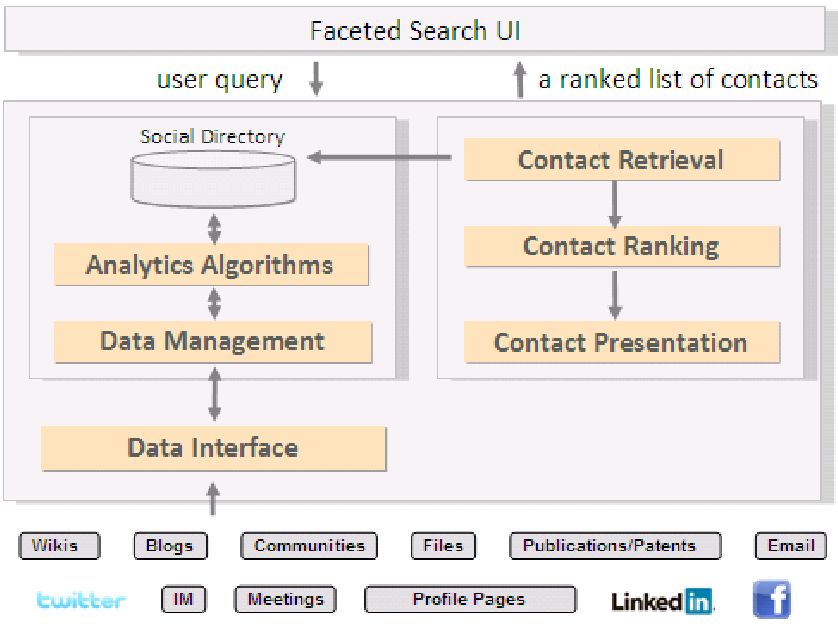
REACH doesn't just store names; it builds a multifaceted profile for every contact based on your actual history with them.
1. Multi-faceted Characterization
The system analyzes data sources (emails, calendars) to extract three types of facets:
- Profile Facets: Sourced from corporate directories and signature blocks.
- Pattern Facets: How do you talk? Is it one-on-one (intimate) or massive CC threads (distant)?
- Context Facets: What did you talk about? The "Topic" facet uses keyword salience to tag people (e.g., "The DARPA guy").
2. The Closeness Formula
REACH calculates "Importance" () to ensure that when you search, your most relevant contacts surface first. It prioritizes Form (one-on-one vs. group) followed by Recency.
3. Adaptive UI for Recall
The UI is the "Intelligent" part of the interface. If the system knows you are searching for a "Weak Tie" (someone in the bottom 70% of your interaction frequency), it automatically displays Context Cues (e.g., "You last spoke with them during the 2011 Project GTO") to help your brain complete the memory.
Experiments & Results
The researchers tested REACH against 100 real-world queries. The findings highlighted the power of context:
- High Precision: 76% of the time, the exact person the user was thinking of was the #1 result.
- Common Clues: Users most frequently used First Name (67%) and Topic (62%) as search criteria.
- Personalization: When searching for generic terms like "Database," REACH successfully promoted the individual the user had personally discussed databases with recently, rather than just anyone with "Database" in their title.
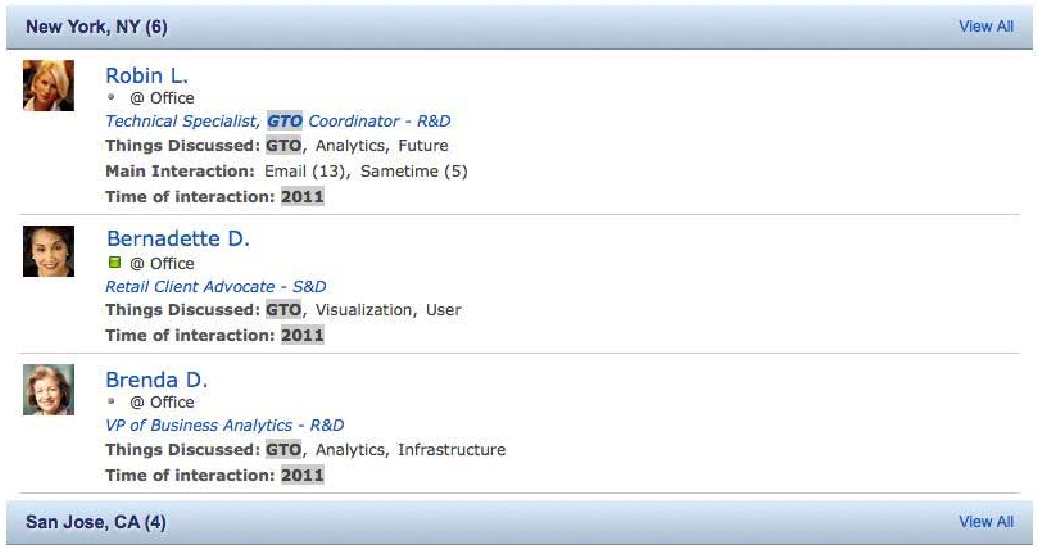 Figure: The system successfully filtering "GTO" contacts by the 2011 timeframe.
Critical Insights & Future Outlook
Summarizing the Value: REACH proves that the "metadata" of our lives—when we talk, who else is in the room, and what the subject line is—is often a more powerful retrieval key than a legal name.
Limitations: The system struggled with "Indirect Personal Clues" (e.g., "Joe's wife"). It lacks a semantic understanding of human relationships beyond what is explicitly mentioned in emails or the corporate organigram.
The Future: With today's Large Language Models, the "Topic" extraction in REACH could be significantly upgraded. Imagine a system where you can ask, "Who was that person who seemed really skeptical about my proposal last Tuesday?" and have REACH find the exact participant from a calendar invite. This paper laid the foundational logic for the personalized "AI Second Brain" we are seeing emerge today.