
Searching the Village: Aardvark and the Shift from Library to Social Search
Searching the Village: Models and Methods for Social Search
This paper introduces Aardvark, a social search engine based on the "village paradigm" that routes natural language questions to humans within a user's extended social network. Unlike traditional document-centric search, Aardvark utilizes a Bayesian routing algorithm to match queries with responders based on topical expertise and social intimacy.
TL;DR
Aardvark is a pioneer in "Social Search" that replaces the traditional library-style indexing of documents with an index of people. By modeling users as content generators and leveraging social proximity, Aardvark routes natural language questions—especially the subjective and "un-googleable" ones—to experts within your extended social circle. It achieves a 87.7% answer rate with a median response time under 7 minutes.
Problem & Motivation: The Library vs. The Village
Traditional Information Retrieval (IR) is rooted in the Library Paradigm. In this world, we use keywords, search static repositories, and trust results based on authority (e.g., PageRank).
However, the authors argue that much of human knowledge acquisition historically happened in the Village Paradigm. In a village, if you need a recommendation for a twin-friendly babysitter, you don't look for a manual; you find the right person.
The gap Aardvark fills is for queries that are:
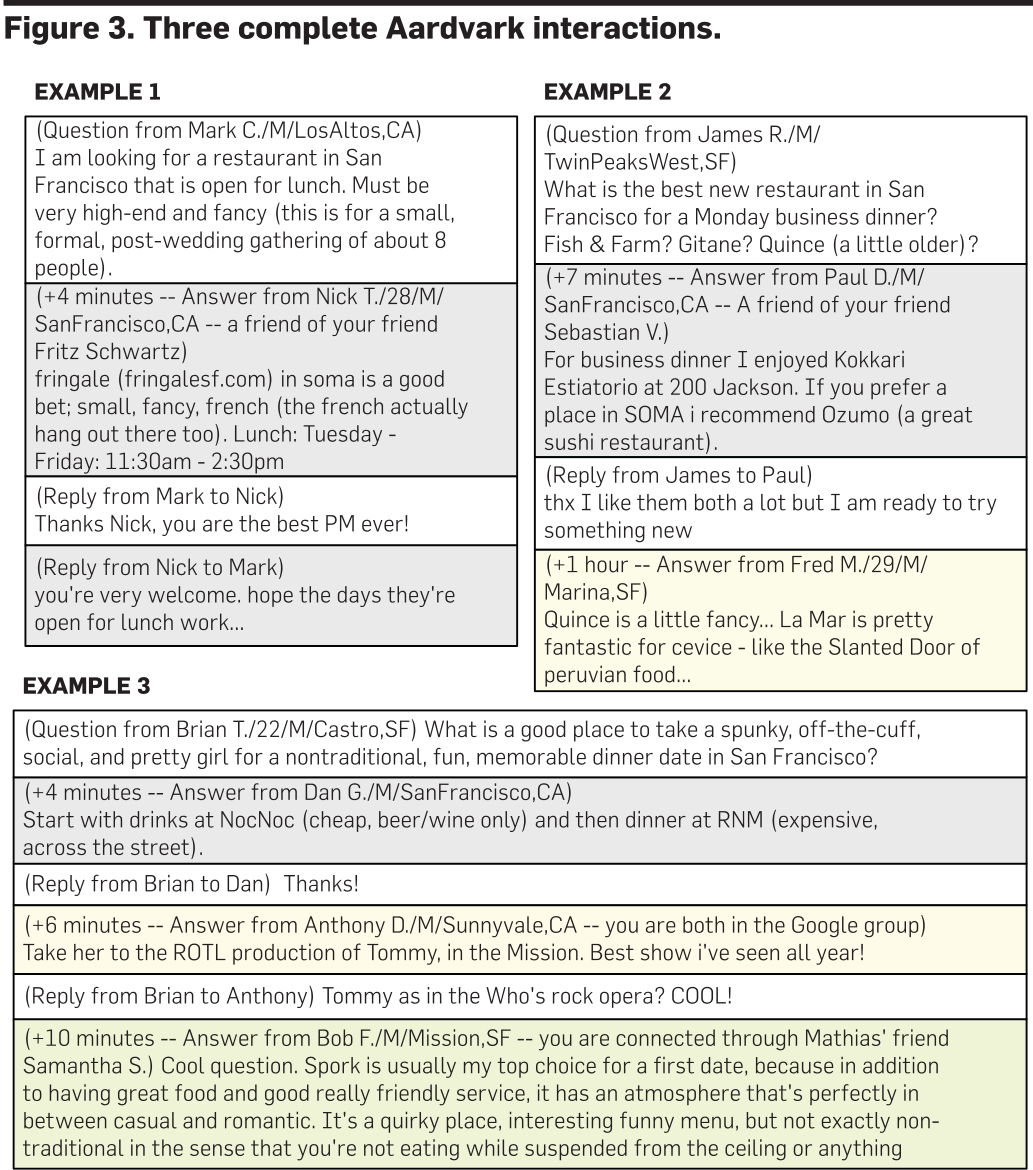
- Subjective: "What is a good place for a first date?"
- Hyper-contextualized: Questions averaging 18.6 words vs. Google’s ~2.5 words.
- Trust-based: Relying on intimacy rather than just technical authority.
Methodology: The Core Routing Engine
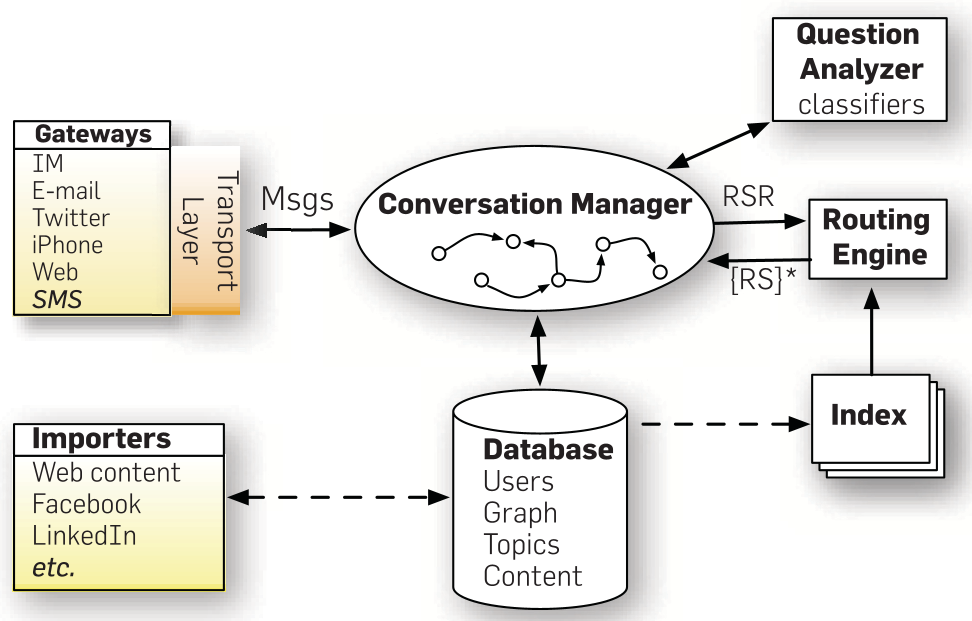
The technical heart of Aardvark is a statistical model designed to maximize the probability that user will successfully answer a question asked by user .
The model follows this elegant decomposition:
- Topical Relevance ( and ): The Question Analyzer determines the topic of the query using SVMs and taxonomy mapping. Simultaneously, the Indexer builds a profile of each user’s expertise by parsing their social profiles, status updates, and previous answering behavior.
- Social Intimacy (): Unlike PageRank which is query-independent authority, Aardvark calculates a "connectedness" score using social graphs (Facebook/LinkedIn), demographic similarity, and even "verbosity match" to ensure the asker and answerer are a good conversational fit.
Experiments & Results: Human Speed vs. Machine Speed
While Google provides results in milliseconds, Aardvark operates on "Human Real-Time." The study shows that the median time to a satisfactory response is ~6.5 minutes.
Key Findings:
- Engagement: 55.9% of the user base actively asked or answered questions—a significantly higher participation rate than platforms like Yahoo! Answers.
- Subjectivity: 64.7% of queries were subjective, proving that Aardvark captures a different "market" of information needs than Google.
- Quality: 70.4% of answers were rated as "good." Interestingly, social proximity directly correlated with quality; answers from within the social network were rated 8% higher than those from strangers.
Critical Analysis & Conclusion
Takeaway
Aardvark successfully demonstrated that "Trust is based on Intimacy." By acting as an automated intermediary, the system removes the social friction of "bothering" a friend while maintaining the high utility of a personalized human response.
Limitations
- Scalability of Attention: Human attention is a finite resource. While the paper mentions spreading the load, a massive influx of queries could lead to "answerer fatigue."
- Fact Retrieval: As the authors admit, for objective facts ("What is the train schedule?"), the library paradigm (Google) remains undefeated.
Future Outlook
In the age of LLMs, Aardvark’s "Village Paradigm" is more relevant than ever. While AI can simulate human-like advice, the authenticity and accountability of a response coming from a "friend of a friend" provides a layer of social verification that synthetic agents currently lack.