
SEBAR: Leveraging Social Energy to Solve the Intermittency Puzzle in DTNs
SEBAR: Social-Energy-Based Routing for Mobile Social Delay-Tolerant Networks
This paper introduces SEBAR, a novel social-based routing protocol for Delay-Tolerant Networks (DTNs) using a physics-inspired "Social Energy" metric. SEBAR quantifies a node's message-forwarding potential based on encounter frequency, community centrality, and temporal decay, significantly outperforming traditional protocols like Bubble Rap in delivery ratio.
TL;DR
Routing in Delay-Tolerant Networks (DTNs) is notoriously difficult due to the lack of end-to-end paths. SEBAR (Social-Energy-Based Routing) introduces a "Social Energy" metric—inspired by particle physics—to quantify a node's ability to deliver messages. By combining encounter dynamics, community structures, and a temporal decay mechanism, SEBAR beats standard social-based protocols in delivery efficiency across real-world traces.
The "Aging" Problem in Social DTNs
In mobile social networks, humans carry devices that connect intermittently. Previous SOTA methods like Bubble Rap used social centrality to find relays. However, social influence isn't static. If you met a productive relay three weeks ago, their "usefulness" should be lower today than someone you met this morning. Existing protocols struggle to balance this temporal volatility with the structural stability of social communities.
Methodology: The Physics of Socializing
The core of SEBAR is the Social Energy () mathematical model. It treats node encounters as "particle collisions" that generate energy.
1. Energy Generation and Sharing
When two nodes collide, they generate energy . Crucially, a portion of this energy is "taxed" and sent to the node’s community. This community energy is then redistributed to all members based on their Community Centrality—how active they are compared to their peers.
2. The Decay Mechanism (Radiation)
To prevent "stale" contacts from dominating routing decisions, social energy radiates away over time. Unless a node continuously encounters others, its energy will decay toward zero.
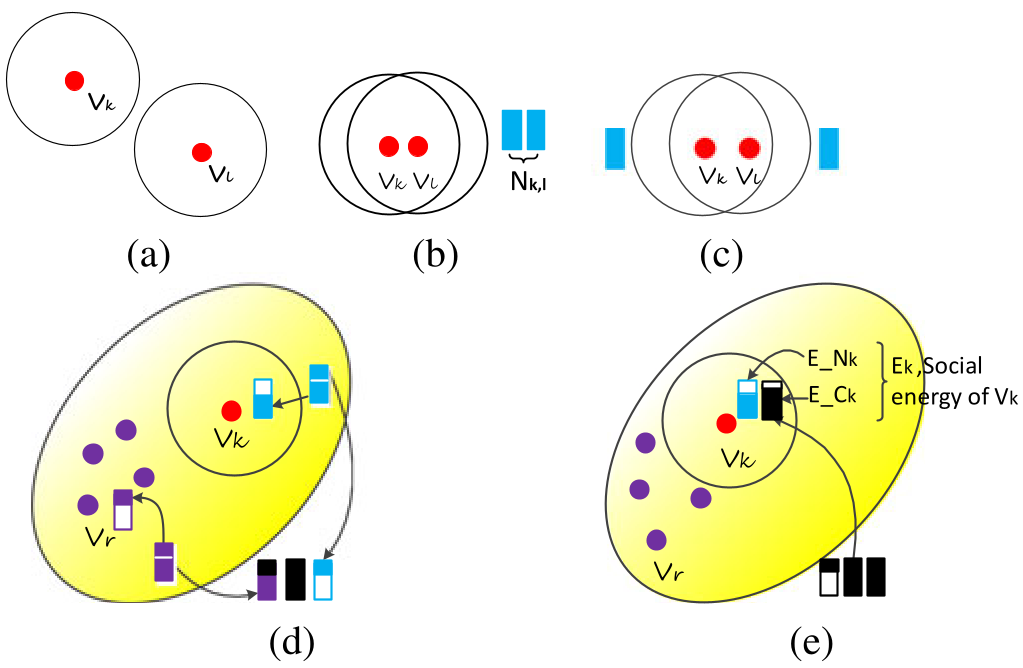
3. Forwarding Logic
SEBAR uses a greedy approach:
- Global Search: If the packet hasn't reached the destination's community, it moves to nodes with higher total social energy.
- Local Search: Once inside the destination's community, it targets nodes with the highest community-allocated energy.
Experimental Results: SOTA Performance
The authors validated SEBAR using two famous datasets: MIT Reality Mining and InfoCom 2006 Bluetooth traces.
Key Findings:
- Delivery Ratio: SEBAR consistently outperformed Bubble Rap, Spray and Wait, and Greedy-Total. In many cases, it approached the "Epidemic" (flooding) upper bound but with a fraction of the overhead.
- Efficiency: By introducing SEBAR-AU (Accumulated Updates), the authors proved they could reduce the control message overhead by delaying energy updates until specific thresholds were met, without a massive drop in delivery success.
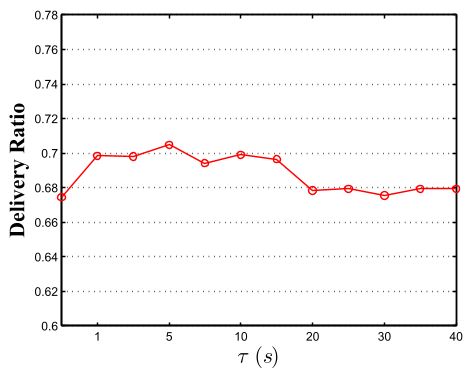
Deep Insights & Future Outlook
The genius of SEBAR lies in its Inductive Bias: it assumes that data flow follows the "heat" of social activity. By mimicking physical energy, the protocol naturally adapts to the ebb and flow of human daily routines.
Limitations:
- The protocol assumes nodes are cooperative. In real-world scenarios, "selfish" nodes might refuse to act as relays or lie about their energy levels to save battery.
- It requires a degree of community awareness (global structure), although the SEBAR-LN (Local Neighborhood) variant attempts to decentralize this.
Conclusion: SEBAR shifts the DTN routing paradigm from "who do you know" to "how active are you lately." This transition is essential for building resilient communication systems in environments where infrastructure is non-existent or destroyed.