
SecBCS: Re-Engineering Trust in Crowdsourcing via Blockchain and TEE
Special Focus on Security and Privacy in Blockchain-based Applications SecBCS: a secure and privacy-preserving blockchain-based crowdsourcing system
SecBCS is a secure, privacy-preserving blockchain-based crowdsourcing system designed for smart city crowd management. By integrating Group Signatures (GS), Ciphertext-Policy Attribute-Based Encryption (CPABE), and Trusted Execution Environments (TEE/SGX), it achieves SOTA levels of anonymity and data confidentiality without the heavy computational overhead of zk-SNARKs.
Executive Summary
TL;DR: SecBCS is a decentralized crowdsourcing framework that tackles the "security-efficiency-privacy" trilemma. By swapping heavy zero-knowledge proofs for a combination of Group Signatures, Attribute-Based Encryption (CPABE), and Intel SGX, it provides a robust infrastructure for smart city applications that is both privacy-preserving and computationally efficient.
Positioning: This work moves beyond simple "blockchain-for-payments" models, establishing a comprehensive security protocol that addresses the full lifecycle of a crowdsourcing task—from anonymous request to verified execution.
Problem & Motivation: The Centralization Trap
Conventional crowdsourcing (e.g., Amazon Mechanical Turk) relies on a "trusted" intermediary. This creates three critical failure points:
- Privacy Leakage: Requesters and workers must expose their identities and sensitive data to the platform.
- Unfairness: Intermediaries can side with one party in disputes without transparency.
- Fragility: A single system failure halts all operations.
While earlier blockchain-based efforts like ZebraLancer attempted to solve this, they relied on zk-SNARKs, which require massive CPU/RAM resources—making them unsuitable for the very IoT devices (sensors/phones) that power smart cities.
Methodology: The Core Security Stack
SecBCS introduces a four-pillar approach to secure the crowdsourcing workflow:
1. Identity Privacy via Group Signatures (GS)
Instead of fixed public keys, workers use group signatures. This allows for Anonymity (anyone can verify a signature belongs to the group, but not who sent it) and Traceability (a manager can reveal the identity only in cases of malicious behavior).
2. Fine-Grained Access via CPABE
Not every worker should see every task. SecBCS uses Ciphertext-Policy Attribute-Based Encryption. Tasks are encrypted with a policy (e.g., "Must be in NYC AND have 5-star rating"). Only workers with matching attributes can decrypt the task details.
3. Verification via Trusted Execution Environments (TEE)
To prevent workers from forging results or users from refusing to pay, the system uses Intel SGX.
- The Logic: The verification code (VerifyCode) runs inside an isolated CPU "enclave."
- The Result: The enclave generates a hardware-signed attestation (vSig). The Smart Contract only releases the reward if this attestation is valid.
4. Secure Smarter Contracts
Recognizing that smart contracts are prone to bugs (like the DAO attack), authors use an FSM (Finite State Machine) design. This ensures the contract cannot enter an "illegal" state (e.g., paying twice or locking funds).
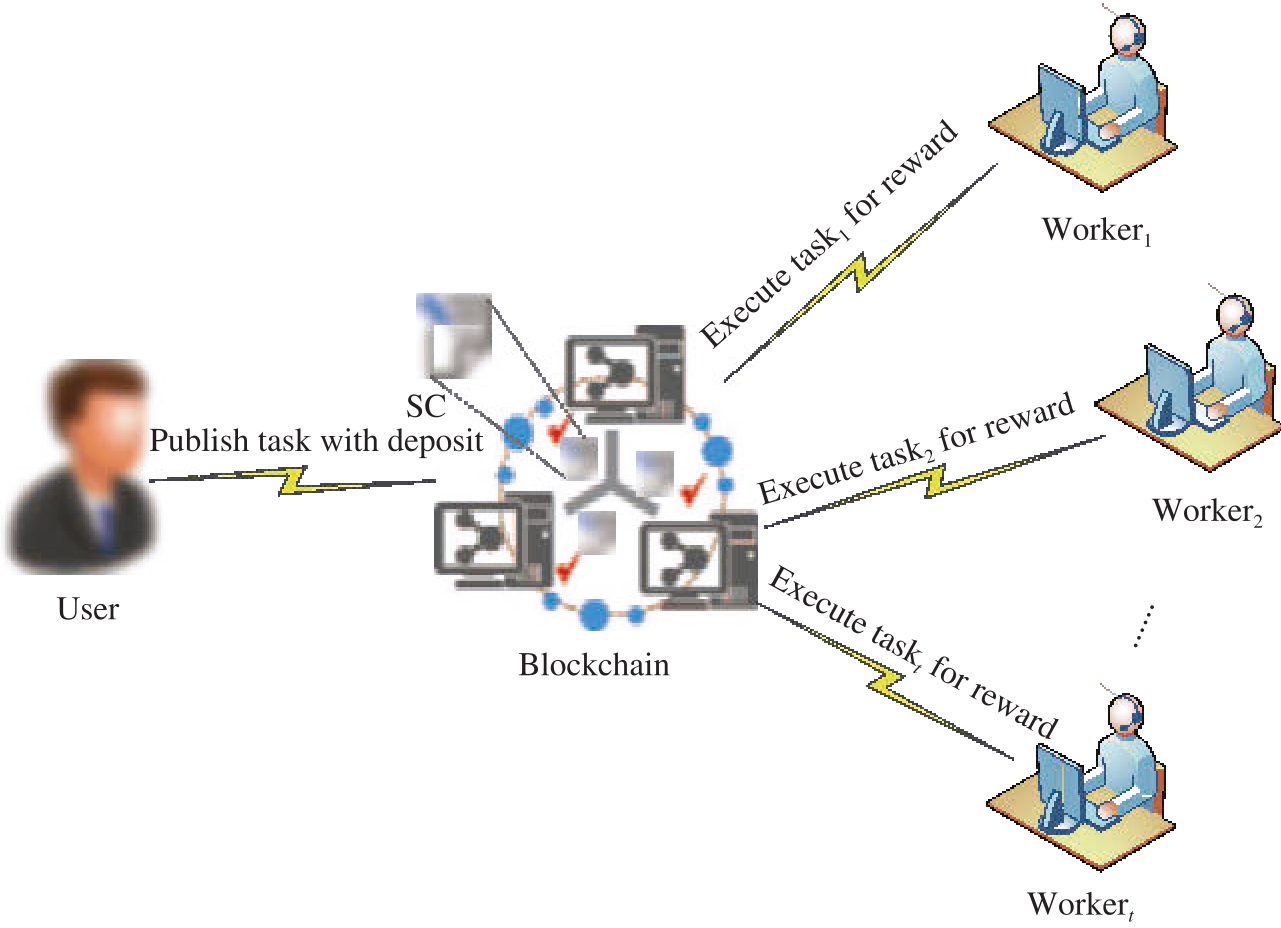 Figure 1: The interaction between User, Worker, Blockchain, and TEE.
Experiments & Results: Real-World Viability
The authors prototyped SecBCS on the JUICE platform (an Ethereum-compatible environment).
Efficiency vs. Scalability
Unlike zk-SNARK based systems where proof generation can take minutes, SecBCS's primary overhead is network latency.
- Latency: Even with 500 concurrent users, execution confirmation stays around 12 seconds.
- Cost Efficiency: Standard operations (uploading results, getting tasks) cost between 0.01 USD, a negligible fee compared to typical crowdsourcing rewards.
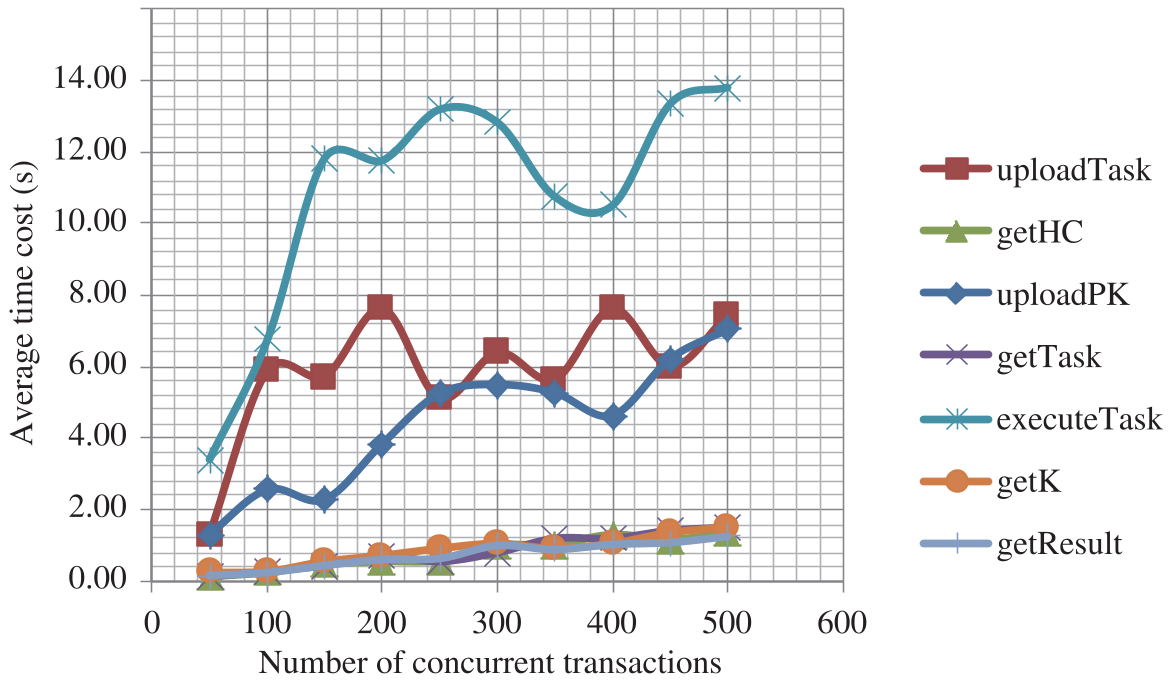 Figure 2: Time cost performance under high concurrency.
Security Comparison
SecBCS is compared against AMT and ZebraLancer across several dimensions:
| Feature | AMT | ZebraLancer | SecBCS |
|---|---|---|---|
| Data Confidentiality | No | Yes | Yes |
| Traceability | Yes | No | Yes |
| Secure Deployment | N/A | No | Yes |
Critical Analysis & Conclusion
Takeaway
SecBCS successfully demonstrates that hybrid security (cryptography + hardware isolation) is the path forward for decentralized IoT applications. By moving the heavy lifting of verification to TEEs (SGX) and using CPABE for access control, it removes the performance bottlenecks of previous generation systems.
Limitations & Future Work
The reliance on Intel SGX introduces a hardware dependency and a centralized trust point in Intel's manufacturing. Future iterations might explore Multi-Party Computation (MPC) or cross-hardware TEEs to further decentralize the trust model. Additionally, as the authors note, designing specialized verification logic for complex tasks (like geospatial data analysis) remains a separate, open challenge.
Editor's Note: SecBCS represents a pragmatic shift in blockchain research—prioritizing engineering feasibility and hardware-assisted security over "purist" cryptographic approaches that are too slow for real-world IoT.