
Second-Order Dynamics: Mastering "Contextual" Influence Maximization
18740_A Second-Order Diffusion Model for Influence Maximization in Social Networks.
This paper introduces a Second-Order Independent Cascade (2nd-IC) model for Influence Maximization (IM), moving beyond traditional node-to-node dynamics to capture "edge-to-edge" activations. By incorporating previous activation history, the authors propose the IMM_2nd algorithm (and its distributed version DIMM_2nd) which achieves SOTA accuracy in social influence simulation.
TL;DR
Standard Influence Maximization (IM) models often fail because they assume influence is "memoryless." This paper introduces a Second-Order Independent Cascade (2nd-IC) model that considers the source of information. By shifting from node-to-node to edge-to-edge activation, the researchers achieved a 22.5% boost in precision on Twitter data and provided a distributed algorithm capable of handling billion-scale edges.
Contextual Blindness: Why the IC Model Fails
Most social network algorithms use the Independent Cascade (IC) model: if Alice follows Bob, Bob has a fixed probability of influencing Alice. However, this ignores the provenance of the information.
If Bob (a tech influencer) tweets about a new GPU because he was influenced by NVIDIA, his followers react differently than if he was influenced by a gaming community. The IC model treats both scenarios as "Bob tweeting," leading to skewed predictions. This paper argues that influence is naturally second-order: the probability of a node being activated depends on the pair that preceded it.
The Core Innovation: Edge-to-Edge Diffusion
To bridge the gap between theory and reality, the authors reinvent the diffusion process.
1. Second-Order Influence Probability
The model defines as the probability that node activates , given that was originally activated by . This captures the "path-dependent" nature of social influence.
2. The Augmented-Line Graph Transformation
The most elegant part of the methodology is the transformation of the graph. By constructing an Augmented-Line Graph, the second-order problem is mapped back to a first-order problem.
- Original Edge (i, j) becomes a Node in the new graph.
- Original Path (i → j → k) becomes an Edge in the new graph.
This allows the use of established Reverse Influence Sampling (RIS) techniques while accounting for second-order dynamics.
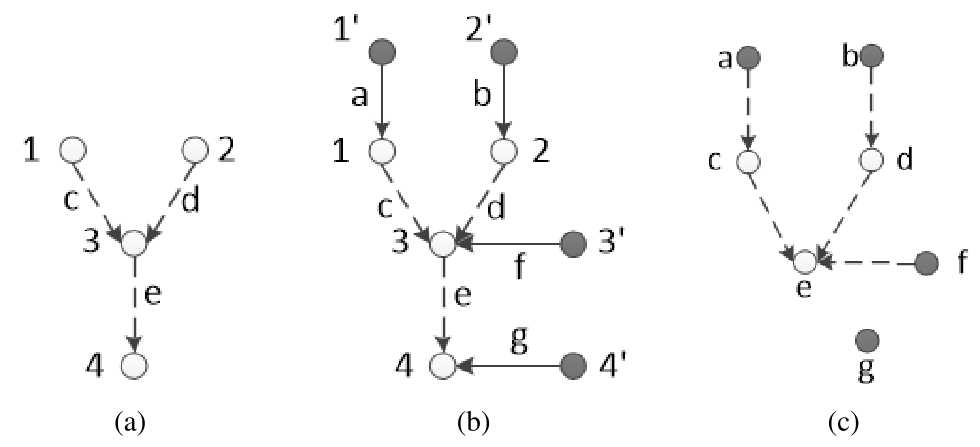 Figure: The transformation from a standard graph to an augmented-line graph enables second-order modeling within a first-order framework.
Scalable Performance: IMM_2nd and DIMM_2nd
Since 2nd-order modeling increases the number of "interaction units" from edges () to paths of length two (), computational efficiency is a major concern. The authors proposed:
- IMM_2nd: An RIS-based algorithm that provides a approximation guarantee.
- DIMM_2nd: A Hadoop-based distributed version that parallelizes the sampling of Reverse Reachable (RR) sets.
Experimental Results
Testing on the Twitter follower network (801K nodes, 10.2M edges) showed that the IC model predicted similar influence for unrelated communities (e.g., Game of Thrones vs. Westworld), while the 2nd-IC model correctly identified community-specific diffusion.
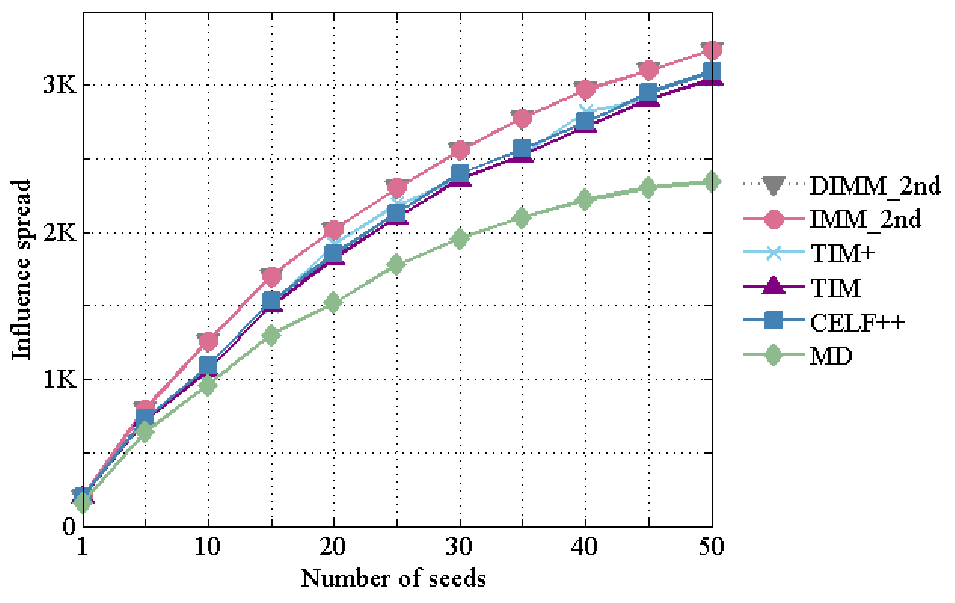 Figure: Comparison of influence spread and running time. Notice that while 2nd-order complexity is higher, the distributed algorithm (DIMM_2nd) keeps execution time competitive.
Critical Insight & Conclusion
This work highlights a critical shift in social network analysis: Context is king. By treating the activation of an edge as the primary event rather than the activation of a node, we can model much more complex social behaviors.
Limitations: The model relies on knowing or estimating . While the authors use an autoregressive model to estimate these for generic networks, the true power of this model is only unlocked when rich historical cascade data is available to train the probabilities.
Future Outlook: As we move toward more nuanced social AI, incorporating higher-order dependencies (3rd-order and beyond) and temporal decay into these edge-to-edge models will be the next frontier for viral marketing and misinformation containment.