
Deducing the "Hidden" Feelings: How Context Bridges the Gap to Secondary Emotions
Secondary Emotions Deduction from Context
This paper proposes a context-aware method for deducing secondary emotions (e.g., curiosity, interest, relaxation) in mobile users, specifically within a museum environment. By integrating user profiles with a multilayer perceptron neural network, the authors achieve a 35.5% recognition rate, significantly outperforming random chance and basic profile-based inference.
TL;DR
While AI has become proficient at recognizing a "happy" or "sad" face, detecting complex secondary emotions like curiosity or enthusiasm in the wild remains a challenge. This paper moves beyond facial expressions, proposing a system that predicts a user's emotional state by analyzing their context (weather, crowd size, time) and personal profile. Using a Neural Network, the researchers achieved a 35.5% accuracy rate in a museum setting—a major step toward truly empathetic mobile assistants.
The Problem: The "Basic" Emotion Trap
Most affective computing research resides in the laboratory, focusing on the "Big Seven" basic emotions. However, human experience—especially in learning environments like museums—is defined by secondary states: confusion, boredom, interest, and relaxation. These states don't always have a distinct "look" on a face, but they are heavily influenced by the environment.
The challenge is twofold:
- Subjectivity: One person's "crowded" is another person's "lively."
- Context Complexity: How do you quantify the impact of a rainy day vs. the celebrity of a painting on a visitor's mood?
Methodology: Context as a Proxy for Emotion
The authors turned a university room into an art gallery test-bed to collect data. They identified 18 binary Contextual Factors and 6 predominant Secondary Emotions relevant to the experience.
The Two-Tiered Approach
- Profile-Based Inference: Users filled out a questionnaire relating factors (e.g., "sunny day") to emotions (e.g., "calm"). The system multiplied current context values by this personal matrix to guess the emotion.
- Neural Network Enhancement: To capture non-linear relationships that a simple matrix couldn't, they designed a Multi-Layer Perceptron (MLP).
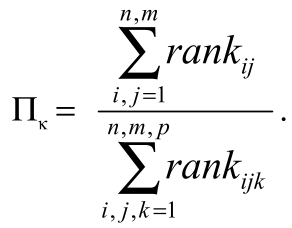 The mathematical core: Probability of emotion intensity as a function of contextual factors.
The Tech Stack
The researchers built a custom Mobile Museum Guide using J2ME (Java 2 Micro Edition) on legacy Nokia devices. The system tracked the number of people in the room, the specific painting being viewed, and current weather, communicating with a PHP/MySQL backend to log user-declared emotions for training.
Experiments & Results: Beyond Random Guessing
The study compared different classification architectures to see which could best map 48 input values (18 factors + 30 profile values) to 6 emotional outputs.
- Baseline (Random Guessing): 3.12% accuracy.
- Profile-Only: 17.3% accuracy.
- Neural Network (MLP): 35.5% accuracy.
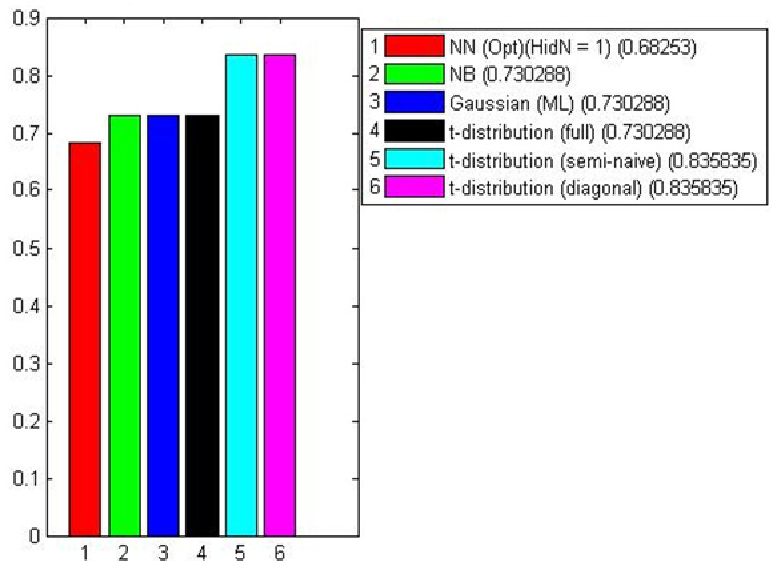 The comparison of various classifiers (Neural Network, Naïve Bayes, Gaussian, and SVM). The Neural Network with 8 hidden nodes emerged as the optimal performer.
The data showed that "Curiosity" and "Interest" were most strongly induced by the novelty of paintings and the celebrity of authors, while bad weather significantly diminished "Relaxation" and "Calm."
Critical Insight: Why This Matters
The shift from biometric sensing (which requires cameras or skin sensors) to contextual sensing is vital for privacy and hardware constraints. If a mobile device knows you are at a famous exhibit, it's a "sunny day," and you have "limited time," it can deduce you might feel "stressed" rather than "interested" and adapt its content accordingly (offering a "Quick Highlights" tour instead of a "Deep Dive").
Limitations & Future Work
While 35.5% is an improvement, it is far from perfect. The authors note that:
- Small Sample Size: The model was trained on only 8 users (231 events).
- Static Profiles: The profiles don't evolve. Future versions plan to use "Online Machine Learning" to let the system learn from real-time user feedback (e.g., "The system thinks you are interested—is that right?").
Conclusion
This work provides a blueprint for Affective Aware Services. By demonstrating that secondary emotions can be statistically linked to environmental factors, it paves the way for software that understands not just where we are, but how we are likely feeling because we are there.