
Secure Collaborative Social Networks: Bridging Data Silos with Homomorphic Encryption
Secure Collaborative Social Networks
The paper proposes a cryptographic framework for building Secure Collaborative Social Networks among multiple parties. It introduces a privacy-preserving protocol utilizing Paillier homomorphic encryption and digital envelopes to construct social graphs (e.g., from email metadata) without exposing raw interaction data between participants.
TL;DR
In an era of strict data regulations, organizations often find it impossible to share sensitive interaction data, hindering collective efforts like fraud detection or counter-terrorism. This paper introduces a privacy-preserving protocol that allows multiple parties to collaboratively build a social network. By using Paillier homomorphic encryption and a clever digital envelope technique, it ensures that no party ever sees another's raw data, yet the final global network is constructed with 100% accuracy.
Problem & Motivation: The "Data Sharing Paradox"
Social network analysis is a powerful tool for visualising flows of information and influence. However, we face a paradox: the most valuable insights come from merging datasets from different entities (e.g., banks or government agencies), but legal constraints (GDPR, HIPAA) and business secrecy make such sharing illegal or risky.
Previous attempts to solve this usually involved Anonymization (which can be reversed) or Perturbation (which ruins data accuracy). The author, Justin Zhan, identifies the core challenge: How can multiple parties decide if a relationship is "strong enough" to be an edge in a shared graph without revealing the exact weight of that relationship to anyone else?
Methodology: The Cryptographic "Secret Sauce"
The paper proposes a protocol centered on several key pillars:
1. Homomorphic Encryption (The Paillier System)
The foundation is a system where . This allows participants to "add" their local data to a global sum while the data is still encrypted.
2. Digital Envelopes and Modulo Arithmetic
To prevent the last person in the chain from reverse-engineering the total, the protocol uses a large integer and random numbers .
- Step I: Parties compute an encrypted sum of , where is local data and is the threshold.
- Step II: Because of the modulo operation, the noise disappears during decryption, leaving only the decision bit (whether the sum ).
3. Permuted Verification
To ensure Party 1 (the key owner) doesn't know which specific edge they are decrypting, Party sends a sequence of encrypted results mixed with random "dummy" values in a random permutation.
 Note: The protocol relies on a sequential ring architecture (P1 -> P2 -> ... -> Pn).
Experiments & Results
The author validated the framework using two real-world datasets:
- Enron Email Corpus: Building a graph where edges represent email frequency.
- NEC Research Article Dataset: Building a co-authorship network.
Key Performance Insights:
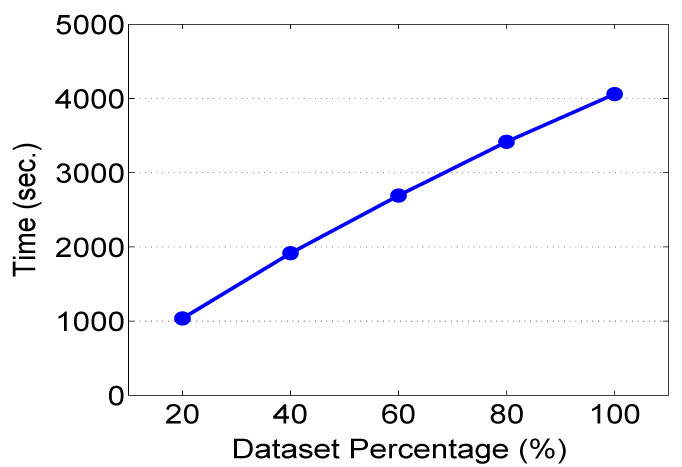
- Scalability: The time and communication costs scale linearly with the number of parties. Even with 100 participating organizations, the overhead remains manageable for offline network construction.
- Privacy Level: The variable (number of random dummy elements) act as a "privacy knob." As increases, the probability of an attacker correctly guessing a private value drops exponentially.
| K (Noise size) | Email Advantage (leakage) | Article Advantage (leakage) |
|---|---|---|
| 1 | 2.67E-05 | 9.26E-04 |
| 5000 | 5.35E-09 | 1.85E-07 |
The data confirms that the advantage gained by a malicious party is virtually negligible when is sufficiently large.
Critical Analysis & Conclusion
Takeaway
This paper moves beyond theoretical "toy" examples by applying heavy-duty cryptography to massive real datasets like Enron. It proves that privacy-preserving collaborative social networks are not just possible but computationally efficient enough for production use in investigative auditing and security.
Limitations
- Semi-Honest Model: The protocol assumes parties follow the rules. It may be vulnerable to "malicious" actors who provide fake local data to skew the global result.
- Sequential Latency: Because the protocol is a chain ( to ), if one party goes offline, the construction halts.
Future Work
The author suggests moving toward a general software library for privacy-preserving graph algorithms and exploring preprocessing techniques that could further obscure data before it even enters the cryptographic protocol.