
Streamlining Cross-Domain Access: A High-Efficiency Multi-Authority CP-ABE Scheme
A Secure Cross-Domain Access Control Scheme in Social Networks
This paper introduces a secure cross-domain access control scheme for social networks utilizing Multi-Authority Ciphertext-Policy Attribute-Based Encryption (CP-ABE) and symmetric hybrid encryption. The method removes the need for costly Proxy Re-encryption (PRE) by employing trusted Domain Proxy (DP) users to manage inter-domain key exchanges, achieving significantly faster encryption speeds than existing SOTA models.
TL;DR
The expansion of social networks into isolated administrative domains has created a "data silo" problem. This paper proposes a novel security architecture that combines CP-ABE with Symmetric Hybrid Encryption. By replacing traditional Proxy Re-encryption (PRE) with a Trusted Proxy User (DP) model, the authors achieve faster cross-domain data sharing without sacrificing fine-grained access control or collusion resistance.
Background & Motivation: The Cost of Crossing Borders
In modern social networking, users are often partitioned into different domains for management. If a User in Domain B wants to access data owned by a User in Domain A, the technical hurdle is high.
Current SOTA solutions usually rely on Proxy Re-encryption (PRE). In PRE, a semi-trusted proxy takes a ciphertext encrypted for Domain A and "transforms" it into a ciphertext for Domain B. While functional, this process is computationally expensive and introduces a heavy overhead that scales poorly with the number of attributes. The authors identify this "re-encryption bottleneck" as the primary obstacle to efficient big data sharing.
Methodology: Hybrid Encryption & DP-Assisted Exchange
The proposed scheme breaks the process into two logical layers:
- Hybrid Encryption Strategy: Instead of encrypting the entire message with ABE, the Data Owner (DO) uses a fast symmetric key (). Only this small is encrypted via CP-ABE.
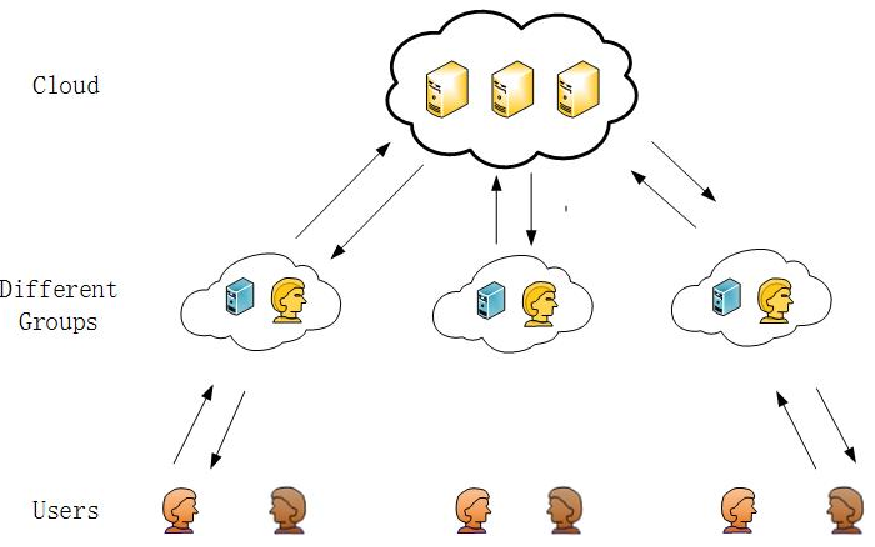
- The Role of the Domain Proxy (DP): Each domain features a DP. When a cross-domain request occurs, the DP of the target domain negotiates with the DP of the source domain. They exchange the symmetric key via secure digital signatures and asymmetric encryption.
- Decentralized Power: By evolving the multi-authority model, the scheme ensures that no single authority holds all the power, enhancing system stability and privacy.
Mathematical Intuition
The scheme utilizes Bilinear Maps over groups of order . The logic ensures that a Data User () can only reconstruct the pairing required to unlock if their attributes satisfy the access matrix . The "secret" is shared via a Linear Secret Sharing Scheme (LSSS), allowing for complex, monotonous access policies.
Experiments & Results
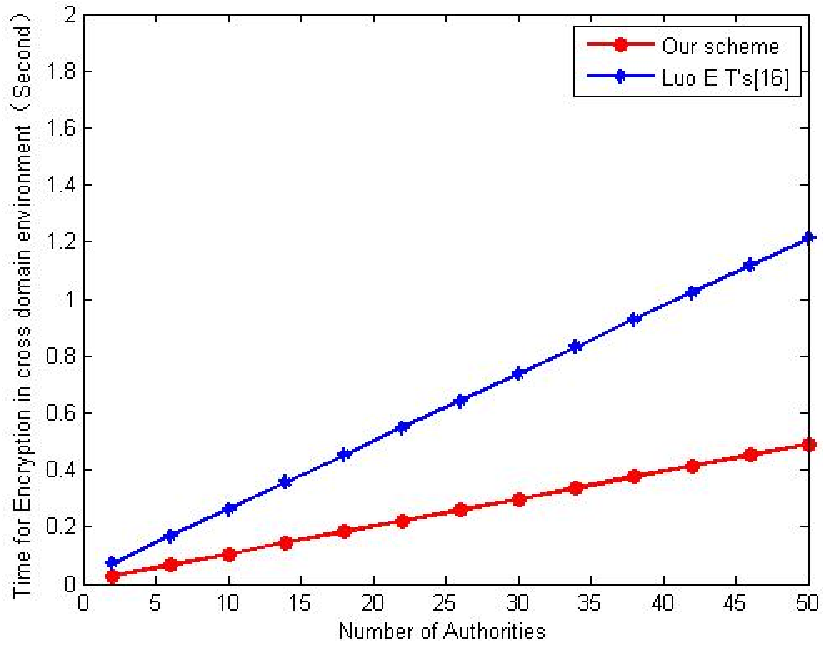
The authors compared their work against the baseline Luo et al. [16]. The theoretical analysis shows a reduction in the number of exponentiations in and pairing operations during the encryption phase.
Encryption Efficiency
As shown in the figure below, the time required to encrypt data in our scheme is significantly lower as the number of attributes increases. While SOTA methods show a steep linear growth, this scheme's slope is much gentler.
Decryption Performance
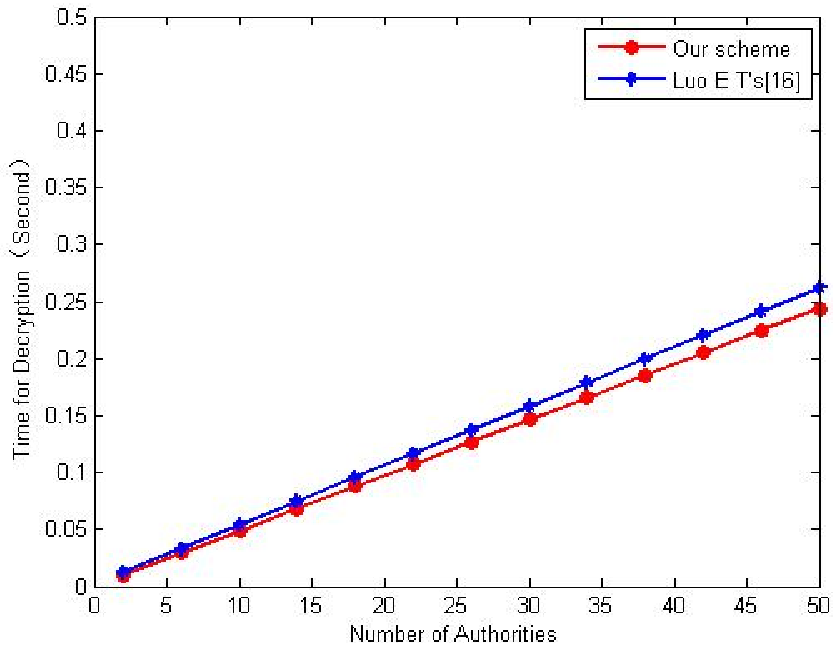
Interestingly, while the encryption speed is a major victory, the decryption speeds remain comparable to existing SOTA methods. This suggests that the optimization is "free"—improving one side of the system without penalizing the end-user's experience.
Critical Analysis & Conclusion
Takeaway
The paper successfully demonstrates that Inter-domain Proxying of keys is superior to Proxy Re-encryption of ciphertexts for high-concurrency social networks. It maintains Collusion Resistance by tying decryption keys to a unique Global Identifier (GID), ensuring that two unauthorized users cannot combine their attributes to steal data.
Limitations
- Proxy Trust: The DP is assumed to be "completely trusted." In a real-world adversarial environment, a compromised DP would be a single point of failure for that domain's key exchange.
- Attribute Revocation: The paper does not deeply explore how attributes are revoked or updated across domains once a key has been shared.
Future Outlook
This architecture is a strong candidate for integration with Edge Computing or Mobile Social Networks, where the computational savings of avoiding PRE would significantly extend battery life and reduce latency for mobile devices.