
Fo-DSC: Balancing Efficiency and Privacy in Fog-Based Spatial Crowdsourcing
Secure and Deduplicated Spatial Crowdsourcing: A Fog-Based Approach
This paper introduces Fo-DSC, a fog-based framework for spatial crowdsourcing that optimizes task allocation and enables secure data deduplication. By leveraging fog nodes at the network edge, the system achieves higher precision in locating mobile users while reducing communication overhead through privacy-preserving redundant data elimination.
TL;DR
Fo-DSC is a novel spatial crowdsourcing framework that integrates Fog Computing to solve the dual challenges of inefficient task allocation and redundant data overhead. It utilizes Message-Locked Encryption (MLE) to allow fog nodes to delete duplicate reports without seeing their content, and Key-Homomorphic Signatures to ensure every user gets credit for their contribution even if their data was pruned.
Background: The Crowdsourcing Bottleneck
As mobile devices become ubiquitous, spatial crowdsourcing (e.g., air quality monitoring, traffic sensing) has become a powerful way to collect environmental data. However, two "Efficiency Killers" plague the current systems:
- The Allocation Gap: Centralized servers (SC-servers) often don't know the real-time local distribution of users, leading to tasks being assigned to users who are unavailable or too far away.
- The Redundancy Tax: Multiple users in the same area often report the same data (e.g., "The air quality index is 50"). Sending these duplicates to the cloud wastes massive bandwidth, but deleting them at intermediate nodes usually exposes user privacy.
Methodology: The Power of the Fog
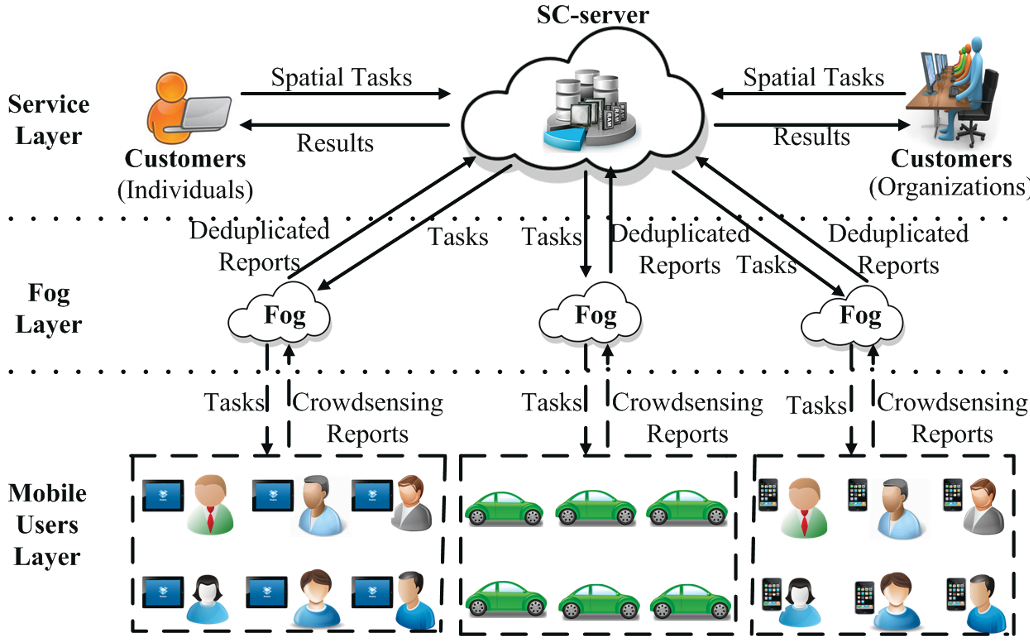
Fo-DSC inserts a Fog Layer between the cloud server and mobile users. This layer consists of edge devices like routers or access points that have "local eyes."
1. Two-Step Task Allocation
Instead of the SC-server talking to every user, it delegates to Fog Nodes. These nodes, being physically close to the action, use their knowledge of user mobility and trust levels to recruit the best candidates.
2. Secure Deduplication (The "Zero-Knowledge" Deletion)
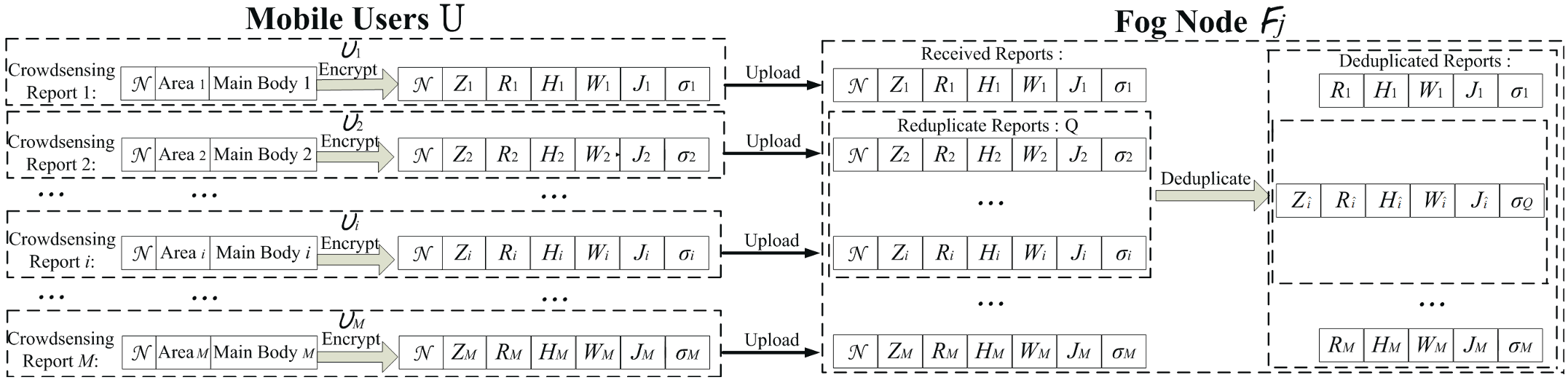
How can a fog node delete a duplicate report without reading it? The secret is Message-Locked Encryption (MLE). In MLE, the encryption key is derived from the message itself. If two users submit the same data, they will produce the same ciphertext and a matching "tag" (). The Fog Node simply compares the tags. If they match, it keeps one copy and discards the rest.
3. Contributor Aggregation
A common problem with deduplication is "lazy users" or ignored contributors. Fo-DSC uses Key-Homomorphic Signatures to allow nodes to multiply individual user signatures into a single aggregate signature (). This proves to the server that multiple people submitted it, ensuring everyone gets paid for their work.
Experiments & Performance
The authors benchmarked Fo-DSC against "TraS" (a traditional scheme without deduplication).
- Communication Efficiency: As the percentage of duplicate data increases, the bandwidth savings of Fo-DSC grow linearly. At 20% redundancy, the reduction in data traffic between the fog and server is substantial.
- Operational Success: Compared to random or epidemic task allocation, the fog-based approach achieves a significantly higher Task Perform Ratio while maintaining much lower Response Delay.
Critical Insight: Fairness vs. Security
The inclusion of signature aggregation is the "secret sauce" of this paper. Many deduplication schemes focus purely on storage savings, often leaving the original contributors invisible. By using homomorphic properties, Fo-DSC achieves "Accountable Anonymity"—the server knows who contributed (for rewards) but not what they specifically said until it decrypts the final consolidated report.
Conclusion
Fo-DSC presents a mature vision of edge-assisted sensing. By moving the heavy lifting of data cleaning and user management to the Fog, it paves the way for scalable, privacy-respecting urban sensing applications. Future work will likely look into how to filter out "noisy" or malicious data beyond simple identical duplicates.