
Secure DDS: Reclaiming Social Sovereignty through Distributed Buckets
Secure distributed data structures for peer-to-peer-based social networks
The paper proposes a secure, bucket-based Distributed Data Structure (DDS) for Peer-to-Peer (P2P) social networks. It introduces a decentralized list architecture implemented on top of the Pastry DHT, utilizing cryptographic access control and "remote operations" to achieve efficient, SOTA-level data management without central authorities.
TL;DR
The monopoly of centralized social giants like Facebook poses significant risks of censorship and data exploitation. This paper introduces a robust framework for Secure Distributed Data Structures (DDS)—specifically lists, sets, and trees—built on Peer-to-Peer (P2P) technology. By utilizing a "bucket-based" storage methodology and remote operations, the authors provide a scalable, encrypted, and efficient alternative to centralized databases.
Background: Beyond Simple Put/Get
Current P2P-based social networks (like LifeSocial or PeerSoN) rely on Distributed Hash Tables (DHTs). However, DHTs are fundamentally simple: you provide a key and get a value. In a real-world social network, we need more:
- Wall posts (ordered lists)
- Friend lists (sets)
- Profile searches (trees)
Implementing these with raw DHT operations is either bandwidth-heavy (downloading the whole list for one edit) or metadata-fragile. The core challenge is: how do we manage these structures across untrustworthy nodes while maintaining strict access control?
The Mathematical Intuition: Bucket-Based Organization
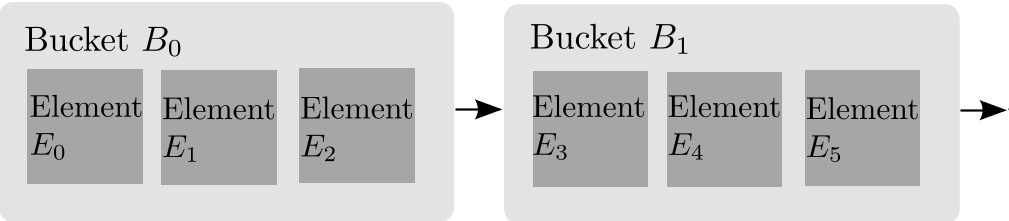
The authors reject the "all-on-one-node" vs. "one-entry-per-node" extremes. Instead, they propose Buckets.
Each list is divided into chunks defined by a splitsize. The key for a bucket containing the -th element is calculated as:
where is the hash function. This allows for parallel retrieval and ensures that even if one node fails, the entire OSN doesn't collapse.
Methodology: The Security Layer
The paper distinguishes between Read Access and Write Access:
- Read Access: Symmetric keys are encrypted for a specific "Group" of public keys.
- Write Access: Every entry has an owner. To modify a bucket, the user must provide a signature of the new content concatenated with a random nonce of the content being overwritten, preventing replay attacks.
Remote Operations & Consolidation
To save bandwidth, the system uses Remote Operations. Instead of downloading a 1MB bucket to change 1KB of data, the user sends a "change request" and a "new signature." The hosting node performs the update locally.
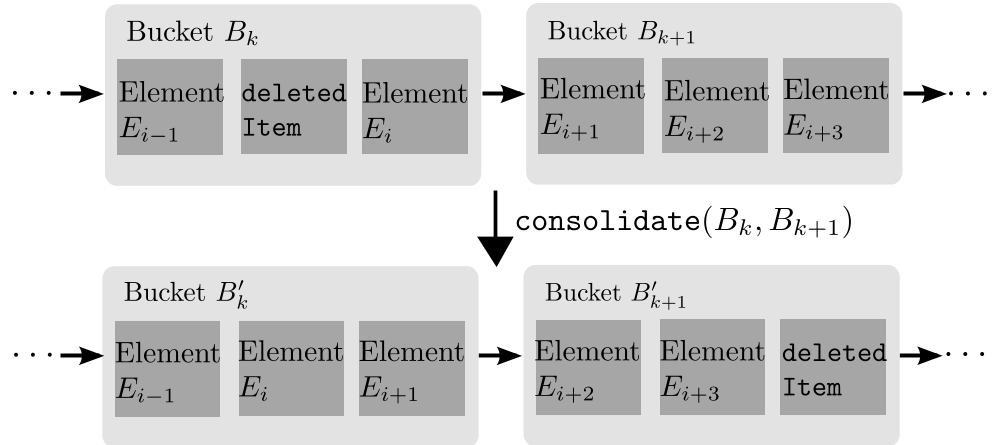
A significant contribution is the Consolidation Protocol. When items are deleted, they leave "tombstones" (deleted items). The consolidation protocol lazily shifts elements to close these gaps, ensuring the DHT doesn't fill up with "garbage" metadata.
Performance: The Traffic Trade-off
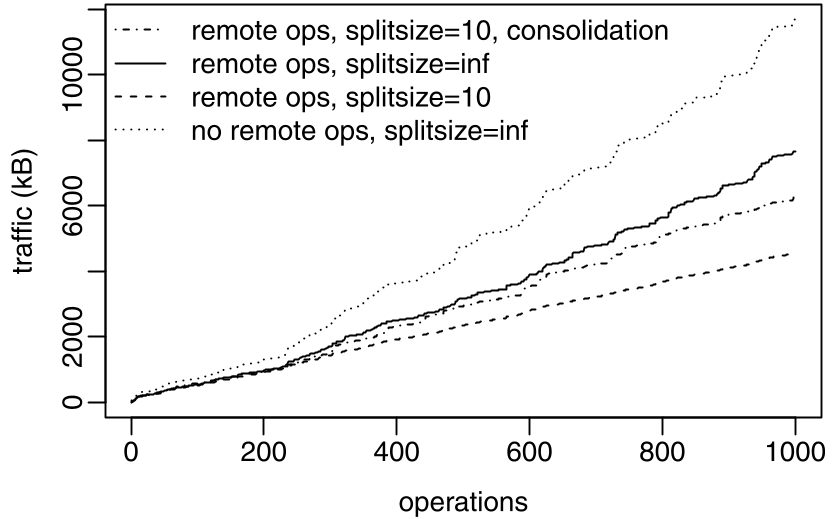
Experimental results (Settings A and B) highlight that:
- Remote Operations + Buckets significantly out-perform standard DHT methods.
- Traffic vs. SplitSize: Larger buckets increase bandwidth per write but drastically reduce the message count and the complexity of list consolidation.
- Efficiency: The ratio of deleted items can be kept under 5% with minimal traffic overhead, proving the system's sustainability.
Critical Insight & Conclusion
The genius of this work lies in the Security-Efficiency balance. By decoupling the "Pointer Structure" security from the "Entry Content" security, the authors allow the P2P network to perform structural maintenance (like consolidation) without ever needing to decrypt the private content of the users.
While the approach relies on a modified version of Pastry, its logic is portable to any modern DHT or decentralized storage system (like IPFS). As we move towards Web3 and sovereign data, these secure distributed structures will be the "standard libraries" for the decentralized apps of the future.