
Decentralizing Trust: A Hierarchical Approach to Secure Friend-Making in MSNs
Secure fine-grained friend-making scheme based on hierarchical management in mobile social networks
This paper introduces a Secure Fine-grained Friend-making (SFF) scheme for Mobile Social Networks (MSNs) based on hierarchical multi-authority attribute-based encryption (CP-ABE). It utilizes Shamir Secret Sharing and Bilinear Pairings to manage user attributes across multiple distributed centers, eliminating single-point failures and enhancing privacy during high-dimensional social matching.
TL;DR
Mobile Social Networks (MSNs) often force a trade-off between social connectivity and data privacy. This paper breaks that deadlock by proposing a Hierarchical Multi-Authority Attribute-Based Encryption (CP-ABE) scheme. By splitting attribute management across multiple authorities, the system prevents "all-or-nothing" security breaches and provides fine-grained control over who can see your data, all while maintaining high performance for mobile devices.
The "Single Point of Failure" Motivation
In typical dating or social apps (Tinder, Shopify), your personal data—hobbies, location, photos—is aggregated on a central server. If that server is hacked, or if the service provider is untrusted, your entire identity is exposed.
Previous attempts at using Attribute-Based Encryption (ABE) to solve this usually relied on a single central authority. The authors point out two critical flaws there:
- Key Escrow Risk: If the master key of the single authority is compromised, the attacker can generate any user's sub-key.
- Performance Bottleneck: A single server becomes overwhelmed as millions of users update their attributes simultaneously.
Methodology: Divide, Conquer, and Encrypt
The core innovation lies in Hierarchical Management. Instead of one authority, the system uses a Trusted Authority (TA) to manage several Attribute Authorities (AA).
1. Key Splitting and Sub-keys
User attributes (e.g., "Software Engineer," "Enjoys Hiking") are partitioned into disjoint shares. Each share is managed by a different AA. To decrypt a potential friend's profile, a requester must satisfy the access policy by gathering sub-keys from different AAs.
2. The Access Policy Tree
The data owner (Alice) defines an access tree (ACT) embedded in the ciphertext.
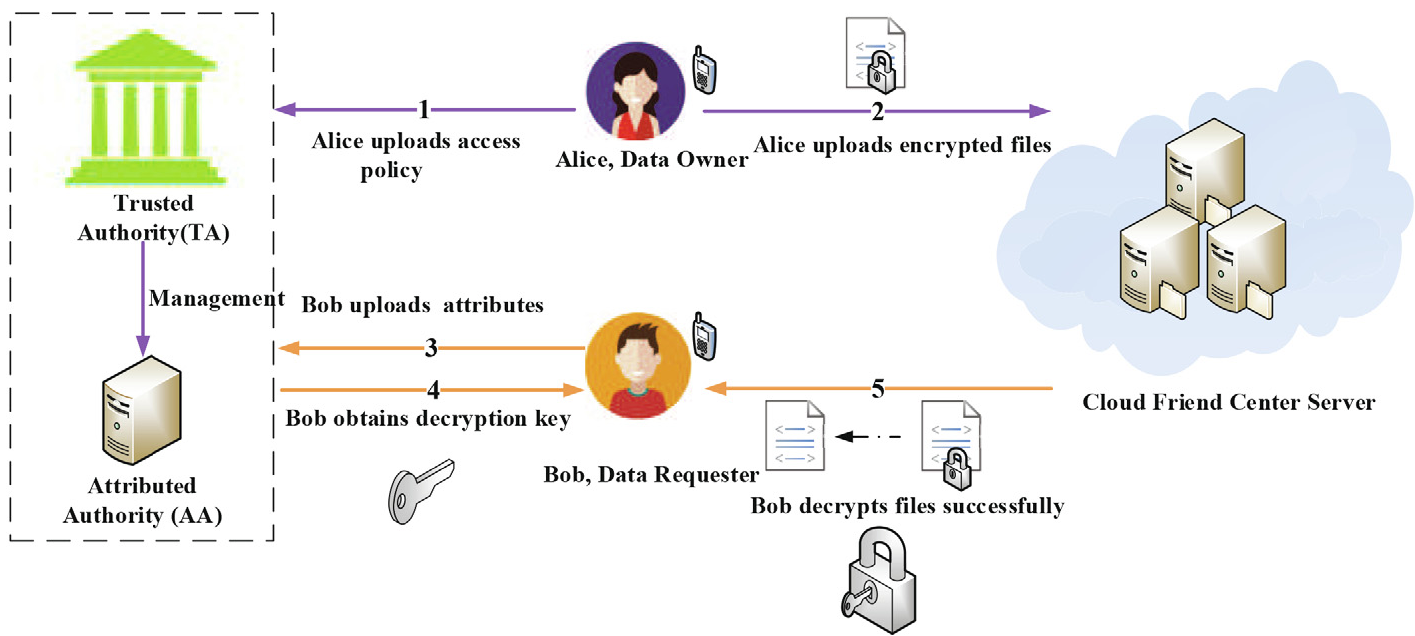 Fig 1: The overall workflow of secure friend discovery.
3. Recursive Decryption Logic
The scheme uses a DecryptNode function. If Bob is a requester, the system recursively checks if his attributes satisfy Alice's tree structure. Using Bilinear Pairings (), the system reconstructs the secret key if—and only if—the threshold of attributes is met.
Experimental Validation
The authors implemented the prototype using the PBC (Pairing-Based Cryptography) library.
Scalability with Attributes
As shown in the results, the system initialization time remains constant regardless of attribute count. More importantly, the Encryption Time is actually faster than previous multi-authority schemes (like Chase or Li) because the workload is distributed.
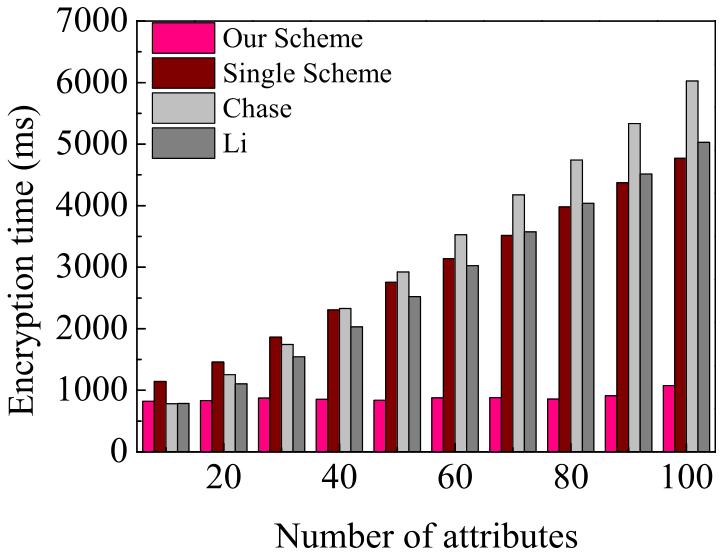 Fig 2: Encryption time scales linearly but stays beneath the 1-second threshold for 100 attributes.
Efficiency vs. File Size
The decryption of a 100MB file (including video or high-res images) takes less than 1.4 seconds, a negligible delay for a mobile user experience.
 Table 1: Theoretical vs. Practical Complexity analysis.
Critical Insight: Why This Matters
The shift from Single-Authority to Multi-Authority Hierarchical Management is not just a performance tweak; it is a fundamental shift in the security model. By ensuring that no single AA knows all of a user's attributes or the master secret, the scheme introduces a robust anti-collusion mechanism.
Even if an AA is "honest-but-curious," it cannot reconstruct the final plaintext because it only possesses a fragment of the necessary math to solve the Bilinear Pairing.
Conclusion & Future Outlook
This work demonstrates that fine-grained privacy and social matching are not mutually exclusive. While the current model assumes AAs are generally reliable, the authors suggest future work in identifying malicious users (social bots) who might simulate attributes to "scrape" profiles. Combining this hierarchical ABE with behavior-based trust scores could be the next frontier in MSN security.