
FTDS: Shielding Vehicular Social Networks with Blockchain and Aggregate Encryption
A Secure Flexible and Tampering-Resistant Data Sharing System for Vehicular Social Networks
The paper proposes FTDS, a secure and flexible data-sharing system for Vehicular Social Networks (VSNs). It integrates a novel Key-Aggregate Searchable Encryption (KASE) scheme with blockchain technology to achieve verifiable one-to-many selective encrypted data sharing and resistance against data tampering, reaching SOTA performance in security and functionality balance.
TL;DR
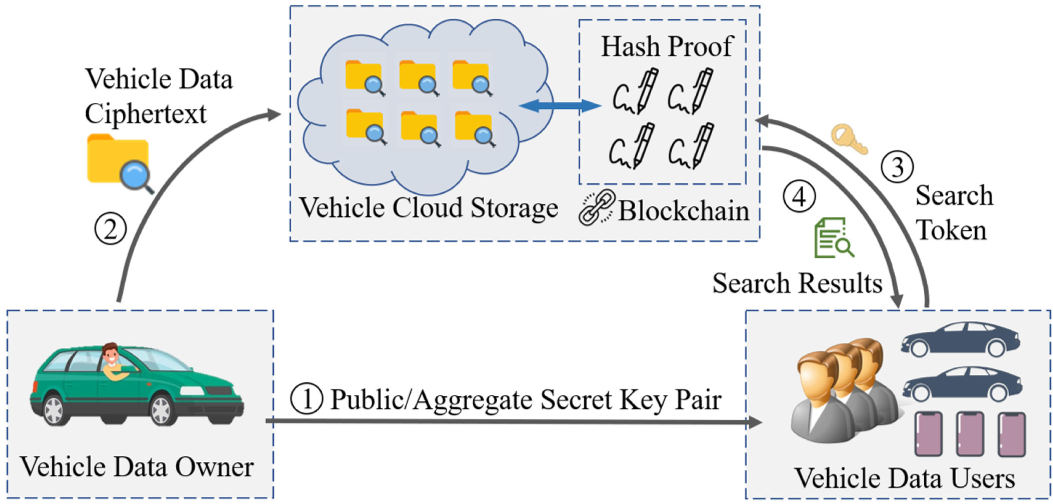
Vehicular Social Networks (VSNs) promise safer roads through data sharing, but they are prime targets for data tampering and privacy leaks. This paper introduces FTDS, a system that marries a novel Key-Aggregate Searchable Encryption (KASE) scheme with Blockchain technology. It allows vehicle owners to share various sensor data selectively with a single aggregate key while ensuring that neither the cloud nor the vehicle owner can secretly alter the records.
Problem & Motivation: The Trust Gap in VSNs
In a typical VSN, vehicles upload sensory data (speed, location, road conditions) to a cloud server. However, two major issues persist:
- Selective Sharing vs. Overhead: If a driver wants to share ten different types of data with a colleague, they usually need to share ten different keys. This is a management nightmare for mobile devices.
- The Incentive to Cheat: In the event of an accident, a driver might want to "edit" their uploaded speed data. Conversely, a cloud server might accept bribes to delete incriminating evidence. Existing "searchable encryption" often lacks a way to verify if the server returned the correct and untampered result.
Methodology: The FTDS Architecture
FTDS solves these issues through a multi-layered cryptographic approach.
1. Key-Aggregate Searchable Encryption (KASE)
The core innovation is the ability to generate a constant-size aggregate key. A data owner can delegate search rights for any subset of encrypted files. The user only needs one trapdoor to search across all authorized files, significantly reducing storage and communication overhead.
2. Blockchain as a Tamper-Resistant Ledger
Unlike previous works that store the data itself on-chain (which is expensive and slow), FTDS uses the blockchain to store Hash Proofs.
- Data Integrity: When a vehicle uploads encrypted data to the cloud, it simultaneously records the hash of that ciphertext on the blockchain.
- Verification: When a user retrieves data, they compare the retrieved data's hash against the immutable record on the blockchain.
3. Verifiable Search via Bloom Filters
To ensure the cloud server didn't "omit" relevant results, the system employs Bloom Filters. This allows the user to verify if the returned keyword-based results are complete and accurate without needing to decrypt everything first.
Experiments & Results
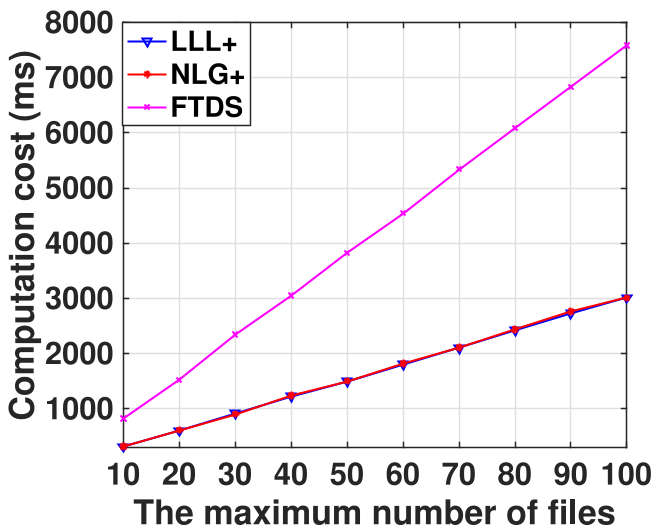
The authors implemented FTDS using the JPBC library (Type-A pairings) and compared it against major baselines including LLL+ and the blockchain-based NLG+.
Computation Efficiency
- Encryption and Retrieval: FTDS shows a significant performance gain over NLG+. For 50 keywords, FTDS encryption is nearly 2x faster due to streamlined modular exponentiation.
- Decryption: A standout feature is that decryption time remains constant (approx. 10-15ms), regardless of the number of files shared.
Storage Overhead
While FTDS requires more setup parameters to accommodate the "flexibility," the Trapdoor size is constant. This is vital for vehicles communicating over unstable wireless links (V2V/V2I).
Critical Analysis & Conclusion
Takeaway: FTDS successfully bridges the gap between privacy and accountability. It provides a "trustless" environment where data can be shared fine-grainedly without fearing that the storage provider (Cloud) or the producer (Vehicle) acts maliciously.
Limitations:
- PoW Latency: The reliance on Proof-of-Work (PoW) for the blockchain might introduce delays that are unsuitable for real-time collision avoidance.
- Setup Complexity: The initialization phase requires a large number of parameters (proportional to files), which could be a bottleneck for massive-scale vehicular networks.
Future Outlook: Shifting from PoW to more efficient consensus mechanisms (like PoS or PBFT) and optimizing the KASE setup for dynamic group environments are the next logical steps for making FTDS production-ready for autonomous driving ecosystems.