
Decoupling Detection from Secrets: A Stealthy Framework for Anti-Money Laundering
A Secure Framework for Anti-Money-Laundering using Machine Learning and Secret Sharing
This paper introduces a secure Anti-Money-Laundering (AML) framework that integrates Machine Learning with Shamir’s Secret Sharing. It enables multiple financial institutions to collaboratively detect "mule" account activities while maintaining strict data confidentiality through deterministic encryption and decentralized result recovery.
TL;DR
Money laundering is a multi-billion pound problem that thrives in the shadows of banking privacy laws. This paper presents a novel framework that allows banks to collaborate without "talking." By combining AES-SIV deterministic encryption with Shamir’s Secret Sharing, the system enables an independent auditor to detect suspicious transaction patterns across different banks while never actually seeing the identities of the account holders.
The "Data Privacy vs. Security" Deadlock
The core challenge in Anti-Money Laundering (AML) is a classic paradox:
- Collaboration is essential: Criminals use "mule" accounts across Bank A, Bank B, and Bank C to fragment funds.
- Secrecy is mandatory: Legal frameworks and commercial interests prevent Bank A from sharing its customer list with Bank B.
Current systems often fail because they only see "half the bridge." If an auditor can't link the "From" account in Bank A to the "To" account in Bank B, the money trail goes cold.
The Core Architecture: Three Pillars of Defense
The proposed framework breaks the detection process into three distinct, cryptographically secured phases.
1. Signalling: Hiding Identity, Keeping Relationships
To let an Auditor link transactions without revealing names, the authors use AES in Synthetic Initialization Vector (SIV) mode. Unlike standard encryption where the same input produces different ciphertexts, SIV is deterministic—the same account ID always produces the same "TY" (ciphertext).
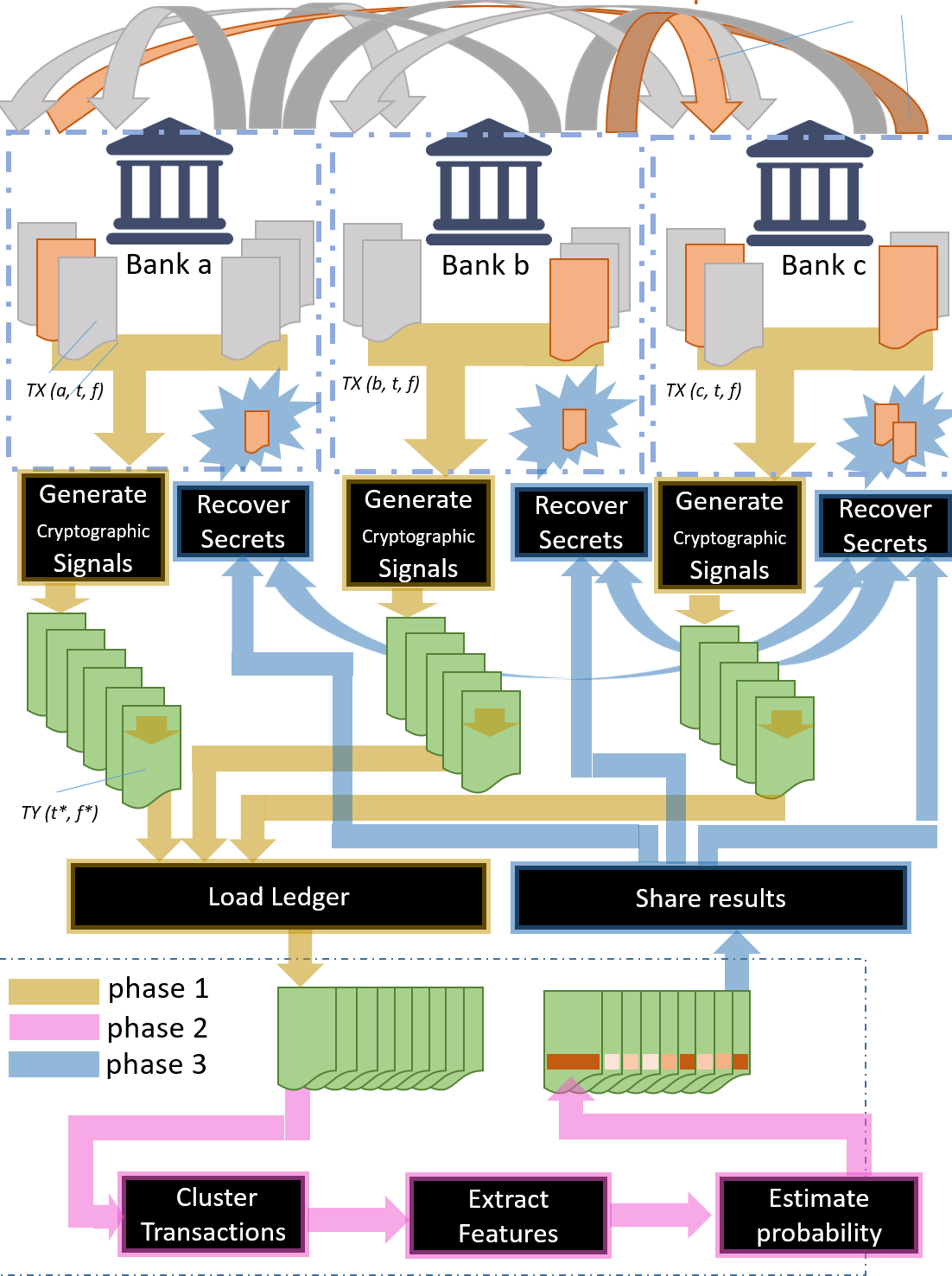 Fig 1: The information flow from banks to the auditor, highlighting the encrypted signalling and secret sharing feedback loop.
2. Detection: ML on Graphs
The Auditor organizes these encrypted signals into Directed Acyclic Graphs (DAGs). Even without knowing "who" the nodes are, the Auditor can calculate:
- The delay between transactions.
- The number of "grandchild" transactions (layering).
- The fragmentation of amounts.
These features are fed into a Supervised Learning model (Neural Networks or Decision Trees) to calculate a Probability of Suspicion ().
3. SAR Feedback: Cooperation via Secret Sharing
Once a Suspicious Activity Report (SAR) is generated, it isn't just emailed back. It is split into shares using Shamir’s (k, n) Secret Sharing.
- To see the result, k banks must agree to cooperate.
- No single bank (and certainly no eavesdropper) can read the report in isolation.
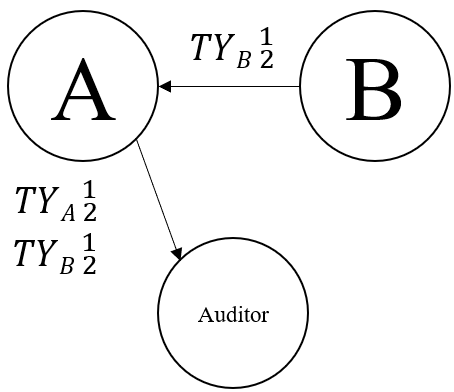 Fig 2: Pairwise signalling ensures that the Auditor receives matching encrypted tokens from both participating banks.
Why This Matters: The Intuition
The brilliance of this work lies in its Inductive Bias. Most privacy-preserving ML tries to use heavy tools like Fully Homomorphic Encryption (FHE), which is computationally expensive. This paper realizes that for AML, we don't need to perform math on the names; we just need to know if two names are the same. Deterministic encryption provides that "relational" link at a fraction of the cost.
Experimental Results
The authors validated the framework using a Python-based prototype:
- Detection Accuracy: 98% positive detection rate using a Fast Tree binary classifier.
- Performance: Negligible overhead for small-to-medium bank networks.
- Security: Protection against Man-in-the-Middle (MITM) attacks via PKI integration.
Critical Insight & Future Outlook
While the 98% accuracy is impressive, the authors rightly acknowledge the "Non-participating Bank" problem. If the money leaves the network of collaborating banks, the graph breaks.
The future of this technology likely involves Distributed Ledgers (Blockchain). Instead of a central Auditor, the neural network processing could be distributed across the banks themselves, creating a truly decentralized, trustless AML shield.
Takeaway: This paper provides a blue-print for how high-stakes industries can leverage Machine Learning without surrendering their "Crown Jewels"—the private data of their users.