
S-match: Beyond Simple Interests – Secure and Strength-Aware Friend Discovery in PMSNs
Achieving secure friend discovery in social strength-aware PMSNs
This paper introduces S-match, a privacy-preserving friend discovery protocol for Proximity-based Mobile Social Networks (PMSNs). It achieves fine-grained matching by integrating both interest priorities and spatiotemporal co-occurrence (social strength) into a unified two-dimensional similarity vector.
TL;DR
Discovering friends nearby via Bluetooth or WiFi usually means sacrificing privacy. S-match changes this by introducing a two-dimensional similarity model that considers not just what you like, but how much you like it and how often you've crossed paths with the other person, all while keeping your data encrypted using Paillier homomorphic encryption.
Context & Motivation
In Proximity-based Mobile Social Networks (PMSNs), the goal is to find "potential friends" in your immediate physical vicinity. Traditional methods treat interests as binary (you either like "Jazz" or you don't). However, real human social connection is more nuanced:
- Priority Matters: Two people both liking "AI" might not be a match if one is a hobbyist and the other is a researcher.
- Social Strength: Frequent co-occurrences in the same place at the same time suggest a higher probability of social relevance.
- Insider Threats: Malicious users might join the network just to "fish" for your private profile details.
Methodology: The Two-Dimensional Approach
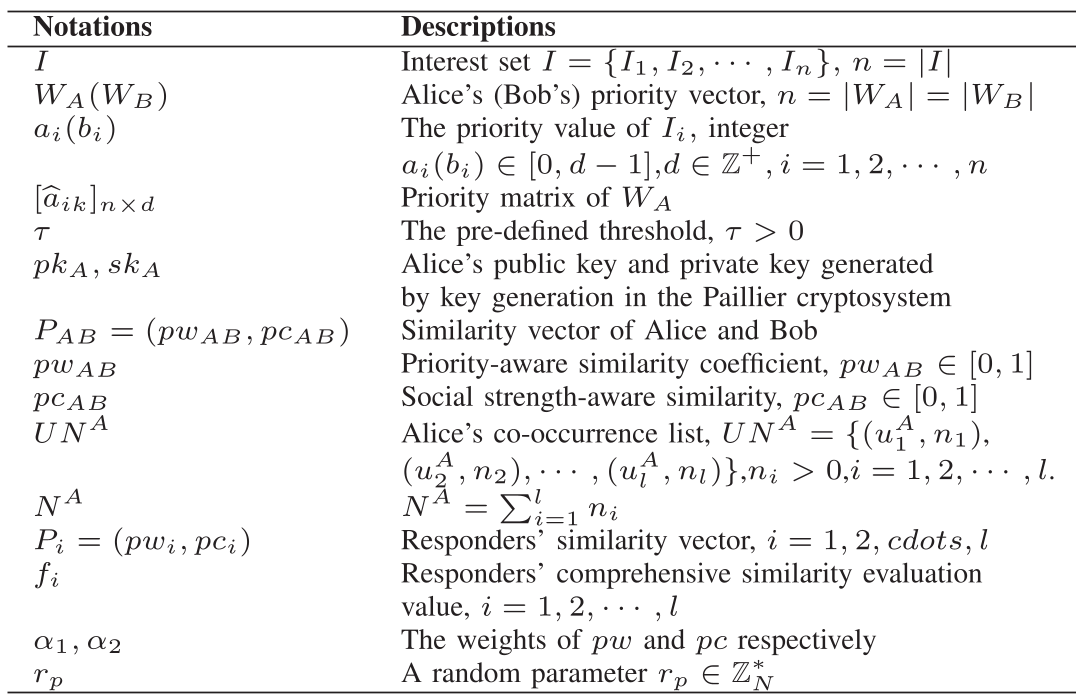
S-match evaluates the bond between users through a vector :
1. Priority-Aware Coefficient ()
Instead of a standard Jaccard index, the authors improve it to account for priority levels (assigned values from 0 to ): This ensures that matching high-priority interests yields a higher similarity score than matching low-priority ones.
2. Social Strength Coefficient ()
This utilizes the "frequency" of encounters. If Alice has scanned Bob's device ID many times over a month, their value increases, indicating a persistent local relationship.
3. Entropy-Based Weighting
To avoid arbitrary weights for interests vs. social strength, S-match uses an Entropy Method. It calculates weights () based on the distribution of data, making the evaluation objective.
Privacy via Paillier Encryption
To perform the calculation without revealing the values of or , S-match leverages the Paillier Cryptosystem.
- Alice (Initiator) sends an encrypted matrix of her priorities.
- Bob (Responder) uses the homomorphic properties to compute the sum of the minimums while the data is still in its encrypted state.
- Blinding: Bob adds a random parameter to the result, ensuring Alice only learns the ratio (the similarity) and not the raw sum.
Performance & Experiments
The authors tested S-match against several baselines (INFOCOM '12, ICME '10, SecureComm '14).
Key Findings:
- Efficiency: S-match requires fewer expensive exponentiation operations () in its online phase by offloading matrix encryption to the offline phase.
- Mobile Viability: On a Nexus S smartphone, S-match outperformed all baseline protocols in total execution time, making it practical for real-time background discovery.
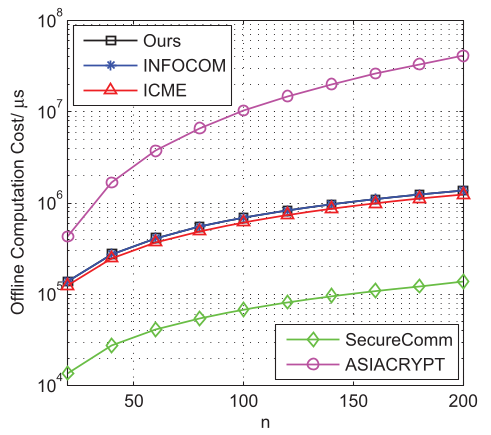 In the figure above, (a) and (b) highlight the significant reduction in computation cost and total execution time compared to previous SOTA methods.
Critical Analysis & Conclusion
S-match successfully addresses the "flatness" of previous proximity-based matching by incorporating social strength and interest priorities.
Strengths:
- Objective Weighting: The use of entropy for attribute weighting is a sophisticated touch that moves away from heuristic-based scoring.
- Insider Attack Resistance: The security proof demonstrates that even a malicious initiator cannot "guess" a responder's profile by iteratively changing inputs.
Limitations & Future Work:
- Communication Overhead: As shown in the results, S-match has a slightly higher communication cost (in bits) because it transmits a priority matrix rather than a simple bitset.
- Scalability: While efficient for one-on-one discovery, future research could explore how this scales to dense environments with hundreds of concurrent users without causing a "broadcast storm."
Takeaway: This work represents a significant step toward "Social-Aware" privacy, acknowledging that our physical habits (co-occurrence) are just as important as our digital profiles.