
SSH: Secure Handshaking as the Bedrock of mHealthcare Social Networks
Secure Handshake with Symptoms-matching: The Essential to the Success of mHealthcare Social Network
This paper introduces the concept of mHealthcare Social Networks (MHSN) and proposes a Secure same-Symptom-based Handshake (SSH) scheme based on bilinear pairings. The core objective is to allow patients to discover and authenticate others with the same medical symptoms while preserving privacy against those who do not share the same condition.
Executive Summary
TL;DR: This paper pioneers the "mHealthcare Social Network" (MHSN) by introducing a Secure same-Symptom-based Handshake (SSH) protocol. It allows patients to anonymously find peers with the same medical condition to exchange support and collaboratively relay health data, while ensuring that those with different symptoms learn nothing about the patient's health status.
Academic Positioning: This work bridges the gap between Mobile Social Networks (MSN) and eHealthcare security. It moves beyond simple encryption-at-rest for health data and addresses the "Matching Problem" in a privacy-preserving way, utilizing bilinear pairings to achieve provable security.
Problem & Motivation: The Privacy Dilemma of Social Healing
For elderly patients, social support from peers with similar chronic conditions (e.g., diabetes or heart disease) is clinically beneficial. However, in an mHealthcare environment (using Body Sensor Networks and PDAs), how do you find someone with your symptom without shouting your illness to the world?
Existing protocols traditionally faced two main threats:
- Impersonator Attack: An adversary pretending to have a symptom to gain access to a patient's support group.
- Detector Attack: A curious observer (or an AP) trying to deduce a patient's symptom by observing their handshake attempts.
The authors identify that for an MHSN to be viable, it must guarantee Detector Resistance—meaning if we don't share the same symptom, you shouldn't even know what I'm looking for.
Methodology: Bilinear Pairings for Symptom Matching
The heart of the paper is the SSH Protocol. Instead of using standard PKI, it leverages Identity-Based Encryption (IBE) logic where the "Identity" is derived from the Symptom (Ti) and the Pseudo-ID (pid).
Model Architecture
The system consists of a Trusted Authority (TA), mobile patients with Wireless Body Sensor Networks (WBSN), and opportunistic Access Points (AP).
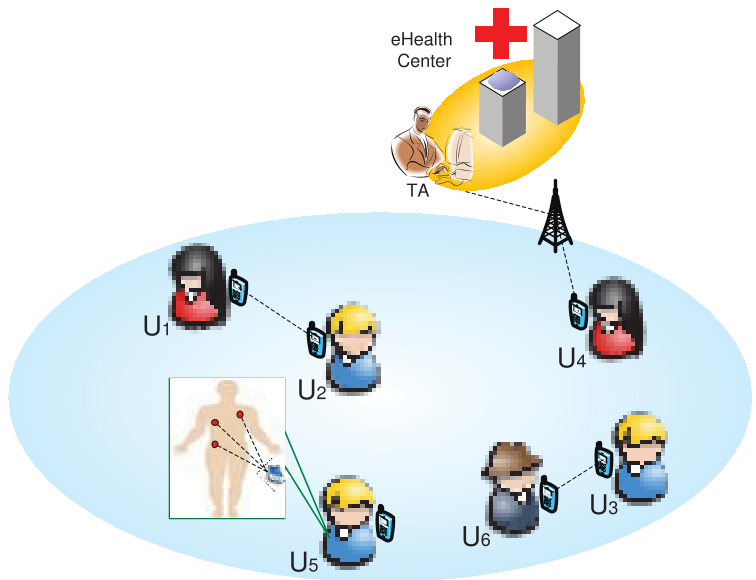
The SSH Handshake Logic
- System Setup: The TA generates a master key and publishes parameters including symptoms .
- The Mutual Challenge: When two patients (Ui, Uj) meet, they exchange pseudo-IDs and generate random nonces. They encrypt these nonces using the other party's pseudo-ID and their own symptom.
- The Cryptographic Lock: Because the private key is mathematically bound to the symptom , the decryption only succeeds if .
- Session Key: If the symptoms match, they derive a shared key , enabling encrypted social chat and collaborative data relaying.
Experiments & Results: Efficiency through Social Collaboration
The authors conducted simulations to see if this social layer actually helps the network beyond just "chatting."
PHI Collaborative Reporting
In mHealthcare, a patient might move out of range of an Access Point. If they "handshake" with a same-symptom peer who is moving towards an AP, they can securely delegate their health data (PHI) to that peer.
Key Result: As shown in the simulation graph below, the Patient Reporting Delay (PRD) drops significantly as the social ratio () increases. Sociable patients (those participating in SSH) consistently see lower latency in getting their medical data to the eHealth center compared to unsociable ones.
Performance Specs
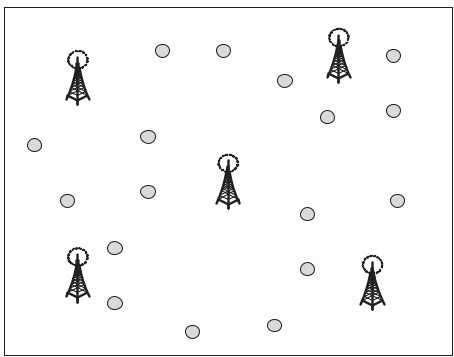
The simulation used 80 patients moving at human speeds (1 m/s) over a 1km x 1km area. The results validate that SSH is not just a security overhead; it is a utility multiplier for the network's throughput and reliability.
Critical Analysis & Conclusion
Takeaway
The SSH protocol successfully solves the "matching" problem without a central intermediary. By tying cryptographic identity to medical symptoms, it creates a "Zero-Knowledge" environment for social discovery. This is a vital step toward making healthcare monitoring human-centric rather than just data-centric.
Limitations
- Trusted Authority Dependency: The system relies heavily on a central TA for key issuance. If the TA is compromised, the privacy of all patients is at risk.
- Symptom Granularity: The paper assumes a finite set of symptoms. In reality, medical conditions are complex and multi-faceted, which might require more complex Attribute-Based Encryption (ABE) rather than simple IBE.
Future Outlook
The concept of "Symptoms-matching" can be extended to Multi-attribute matching (e.g., same symptom + same age group + same neighborhood) using functional encryption, making mHealthcare social networks even more tailored to patient needs.