
Secure Crowdsourcing: Privacy-Preserving Indoor Localization via Gene Sequencing
Secure mobile crowdsourcing for WLAN indoor localization
This paper introduces a secure mobile crowdsourcing framework for WLAN indoor localization that utilizes gene sequencing concepts and PDR to construct mobility maps. The system achieves high-precision positioning (81.9% confidence within 4m error) while intrinsically protecting user location privacy through anonymous, random trace collection.
TL;DR
Indoor localization often faces a trade-off: higher accuracy usually requires more invasive data tracking. This paper breaks that cycle by proposing a Secure Mobile Crowdsourcing framework. By treating fragments of Wi-Fi signals like genetic sequences and stitching them into a "Mobility Map," the system achieves high-precision localization (81.9% accuracy within 4m) without ever identifying a user's specific path from start to finish.
Problem & Motivation: The Privacy vs. Precision Paradox
Most state-of-the-art indoor positioning systems rely on either Fingerprinting (mapping RSSI to coordinates) or Network-side Trilateration. While effective, they have two fatal flaws:
- Maintenance Nightmare: Changes in the indoor environment require manual recalibration of the fingerprint database.
- Privacy Exposure: Continuous tracking of a user’s trace from "Point A to Point B" reveals social relations, personal interests, and daily routines, making users vulnerable to attackers or unauthorized data harvesting.
The authors' insight is to use Anonymous Crowdsourcing. Instead of tracking one person for a long distance, they collect small, random trace segments from many users and "assemble" them like a jigsaw puzzle.
Methodology: Assembling the "Movement Genome"
1. Motion Graph Assembling (The Gene Sequencing Logic)
The core innovation lies in treating RSSI (Received Signal Strength Indicator) sequences as genetic strands. The system computes a similarity scoring matrix between different users' trace segments. By finding overlapping "motifs" in the signal data, the system can stitch random movements into a coherent Motion Graph using Pedestrian Dead Reckoning (PDR).
2. Mobility Map Construction via MDL-DBSCAN
To turn raw graphs into a clean map, the authors use the Minimum Description Length (MDL) principle for segmenting traces, followed by DBSCAN (Density-Based Spatial Clustering of Applications with Noise). This identifies the most frequently traveled corridors and paths, essentially "learning" the walkable areas of a building automatically.
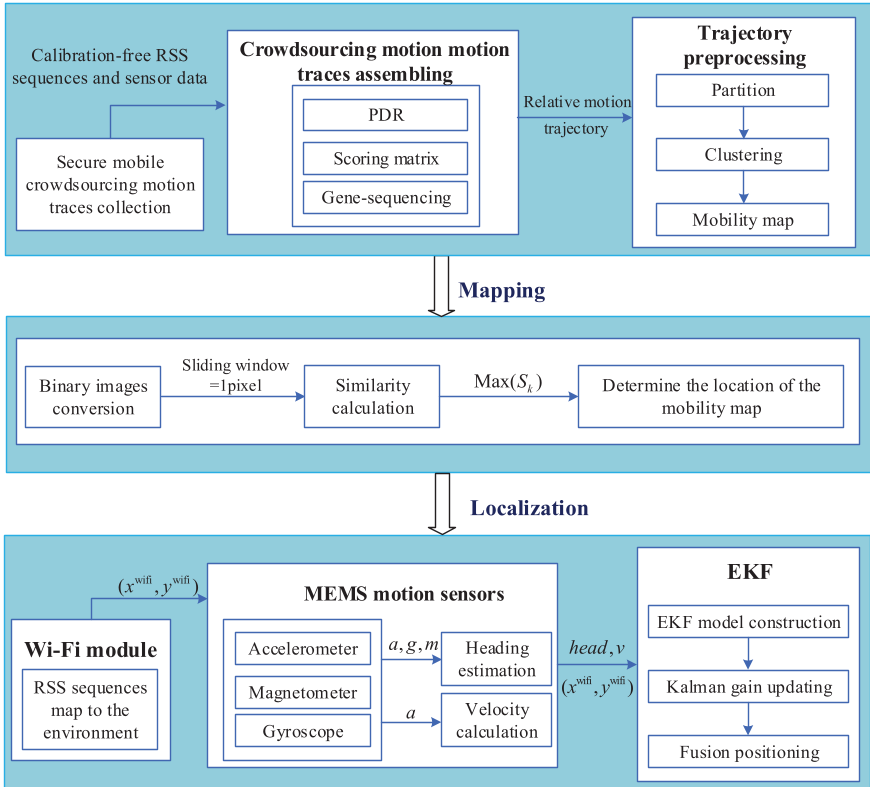 Figure 1: The three-stage process: Data collection, Mobility Map construction, and EKF-based Localization.
3. Pixel Template Matching
Once the mobility map is created, it needs to be "pinned" to the real world. Instead of manual labeling, the authors convert the floor plan and the mobility map into binary images. They then use a sliding window approach to find the highest similarity between the pixels of the generated map and the actual building layout.
Experiments & Results: Better Accuracy, Lower Cost
The system was tested in a real WLAN environment with six Access Points.
- Matching Accuracy: As the number of crowdsourced traces increased from 15 to 150, the coincidence rate of the template matching jumped from 16% to 98.89%. Ironically, the time cost decreased as more data was added because the resulting mobility map became more distinct and easier to match.
- Localization Precision: By using an Extended Kalman Filter (EKF) to fuse MEMS motion sensors (accelerometers, gyroscopes) with WLAN signals, the system significantly outperformed existing methods like CIMLoc.
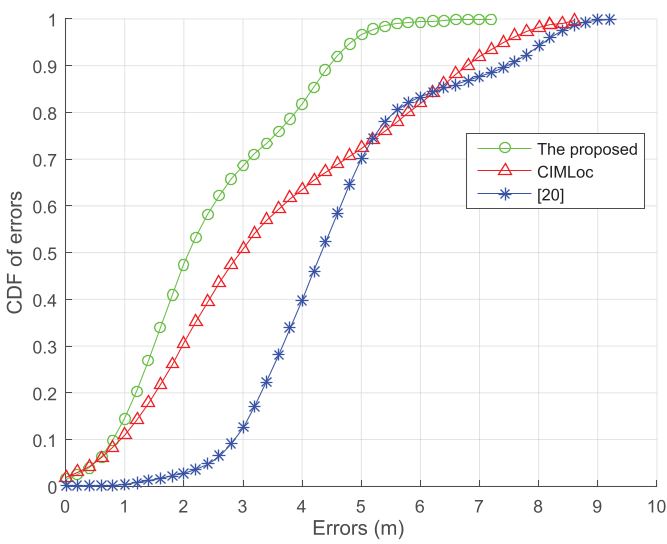 Figure 2: The CDF plot shows the proposed method (solid line) achieving much lower error rates compared to traditional fingerprinting.
Critical Insight & Conclusion
Takeaway
The genius of this work is the decoupling of data from identity. By using the structural similarities in signal space (gene sequencing) and physical space (template matching), the authors prove that we don't need to know who traveled where to build an effective map of how people move.
Limitations & Future Work
While the system is robust, it still relies on MEMS sensors (barometers, magnetometers) which can be noisy in high-interference environments. The authors aim to explore "sensor-less" versions of this privacy-preserving framework in the future, further reducing the hardware requirements for secure crowdsourcing.