
Finding a Secure Place: Re-mapping the City for the Autistic Experience
Finding a Secure Place: A Map-Based Crowdsourcing System for People With Autism
The paper presents a map-based crowdsourcing system designed to help individuals with autism navigate urban environments by identifying "secure places." It introduces a specialized VGI (Volunteered Geographic Information) platform that mirrors the unique sensory and cognitive needs of neurodiverse users, achieving high acceptability among high-functioning autistic participants.
TL;DR
Current urban navigation is built for the "average" brain, often ignoring the sensory landscape that can make or break the day for someone with autism. This paper introduces a groundbreaking crowdsourcing platform that maps cities not by streets, but by sensory safety. By allowing users to rate noise, light, and "crowdedness," the system creates a digital sanctuary for neurodiverse individuals, turning the unpredictable city into a predictable, navigable space.
Problem & Motivation: The Invisible Barriers of the City
For most, a noisy square or a brightly lit shop is a minor annoyance. For a person with autism, it can be a sensory assault leading to "sensory overload" and intense anxiety.
The authors argue that existing assistive technologies suffer from two main flaws:
- The Medical Model Bias: Most tools focus on "fixing" the person or treating autism as a set of limitations rather than a different way of perceiving the world.
- Spatial Blindness: While we have maps for wheelchairs, we lack maps for the mind. There is no "Google Maps" filter for "Quiet, Low-light, and Familiar."
The research intuition here is Phenomenology: understanding the world "from the inside." Instead of telling autistic users where they can go, the authors asked them what makes a place feel secure.
Methodology: Designing for Sensory Autonomy
The researchers defined a "Secure Place" as a triad of Familiarity, Sensory Comfort, and Interest. To turn this into a functional system, they built upon the FirstLife civic social network.
Key Technical Features:
- Sensory Highlights: Users rate places on six dimensions: Noise, Crowding, Temperature, Brightness, Openness, and Smell.
- Multiscale Topology: To avoid "information overload" (a common trigger), the map uses a custom indexing system that clusters data by neighborhoods and blocks, preventing the UI from becoming cluttered.
- Hybrid Recommendation: When a user is in a state of high anxiety, they don't have the cognitive load to browse. The system uses a "cascade" approach (Content-based + Collaborative Filtering) to suggest the nearest "safe" place based on the user's specific aversions.
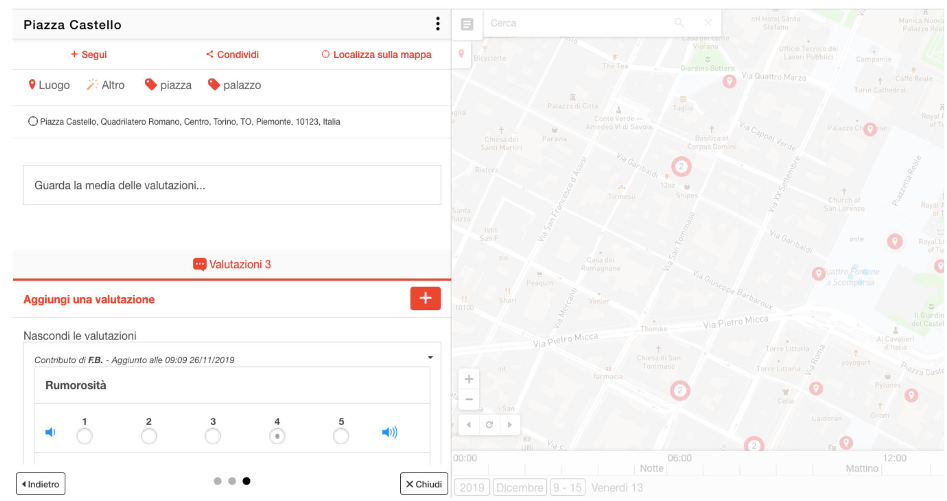 Above: The system's mobile and desktop interface, showing the "Sensory Cards" that provide an instant snapshot of a location's environment.
Experiments & Results: Different Worlds, Different Maps
The evaluation involved 16 participants (8 autistic, 8 neurotypical). The findings were a masterclass in User Experience (UX) diversity:
- Landmark vs. Geometry: Autistic users didn't just look at street names; they searched for "anchor points" like fountains or specific bus stops. If these weren't on the map, they felt lost.
- The "VGI" Success: Autistic participants were highly motivated to contribute to the map, viewing it as a way to help their community ("Aspi-friendly" mapping).
- Quantitative Accuracy: The recommendation engine's simulations showed high precision (RMSE 0.12), suggesting that the system can accurately predict "safe" locations even with sparse user data.
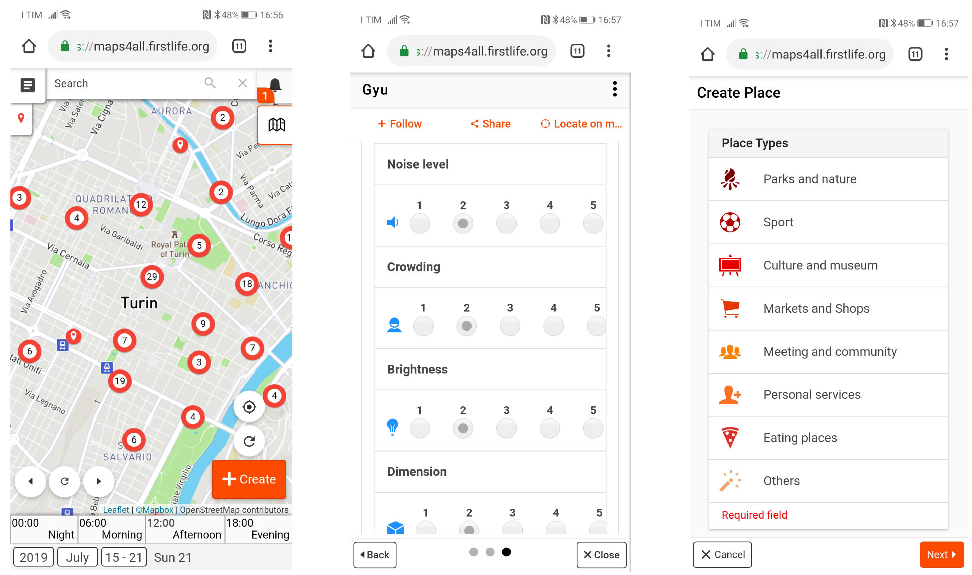 Above: Responsive design ensures that the sensory safety data is accessible on-the-go via mobile devices.
Critical Analysis & Conclusion
The "Personalization" Mandate
The most profound takeaway is that "Accessible" does not mean "Universal." The study found that one autistic user might crave silence, while another avoids too-quiet places. This renders static "autism-friendly" labels useless. The future of neurodiverse design must be hyper-personalized.
Limitations
While the system is brilliant for high-functioning individuals, it currently excludes those with low-functioning autism who may have even more acute sensory needs but struggle with digital interfaces. Furthermore, the "Crowdsourcing" element relies on neurotypical users being willing to provide "sensory data"—a behavior that requires long-term incentive structures.
Conclusion
This paper is a vital step toward Cognitive Urbanism. It proves that technology's greatest role isn't to "correct" neurodiversity, but to provide a layer of predictability and control over an often chaotic world. For a person with autism, a map of "secure places" isn't just a tool—it's a gateway to the city.