
Beyond Blind Trust: A Hybrid Sentinel for Secure Social Networking
A Secure and Sustainable Framework to Mitigate Hazardous Activities in Online Social Networks
This paper introduces a hybrid framework combining pre-filtering and post-filtering mechanisms to mitigate cyber hazards in Online Social Networks (OSNs). By integrating a multi-level Friend Request Acceptance (FRA) evaluation with Natural Language Processing (NLP) based continuous behavior monitoring, the proposed system provides a comprehensive security layer for social interactions.
TL;DR
Online Social Networks (OSNs) are breeding grounds for cyber hazards like stalking and harassment because they rely on binary trust: once a friend request is accepted, the scrutiny ends. This paper proposes a dual-layer defense system—Hybrid Filtering—that employs weighted attribute matching for new friends and NLP-driven monitoring for existing ones. Experimental results show a staggering 2.03x improvement in perceived reliability compared to traditional manual or blind filtering methods.
The "Static Trust" Fallacy
The fundamental flaw in current OSN architectures (Facebook, X, LinkedIn) is their reliance on a static trust model. Most users either accept requests "blindly" or perform a superficial manual profile check. However, a legitimate-looking requester might be a bot, or a once-reliable friend might turn malicious over time due to ideological or personal changes. Existing research has historically been siloed into either Pre-filtering (recommender systems) or Post-filtering (spam detection), but rarely both.
Methodology: The Two-Phase Guard
The core of this work is the synergy between initial vetting and continuous behavioral analysis.
1. Pre-Filtering: Weighted Attribute Matching
Instead of just looking at mutual friends, the system calculates a weighted value () based on common positive and negative features between the user, the requester, and even the requester's friends.
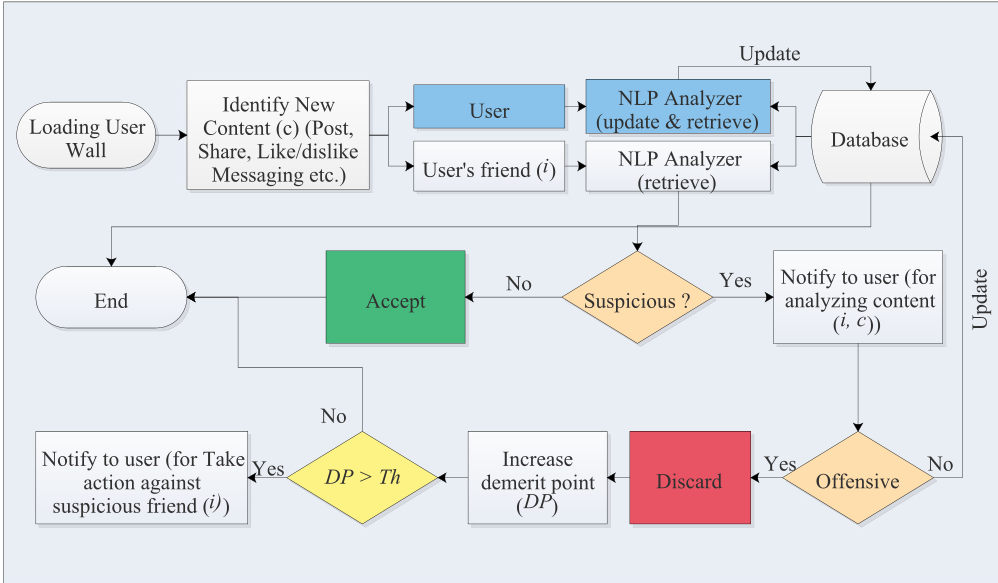 Figure: The Hybrid Approach integrates Reliable FRA and Monitoring.
The formula prioritizes features based on user consent (), ensuring that the system aligns with individual privacy standards:
2. Post-Filtering: NLP and Demerit Points
Once a friend is added, the system doesn't stop watching. It uses an NLP analyzer to verify posts and messages against a database of keywords. If a friend posts offensive content, they are assigned Demerit Points (DP). If the accumulated DP exceeds a threshold (), the system recommends an immediate block.
Experiments and Results
The researchers conducted a T-test analysis comparing the Hybrid method against standalone pre/post-filtering and existing manual methods.
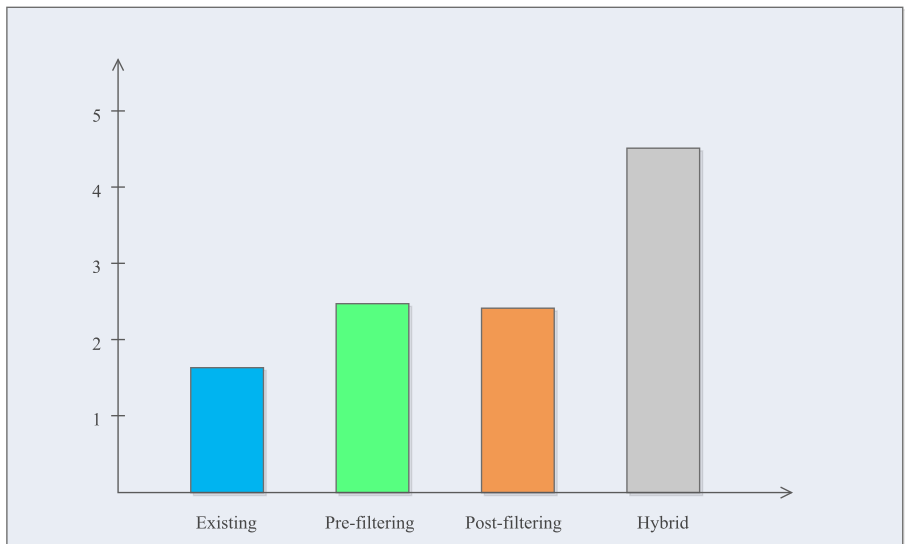 Figure: The Hybrid method significantly dominates in User Preference (Mean = 4.52).
Key Metrics:
- Security Acceptability: The hybrid approach scored 4.50/5.0, whereas existing manual methods struggled at 2.72/5.0.
- Reliability Index: Users felt the hybrid system was significantly more "honest," with a mean rating of 4.62.
- T-test Significance: All results yielded , confirming that the improvements were statistically significant and not due to random chance.
Critical Insights: Sustainability Through Security
The brilliance of this framework lies in its Sustainability. By automating the "gardening" of a user's social circle, it reduces "social fatigue"—the mental burden of manually monitoring who is seeing your private data.
Limitations: While powerful, the NLP analyzer relies heavily on a keyword database, which might struggle with sarcasm, evolving slang, or image-based hazards. Furthermore, the multi-level attribute matching (checking friends-of-friends) introduces potential computational overhead in massive networks.
Conclusion
This paper serves as a blueprint for the next generation of social platforms where security is an active, ongoing process rather than a one-time gatekeeper. By combining the "who you know" with the "how you act," we can finally move toward a truly sustainable digital society free from cyber-technical hazards.