
Securing Digital Reputation: Why Your Real-World Friends Matter More Than Amazon Stars
6161_Securing Digital Reputation in Online Social Media [Applications Corner].
This paper explores strategies for securing digital reputation in online social media by addressing two under-investigated areas: the collection of realistic attack data via crowdsourcing and the significant impact of real-world social connections on digital trust. It introduces a "competition social network" to detect cheating in crowdsourced data collection and highlights that physical-world interactions often override digital ratings in decision-making.
TL;DR
Digital reputation (likes, stars, and reviews) is the backbone of modern social commerce, but it is under constant attack from "zombie fans" and professional reputation repairers. This paper addresses the "arms race" in reputation security by proposing a crowdsourced method to collect realistic attack data and proving a critical insight: in close-knit communities, your real-world connections (call logs and face-to-face meetings) are far more influential than digital ratings.
Problem & Motivation: The Data Deficit and the Digital Illusion
Security researchers face a Catch-22: to build better defense algorithms, they need data on how attackers think. However, crawling social media for fake reviews is inefficient and lacks "ground truth" (knowing for certain which review is a lie). Consequently, most researchers use simulated data, which creates a "lab-only" security model that fails against real-world human ingenuity.
Furthermore, the industry assumes digital reputation is the ultimate king. The authors challenge this, suggesting that we have neglected the Real-World Reputation—the word-of-mouth that happens over coffee or a phone call—which might be the key to more resilient trust systems.
Methodology: Crowdsourcing Attacks and Detecting Cheaters
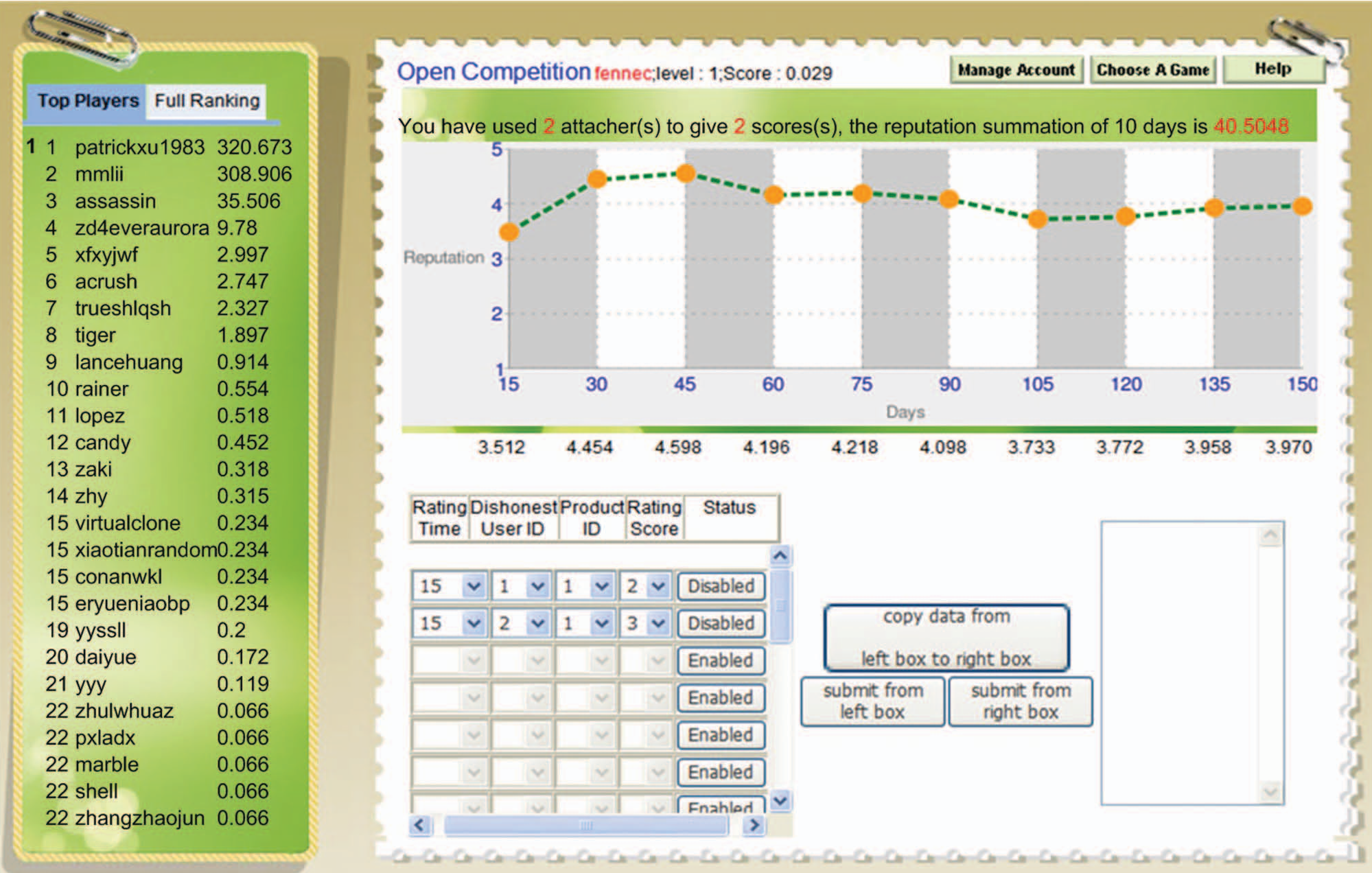
The authors launched the Challenge-of-Attack-on-Network-Trust (CANT). Instead of simulating attacks, they paid 630 real players to try to "break" a virtual reputation system.
The "Competition Social Network"
During the competition, some players tried to cheat by creating "pseudo-IDs" to manipulate their rankings. The authors developed a novel detection method by treating the competition as a social graph:
- Nodes: Individual player IDs.
- Links: A bidirectional link is formed if two IDs "compete" (have winning submissions in the same category).
- Detection Intuition: While normal players gain scores gradually through original work, pseudo-IDs often exhibit sudden spikes in "competition degree" because they are copying the original controller's winning strategies.
Experiments: Real-World Reputation vs. Digital Metrics
Using a dataset from the MIT Media Lab involving 55 participants and their mobile app habits, the authors compared the "predictive power" of different factors on app installation.
| Input Factor | Description | Predictive Impact (F1-Score) |
|---|---|---|
| Call Logs | Frequency of phone calls | Highest |
| Bluetooth Hits | Physical proximity/Face-to-face | High |
| Digital Reputation | App Store ratings/Downloads | Medium |
| Long-term Relation | Shared race or affiliation | Low |

Key Insight: Frequent contacts (call logs) correlate more strongly with user behavior than global star ratings. In a community like a university campus, you are more likely to install an app because a colleague uses it than because it has a 5-star rating on the App Store.
Critical Analysis & Conclusion
Takeaway
The study successfully demonstrates that hybrid trust models—those that combine digital feedback with real-world social signals—are much harder to manipulate. Attackers can buy 10,000 "likes" for a few dollars, but they cannot easily fake a network of consistent phone calls and physical proximity among a local community.
Limitations & Future Work
The primary limitation is the context of the community. The data relied on a university campus environment, which is highly interconnected. In a global, anonymous marketplace (like buying a random product from an overseas seller on eBay), real-world reputation may still be non-existent, leaving digital metrics as the only (albeit flawed) signal.
The future of reputation security lies in personalized trust systems that prioritize reviews from your "real" social graph over anonymous aggregate scores.